 Lucile Mathe · · 5 min read
How to use push notifications to push your fintech startup to the top

Photo credit: mangsaab / 123RF Stock Photo.
Your customers are busy. They build relationships with and use a lot of applications—not just yours. So how should you talk to them when they are constantly bombarded with information, offers, and advice?
A popular communications channel is push notifications, and they are becoming more ubiquitous. But do they provide the answer? And what industries use them best?
Push notifications for financial institutions
Research from marketing automation platform Kahuna suggests that financial services notifications have a higher user engagement than other industries. But for many banks and financial institutions (FI), the question of how to use push notifications can be difficult to answer, as FIs struggle to find the middle-ground between engaging their users too much and too little.
In many cases, FIs are not using notifications enough, diminishing their visibility to customers. The scope of the FI’s notifications can also be too narrow—only supplying balance information, for example. When competing against a host of other notifications—from gaming to utilities—and communicating only a limited message, it’s easy to appear staid, unexciting, and useless. For many FIs, it requires considerable user testing to find a suitable model for their service. One of the most important offers a financial institution can make is real-time intelligence, such as displaying a global view of a user’s financial accounts at multiple institutions through account aggregation. Real-time relevance is important across a range of sectors.
Engagement in different sectors
Engagement with push notifications varies considerably across industries. Kahuna found that financial services and utilities notifications performed the best, while ecommerce alerts performed the worst.
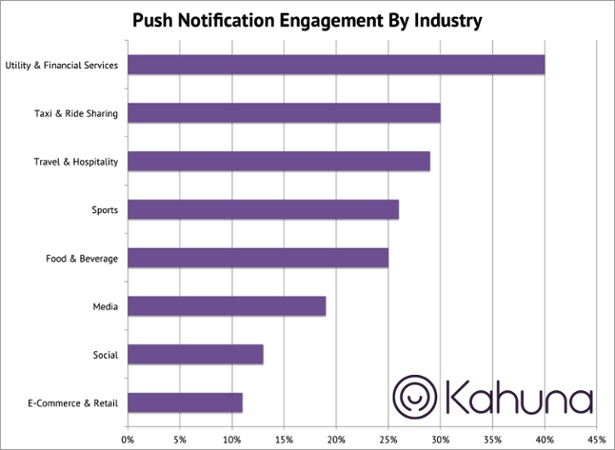
Another study from Accengage notes the reaction rate by industry. The reaction rate is the percentage of users who received a push notification and clicked on it (i.e. did an action on the notification). The financial services industry had a reaction rate of 14 percent for Android users and 3.5 percent for iOs.
Why people opt out of push notifications
The Kahuna research also found that 60 percent of users opt out of push notifications. The question is, “Why?” Is it the technology or the thought process behind the notification that is lacking? In financial services, there are increasing ways to interact with users—from mobile alerts, apps, to chatbots on social media platforms. Despite the mode of delivery, users no longer want to be addressed en masse, but individually, with communications that account for their individual circumstances and at specific times.
For financial services, data aggregation supported by notifications APIs will give consumers the best return, offering timely, holistic, and bespoke advice. Notification alerts have an obvious role to play in combating fraud, but can it also maintain a crucial customer service advantage? This is important, as there is huge value in smarter customer service across industries, with relevant, targeted, and timely alerts.
The role of an ‘immediate trigger’
Andrew Chen, head of rider growth at Uber, noted the value of the relevant, immediate “trigger.” Push notifications, as sometimes used in ecommerce, can be deployed like a broad-brush marketing email: reaching a large audience but not inspiring engagement because these notifications are not linked to an actual event. There is no “trigger” for them.
Alerts must be linked to a particular moment that requires an immediate or near immediate response.
By contrast, an alert for an Uber arriving for a pick up is a tangible trigger. Alerts must be linked to a particular moment that requires an immediate or near immediate response. Notifications should be targeted at a select user base, similar to how Airbnb notifies hosts of a booking. Or, as with the case of ecommerce, notifications could alert users of a product being shipped.
Convenient push notifications
Conclusion





Stay updated on the go with our mobile app.
Get latest insights with smoother, more personalized experience through TIA mobile app.











📅 Upcoming Events
22 October 2026
Payoneer x CSPN Summit 2026