- Insights This article was written by a TIA community member. Insights pieces undergo the same rigorous editorial process that newsroom-produced articles have.
 Rhea Liu · · 7 min read
With Hugo Barra out, here’s how Xiaomi plans to cope
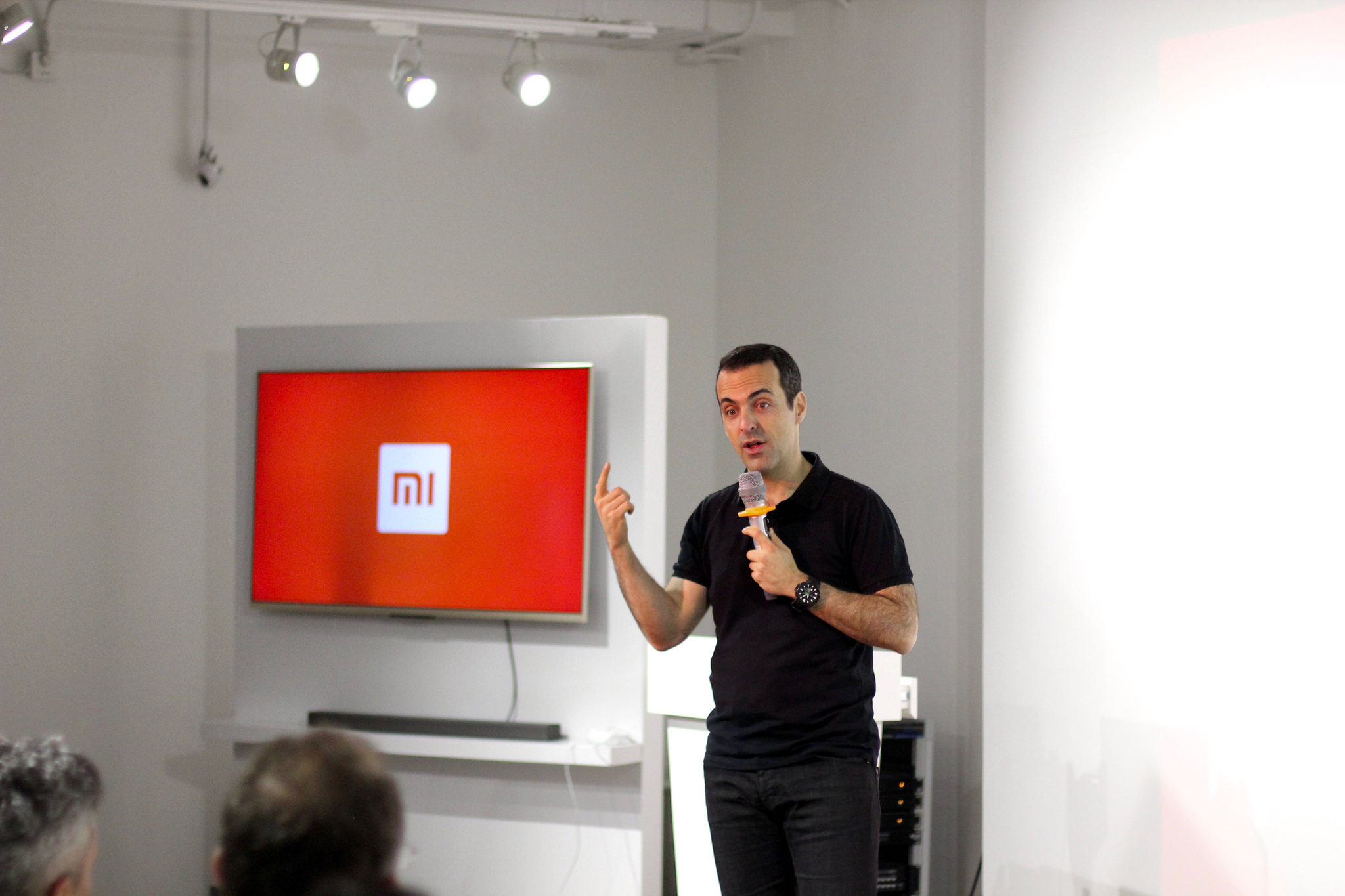
Photo credit: Daniel Cukier.
After three and a half years at Xiaomi, Hugo Barra, the global face of the Chinese smartphone maker, announced his departure from the company and his return to Silicon Valley. He indicated in a lengthy Facebook post that family and health concerns were his reasons for leaving and that his resignation would come into effect right after Chinese New Year. Xiaomi’s founder and president Bin Lin replied to the post expressing his gratitude for Hugo’s commitment to the company while also announcing Xiaomi’s senior vice president Wang Xiang as Hugo’s successor.
See: Who’s the guy replacing Hugo Barra at Xiaomi?
Xiang, who joined Xiaomi in 2015, is a long-time tech veteran. Prior to his time at Xiaomi, he served as the president of Qualcomm for the Greater China area and was employed by a number of prominent tech companies including Motorola and Alcatel-Lucent.
How will this change of leadership impact the company’s globalization? And more importantly, will it reverse or reinforce Xiaomi’s disappointing performance in global competition over the past two years?
Xiaomi in the global market
Hugo’s last public appearance on behalf of Xiaomi was four days before his official announcement. On January 19, he attended the company’s product launch for a new smartphone in India then headed straight to Hong Kong, skipping the party regularly held after this type of event.
This last appearance in India seems symbolic for Hugo; it was this country where he made the most remarkable achievements for the company. Xiaomi CEO Lei Jun revealed at Xiaomi’s annual meeting that the company achieved an annual revenue of US$1 billion in India in 2016.
This achievement was partly due to the successful launch of Xiaomi’s Redmi Note 3 smartphone in India in Q1 2016. According to research firm Strategic Analytics, Redmi Note 3 was among the top three most popular smartphone models shipped in the Indian market in Q3 2016. Xiaomi also announced that the model shipped over one million units in the first 18 days after its launch in the Indian market.
However, the company’s expansion to other markets during Hugo’s tenure hasn’t always been as encouraging.
However, the company’s expansion to other markets during Hugo’s tenure hasn’t always been as encouraging. In May 2016, Xiaomi downsized its business in Brazil with no future product launch plans for the short term.
Xiaomi isn’t the only smartphone provider who has hit a wall in Brazil, though. Due to high tariffs and local protectionism in the country, foreign smartphone makers like Lenovo have found it increasingly difficult to operate there.
Apart from the high costs, Xiaomi also suffered from large fluctuations in Brazil’s local economy. Bin Lin said in an interview that the devaluation of the Brazil real in 2016 made it almost impossible for enterprises to make a profit. “The range of the devaluation is far more than what we can take. If we price a phone at 1,000 BRL, the next day the same amount of money may only be worth half as much. It’s almost impossible for us to run a business there.”
Apart from setbacks in emerging markets, Xiaomi has also had to endure the slow and uncertain process to enter more developed markets like North America and Western Europe. The company was sued for patent rights violations by non-practicing entity BlueSpike in the US in 2013 and 2015. These cases cost Xiaomi millions of dollars in lawsuits according to public information. It is no surprise then that the company has only launched a TV set-top box in the US in cooperation with Google. There has been no trace of a launch of Xiaomi’s core smartphone business in the market.
In 2014, the company was also sued by Ericsson in India for selling smartphones using Ericsson-patented technology without its permission.
Competition from fellow Chinese rivals
New possibilities for Xiaomi in 2017





Stay updated on the go with our mobile app.
Get latest insights with smoother, more personalized experience through TIA mobile app.