- Insights This article was written by a TIA community member. Insights pieces undergo the same rigorous editorial process that newsroom-produced articles have.
 Filbert Richerd Ng Tsai · · 5 min read
A foolproof plan for startups to assess success, runway, and cash burn

Photo credit: Pixabay.
Earlier this month, I shared how you should create your business plan without creating a scholastic report. This time, let me give you a quick guide on creating your financial plan. And again, I apologize in advance for all the illustrations below that are far from creative.
Types of startups in terms of finance
I think it is proper to first go through the two types of startups (non-standard terms) from a financial perspective to provide a better context on the purpose of financial planning.
Quick starters are startups that can theoretically operate immediately without requiring significant investment in time or technology. On the other hand, late bloomers can only start operations once the core product is developed.
The purpose of a financial plan for quick starters is primarily to assess business success. This is the same with all traditional (i.e. non-startup) businesses, where the financial plan is used to determine whether the business will be profitable or not. Knowing how your business will perform (at least on simulation) helps you make a more intelligent decision on whether to start your business.
For late bloomers, a financial plan is primarily used to determine runway and cash burn. A lot of tech startups fall into this category. These companies incur significant cost and time to develop their software solution, so planning early allows you to manage the cost throughout the runway to avoid overrunning the bank balance.
There are fine lines between the purposes of financial planning for both types of startups, but it is clear that having a plan is essential. And even if the purposes are different, the overall structure of how you should do your business plan roughly stays the same.
Building blocks
Overall structure
Generally, a financial plan should have at least three key sections: assumptions, calculations, and reports. It’s not a hard and fast rule but it’s the general rule. Professional model builders will include more details, but hey, you don’t want to go into that level of detail at business planning stage.
Before we proceed, let me show you what most financial forecasts look like when I request one from startups seeking advice:
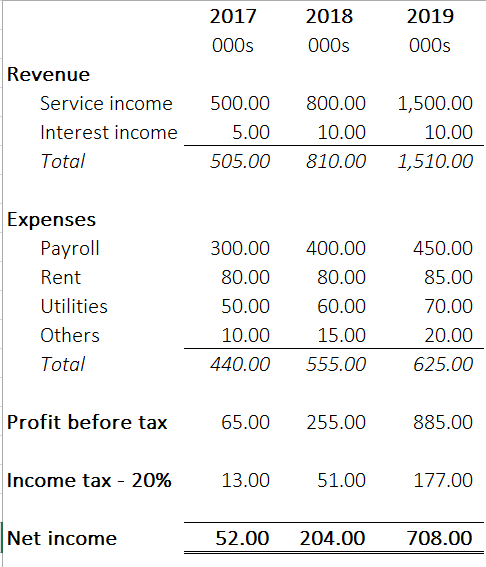
Looks good right? But not at all. These numbers are generated out of thin air without considering what generates revenues and how costs are computed. In the following sections, we’ll go through the proper way of building your financial plan without making it complicated.
In the meantime, hold tight, as the next few illustrations are dull spreadsheet extracts that you can hopefully use for writing your own business plan.
Conclusion





Stay updated on the go with our mobile app.
Get latest insights with smoother, more personalized experience through TIA mobile app.








📅 Upcoming Events
22 October 2026
Payoneer x CSPN Summit 2026