
Photo credit: Ramesh Lalwani
Much has been said recently about Facebook’s controversial Free Basics initiative. The goal of the platform is to connect people to the internet for free through a site and an app called Facebook Free Basics. Free Basics is available in 38 countries spread over Africa, Asia, Latin America and the Middle East. According to Mark Zuckerberg, over 19 million people have been connected through Facebook’s different programs to date.
Critics of the platform argue that Free Basics is a ploy by Facebook to allow it to have a stronger grip over the lives of the poor that are yet to be connected to the internet. On the other hand, some say it could improve their welfare by enabling free access to information that is available online.
In the following article, I argue that this initiative may decrease levels of inequality in some countries.
Facebook’s Free Basics
Facebook’s Free Basics platform currently allows for free access to select sites that include, among other things, applications in the fields of healthcare, education and jobs. If Facebook will emphasize the educational aspect of their platform, as I see it, it could be a game changer to economic inequality in developing countries.
Access to education can reduce economic inequality
Research has shown that education can reduce economic inequality, and that limited access to education preserves low income in developing countries. Therefore, enabling easier access to free education via the Free Basics initiative could improve the lives of low income individuals that until now have never had access to education. Collaboration with a well-known open online education platform, such as Coursera, can foster the recognition and branding of the educational component that lies in Free Basics.
According to a theory hypothesized by the economist Simon Kuznets, as an economy develops, economic inequality will first increase and then decrease due to market forces (an inverse “U” shaped curve). A potential explanation for the rise in inequality at the initial stage is that in the early development phase, only the ones who have enough capital can enjoy the influx of cheap products below their current cost. I will use this theory to describe a possible progression process of this issue on inequality.
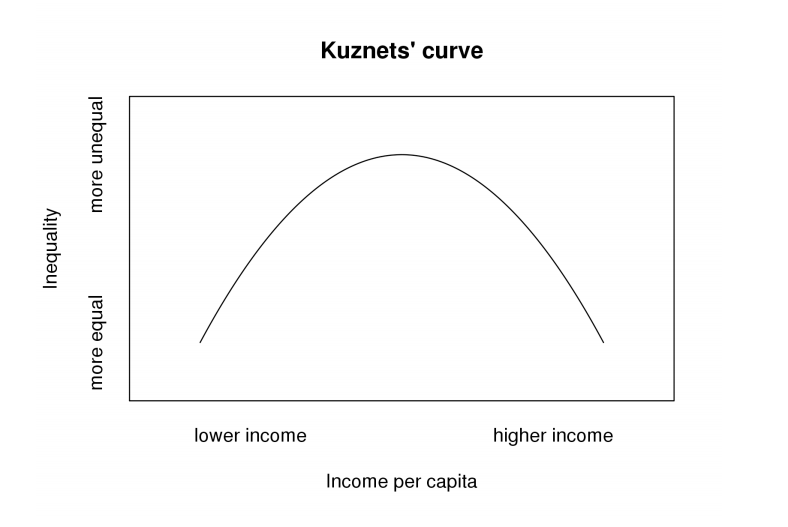
Image credit: Daniel Gandalf Hernandez, Columbia University
Kuznet’s curve delineates how the progression process will occur. At the beginning of the process, the inequality will increase due to the current relatively high penetration of smartphones among individuals with an above-average income, who will be able to enjoy the free educational services of the platform. This will enable them to have an education for free and therefore gain advantage over the low income population.
Then, as the cost of smartphones decrease, the penetration of the platform will be evident among the lower income groups, thus increasing the accessibility of education for this population. They in turn, can acquire education and their standard of living will improve. This may ultimately lead to a decrease in income inequality.
Some may oppose this process as it may increase the supply of skilled workers, and therefore may decrease the wages of the current skilled workers.
Free Basic’s regulatory roadblocks in India
On that note, India’s telecom regulator has recently decided to forbid discriminatory tariffs for data services on the basis of content. In other words, services (such as Free Basics) that only allow access to selected websites, albeit for free, violate the principle that “consumers will get unhindered and non-discriminatory access to the internet”, and will therefore be prohibited.
Mark Zuckerberg has expressed his disappointment for this, and commented that Facebook is “committed to keep working to break down barriers to connectivity in India.” India’s income inequality has gone up along the years, and the Free Basics project in this country could function as a vivid mass experiment which possibly will unfold the effects of free and easy access to online education on levels of inequality.





Stay updated on the go with our mobile app.
Get latest insights with smoother, more personalized experience through TIA mobile app.