- Insights This article was written by a TIA community member. Insights pieces undergo the same rigorous editorial process that newsroom-produced articles have.
 Linus Lee · · 5 min read
How startups can build and scale data science teams

Photo credit: Digital Buggu / Pexels
This article is part of Tech in Asia’s partnership with Monk’s Hill Ventures where we publish articles that feature the firm’s valuable insights. For more articles in this series, go here.
Data is an important competitive advantage for companies as it allows them to understand their customers, decide on a business strategy, and optimize their businesses.
As an operating advisor at Monk’s Hill Ventures, I talk to startup founders about how they can do that. And these startups range from early stage to post-IPO. Some have already established data science teams and are now keen to scale them, while others are still figuring out how to hire their first data scientist or what kind of data they should be collecting.
There are a few common themes that keep coming up, and I hope to address some of them here.
AI or machine learning?
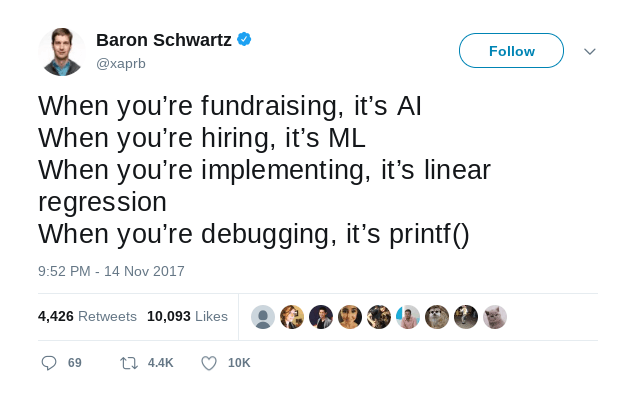
Photo credit: Twitter
We’ve seen many companies pitch themselves as applying AI to X or using machine learning for Y. The truth is, there is a spectrum along which companies lie.
On the extreme end of the spectrum, data and machine learning themselves are the product. The company’s value proposition is applying AI to a particular vertical. Often, these are B2B companies providing a service to existing players by helping to make sense of their data. For example, in fintech, this could include building a credit scoring model for customers. Other examples are AI companies that help with speech recognition, computer vision, or conversational bots for customer service.
Somewhere in the middle of the spectrum, we have companies where data and machine learning algorithms are not the product but are still crucial in providing a superior product experience. These companies can be both B2B or B2C. For example, Ninja Van, a B2B company that helps ecommerce companies with their delivery needs, has route-optimization algorithms that allow for a superior customer experience.
At the other end of the spectrum are companies whose main business model does not depend on data. Nonetheless, being able to harness their data can help them greatly understand their customer/business better. This can even apply beyond technology startups to brick-and-mortar companies. The business may already be doing quite well, but with the added ability to predict what their customers would buy at a particular price, or being able to segment their customers better, they could significantly boost their sales. These all happen to be classic machine learning problems.
Thus, it is crucial to figure out where in the spectrum your company lies as a first step toward figuring out your company’s data strategy.
Data scientist or data engineer?
When companies want to start building their data science teams, they often think of looking for a data scientist. What happens is that the data scientist expects to build models and produce insights, only to find out that the data is not logged or is incomplete and unreliable. The pipelines, if they exist at all, are unstable, and scheduled jobs fail.
Sometimes, the company may already have existing enterprise data warehouses, but the data may be limited by some business intelligence tool that’s optimized for simple SQL queries rather than more computationally intensive machine learning workloads. In these cases, the company actually needs to hire a data engineer first.
How do I scale my data science team?
What makes for an effective data scientist?





Stay updated on the go with our mobile app.
Get latest insights with smoother, more personalized experience through TIA mobile app.











📅 Upcoming Events
22 October 2026
Payoneer x CSPN Summit 2026