
Photo credit: Lakerain Snake.
Is there really a global talent shortage? Your opinion might depend on your location and your company’s hiring needs—or does it? Is your company dependent on highly skilled tech or business development professionals? Maybe you’re always searching for the best creatives or marketing experts? Let me ask you this, does your pipeline have an unlimited supply of motivated professionals that meet all of your job requirements? No? I thought so.
If talent is so difficult to find and bots are going to start taking on new jobs, could they be the answer to our talent shortage? Could your next hard-to-find unicorn employee be a bot? I know, sounds crazy, right? But a recent article in Tech Times had a dread-inducing headline: “Bots Stealing Human Jobs.” Before you say, “Well that won’t be my job,” think again. More things are becoming automated. And who knows what will happen in the future? AI might be able to replace you—just look at Siri or Amazon Echo.
Some live in fear of this future. Bill Gates, however, doesn’t. He has a simple answer for those in fear of it: If you use bots to replace humans, tax the bot as you would a human, then use that money to pay for human training for jobs bots can’t do. So while this may be the future—and the future is always uncertain—what is happening right now with labor?
Skills mismatch
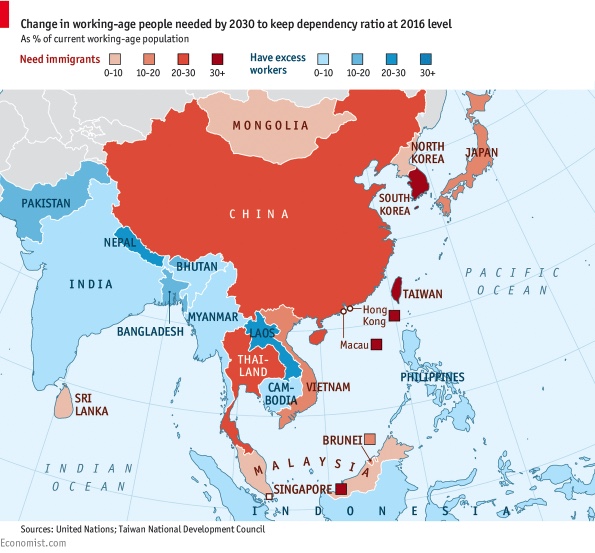
A recent article in The Economist titled “Migration and Labour Shortages in Asian Countries” has a very interesting and visual graphic (featured above) that can’t be misconstrued. In the graphic, Asian countries that have a labor shortage are depicted in red and countries with excess workers are in blue. The article seems to posit that moving workers from the excess labor countries to the nearby countries that desperately need talent would solve all our talent shortage ills (it’s so easy, the countries are right next door!).
Not so fast. The Economist’s data team, no matter how brilliant, is forgetting one key piece of information. Do any of us really think there are direct skill set matches between the red countries and the labor requirements of the blue countries, particularly when we’re only looking within a single region?
Skills shortage
Try typing the words “labor shortages” in Google and see what comes up. The three suggestions after you type those words are in this order:
- At all skill levels,
- in US,
- Canada.
Interesting. Even Google knows there’s a skills shortage AT ALL LEVELS. But let’s not just trust our Google search. This has been a universal topic in all developed countries for some time. The aging populations in Europe, Japan, the US, and even China are leading to a shrinking labor force. Headlines like “Europeans Need Many More Babies to Avert a Population Disaster” are enough to make you realize we’re on the brink. But what if there was another answer and it was sitting right under our noses?
The answer to the shortage
What if you removed the geographical constraints entirely? What if this map from The Economist didn’t focus on a single region? What if we expanded the playing field and matched all the best talent from all over the world with specific sector shortages in labor markets? I know what you’re thinking, “That sounds too easy.” Fair enough, it’s not so easy. If it were, all the hard-to-fill jobs would find the perfect match all the time (and at record speeds!).
The unspoken secret is that hiring managers often make some kind of compromise to fill a job. After all, at some point, you have to cry uncle and hire someone even if they won’t be the savior of your company. Let’s face it, your list of candidates is limited—either by geography, talent, availability, or your salary caps. But what if, just like in romance, you imagined that there’s a whole wide world where the perfect person is just waiting for you to find them.
The unspoken secret is that hiring managers often make some kind of compromise to fill a job.





Stay updated on the go with our mobile app.
Get latest insights with smoother, more personalized experience through TIA mobile app.













📅 Upcoming Events
22 October 2026
Payoneer x CSPN Summit 2026