 Jeffrey Towson · · 7 min read
Opinion: Why bike-sharing isn’t actually part of the sharing economy
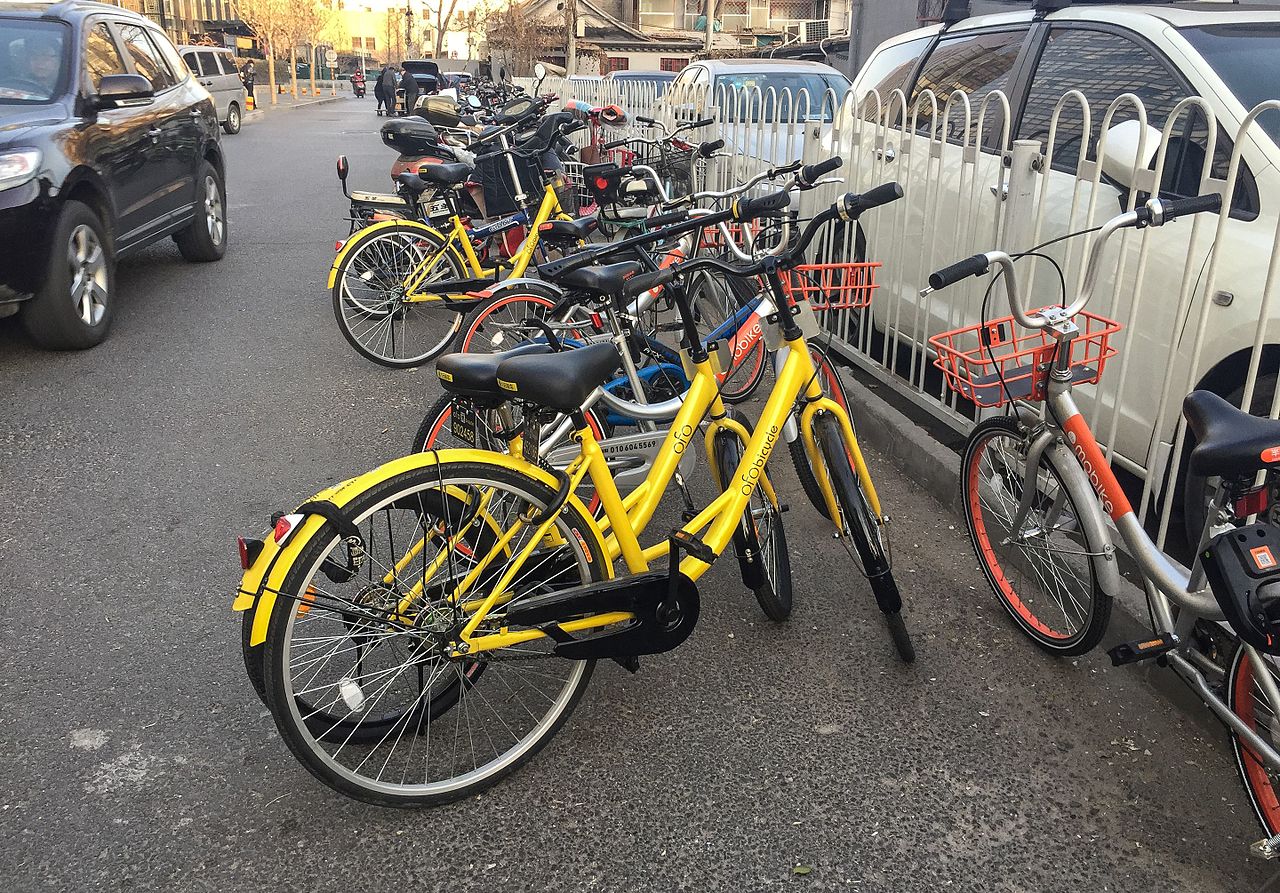
Parked Ofo and Mobike bicycles. Photo credit: Wikimedia Commons.
There has been a lot of talk about Chinese bike-sharing recently. Shanghai-based Mobike says it has already raised over US$300 million in funding this year, with Singapore’s Temasek being its newest investor. Xiaomi, Citic PE, and Coatue participated in a US$130 million round for Beijing-based Ofo in October last year, and the startup has since raised a subsequent US$450 million Series D round.
Bike-sharing has been proclaimed as a new frontier for Didi and for China’s sharing economy (see articles here, here, and here). But there’s a problem.
- Bike-sharing is not really sharing. It is not part of the sharing economy.
- Bike-sharing does not have a network effect.
- Bike-sharing has no real economies of scale (yet).
- There are some serious questions lingering about consumer demand.
Essentially, bike-sharing is nothing like Didi, Grab, Ola, Uber, Airbnb, and other such companies. Its economics are far more like a vending machine business (at this point).
That doesn’t mean it isn’t a really great, scalable business—it is. And I hope it continues to have explosive growth across China. (I really like seeing Ofo’s bright yellow bikes all over Peking University.)
But much of the excitement seems to be the idea that this business is like Didi—it’s just not.
Here are four ways bike-sharing is different than ride-sharing.
1. Bike-sharing does not have a network effect
Ride-sharing is awesome because it has a powerful competitive advantage via a two-sided network. Essentially, each additional rider increases the networks’ value to the drivers (i.e. more customers and they are closer by). And each new driver increases the value of the service to each rider (i.e. shorter wait times, more cars available). So, bigger platforms actually have a superior service offering to both populations. And the market usually collapses to the leading companies quickly (Uber and Lyft in the USA, Didi in China, Ola in India, Grab in Southeast Asia, etc.).
Additionally, once the market has matured, it is very difficult for a new entrant to break in. If you then want to launch a ride-sharing service, you will have to offer the same big driver network and short wait times as the dominant competitors from day one. But to get all those drivers, you have to offer them a big customer base. It’s the multi-sided platform (MSP) “chicken-and-egg” problem but with entrenched competitors.
This type of indirect two-sided network effect also happens in home-sharing (Airbnb), credit cards (Visa, MasterCard), app stores (Apple, Google Play), auction houses (Sotheby’s, Christie’s), and even shopping malls.
But none of this happens in bike-sharing. There is no second population of drivers using the platforms and providing the cars (which are the key assets). You just need to put a lot of bicycles around town. Each new rider does not add any value to the other riders nor to a population of drivers.
Bike-sharing is basically a commodity B2C service; it is a traditional merchant business. Being bigger helps somewhat, but the space is still fairly accommodating of new entrants. All you’d need is about 30,000 bicycles, which would cost about US$2.5 million. This is a cheap and fairly easy business to enter, which will impact long-term profitability.
However, in the short-term, companies like Ofo and Mobike should do well. They are offering an innovative service and are first-movers in a massive market.
2. Bicycle sharing doesn’t have economies of scale (yet)
3. Bike-sharing is not really sharing
4. There are some interesting questions regarding consumer demand
Conclusion





Stay updated on the go with our mobile app.
Get latest insights with smoother, more personalized experience through TIA mobile app.







📅 Upcoming Events
22 October 2026
Payoneer x CSPN Summit 2026