
Photo credit: Business Insider Singapore
Many startups raise money from investors in order to progress to the next stage. Whether you have a great idea that you want to turn into a business, or you’ve already been operational for a while after building a product that customers need and enjoy, and now you just want to grow your company as much as possible — chances are, you don’t have enough capital and revenue to advance your startup to the next stage without money from investors.
Raising money from investors is never easy, especially for new entrepreneurs who lack the relevant experience. A large percentage of startups fail because they lack the funds they need for operation and growth, their revenue is currently not high enough, and they are unable to raise the funds they need.
Here, for example, you can see the chances of raising a follow-on round after your seed round:
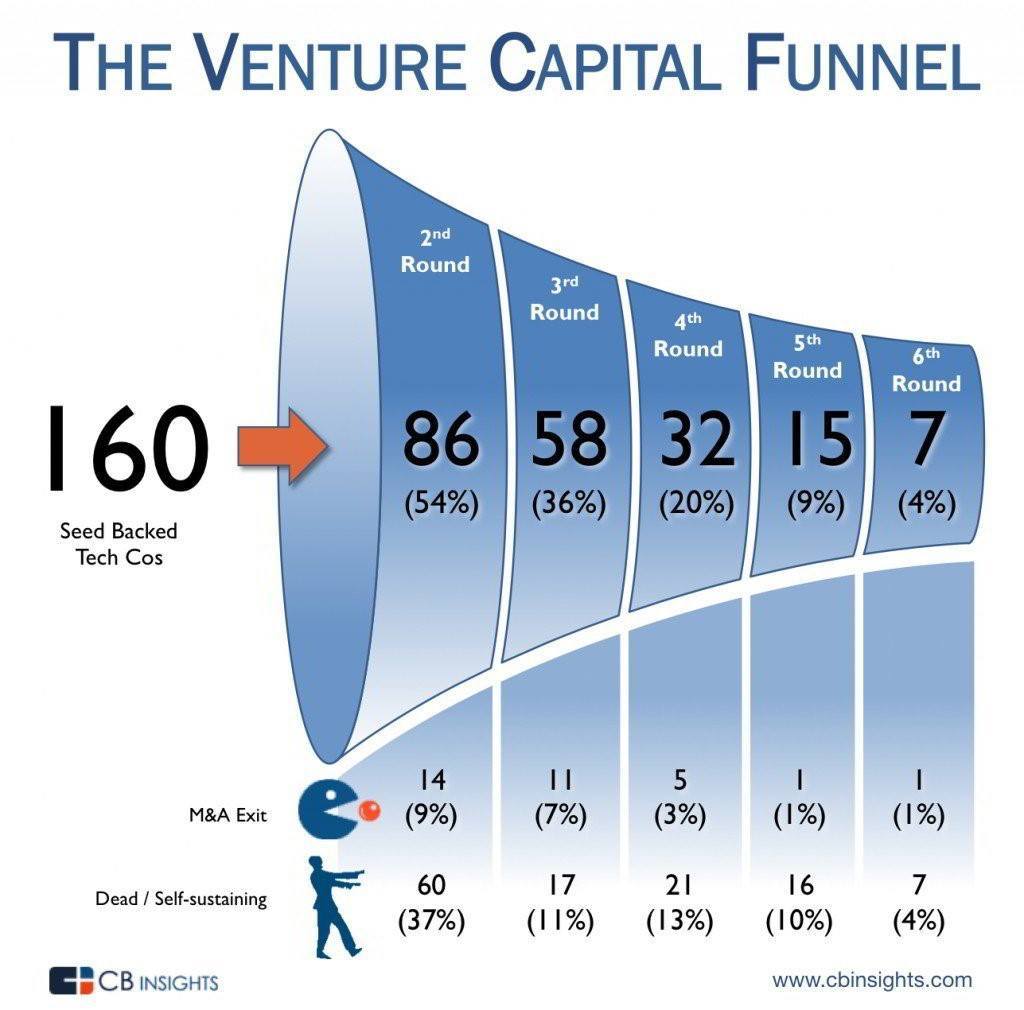
So what can you, as an entrepreneur, do to increase your chances of getting funded?
In this post, I will explain how you can find and choose the most relevant investors for your startup, and how you can do effective outreach to those relevant investors.
I’ll explain how I did this for Israeli startups in the ecommerce and retail field — because our law firm represents a number of these startups and the lists I will show here will be valuable to our clients. However, the system is the same for any other field (cyber security, big data, education, etc.) in any other country.
This is how the final list of relevant investors in the ecommerce and retail field for Israeli startups looks like.
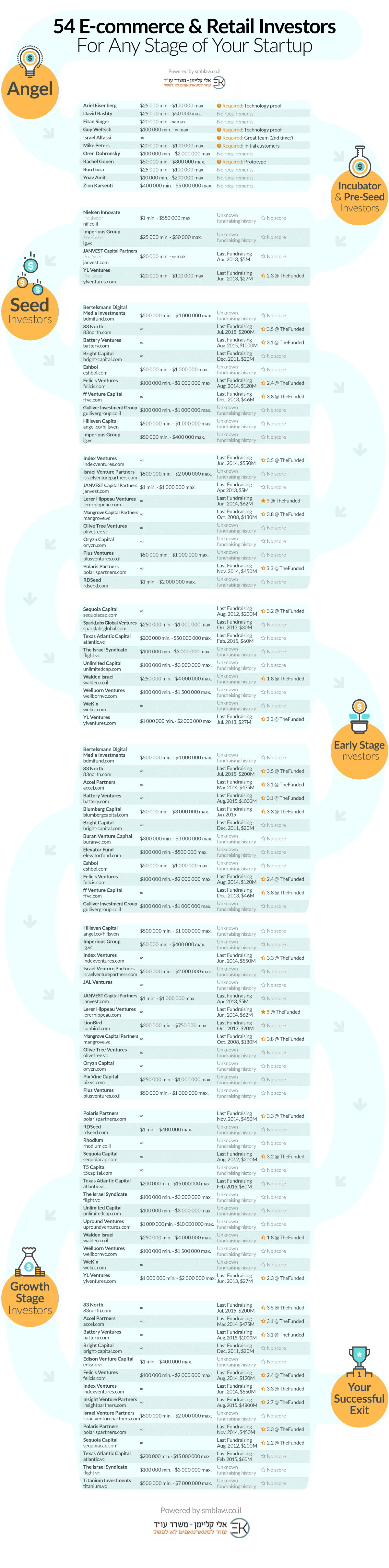
In this post, I will explain exactly how I made the list and how such lists should be used to get results.
Stage 1 – Building a list of investors
The first thing I do is to build a basic list of investors in the chosen field who are active in the geographic area of the startup.
For this purpose, I go to the crowdsourced list of Israeli investors and search for investors in my chosen field.
In Israel, we are fortunate enough to have this list, which was started by Eden Shochat (a partner @ Aleph – an Israeli VC). If you wish, you can read more about its history and relevant lessons.
The Europeans did it first though – with this crowdsourced list of EU investors that was started by Jens Lapinski (a managing director @ Techstars, a global entrepreneurial system). Unfortunately, this list lacks some very important information that is found in the Israeli list – what stage and focus are the investors looking for (and which, if any, milestones) and what sums are they looking to invest. Without this information, the usability of the EU list is much more limited.
I’ve also found similar list for the Nordic Countries and a separate one for Finland.
I have not been able to locate any similar crowdsourced lists for any other parts of the world so if you are familiar with one, leave a comment.
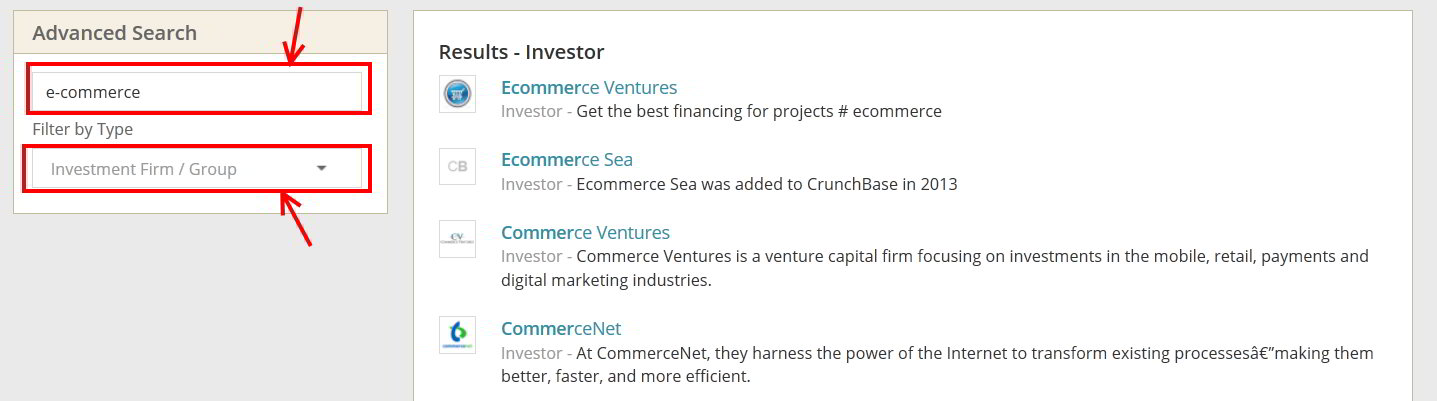
An excellent resource for finding investors is the search function of CrunchBase. Just go to “Filter by Type”, choose “Investment Firm/Group”, and then go to the search box and type your field of choice.
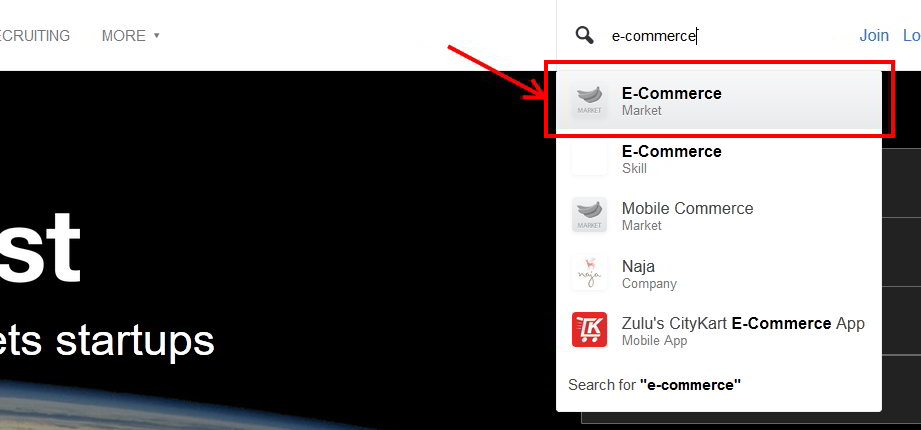
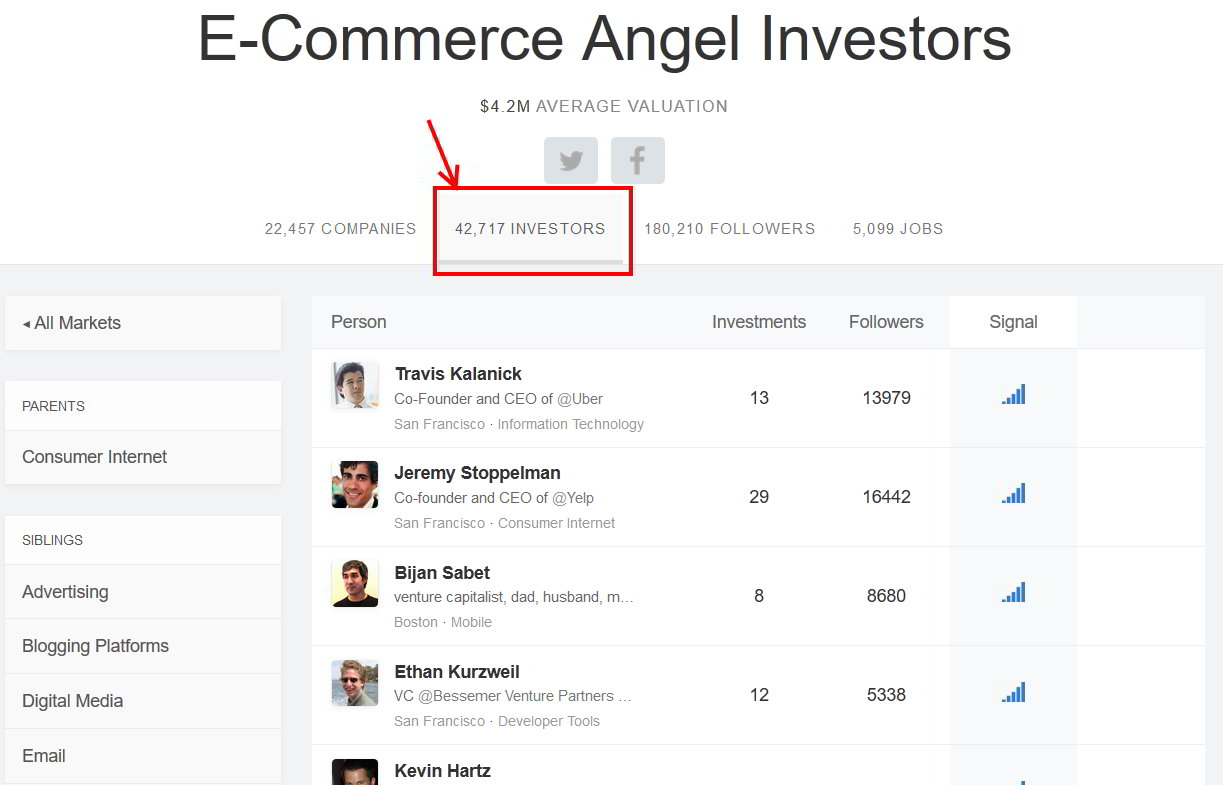
You can also use the search function of AngelList to find additional investors to add to your list. Just type your field in the search box on top.
And on the results page, go to the “Investors” tab.
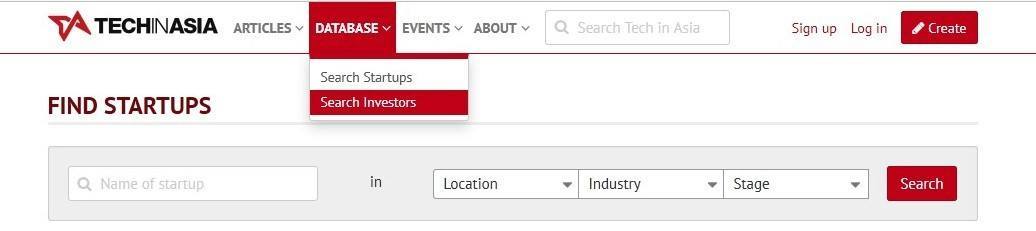
Another great source of information about investors is Tech In Asia. Although the site mostly publishes news about Asia, their investors database has information about investors from all over the world. You can search by amount, location, vertical and stage.
At this stage, I’m making a basic list of investors who invest in my chosen field (ecommerce and retail) and my geographic location (Israel). Change the field and location as required.
Stage 2 – Adding information to the basic list
Once I’m done with the previous stage, I add additional information about the investors that will help me choose which ones are relevant.
What I want to know about the investors is: at what stages do they invest, are there any milestones a startup must achieve before approaching them, and what sums are they looking to invest.
Regarding VCs, I also want to know whether they raised a fund in the last five years, when did they raise their latest fund and what was the size of their latest fund.
You can find this information on CrunchBase. Just search for the name of the investor and look at its profile.
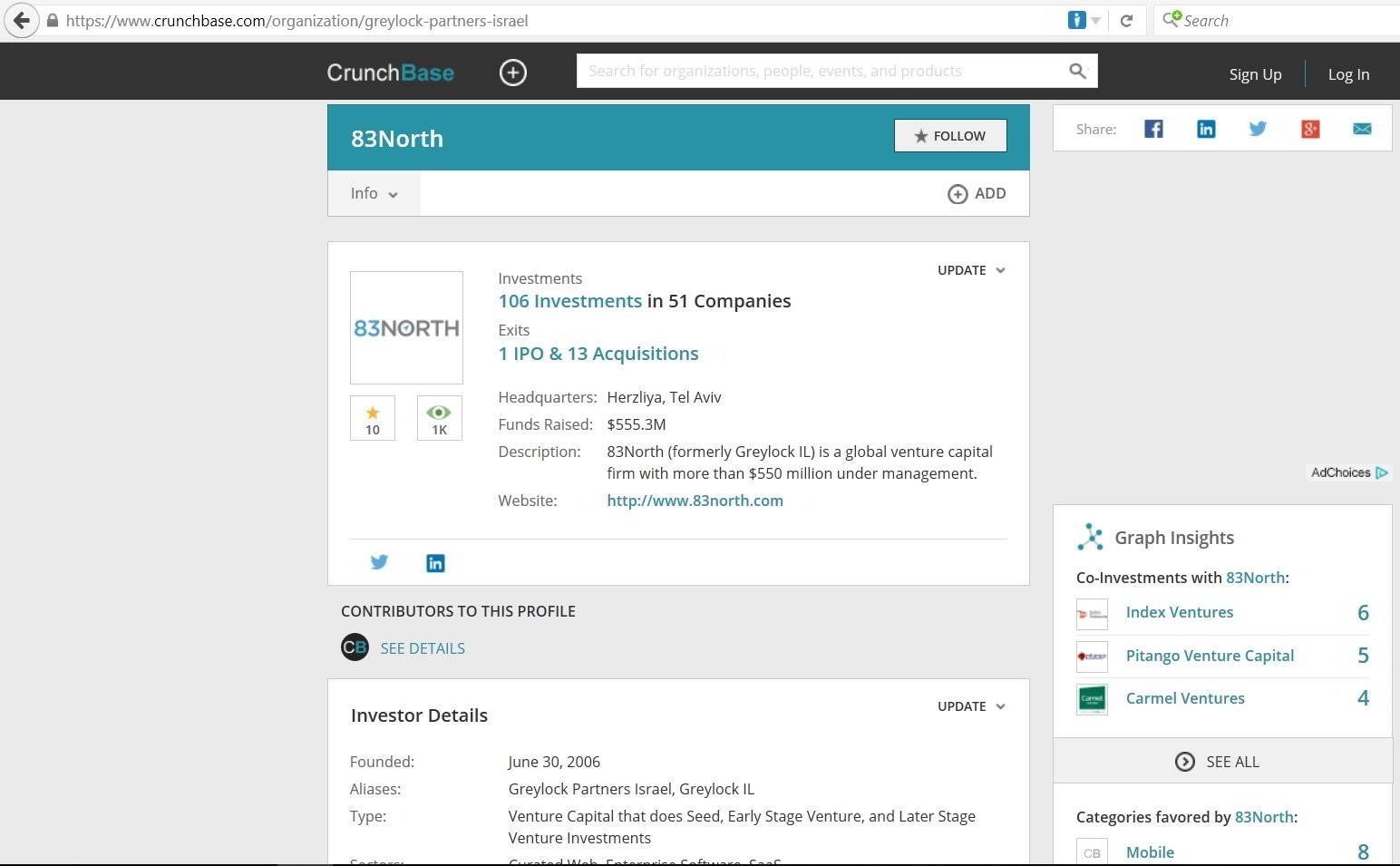
If you are unable to find all the information you need, check out the investor’s website.
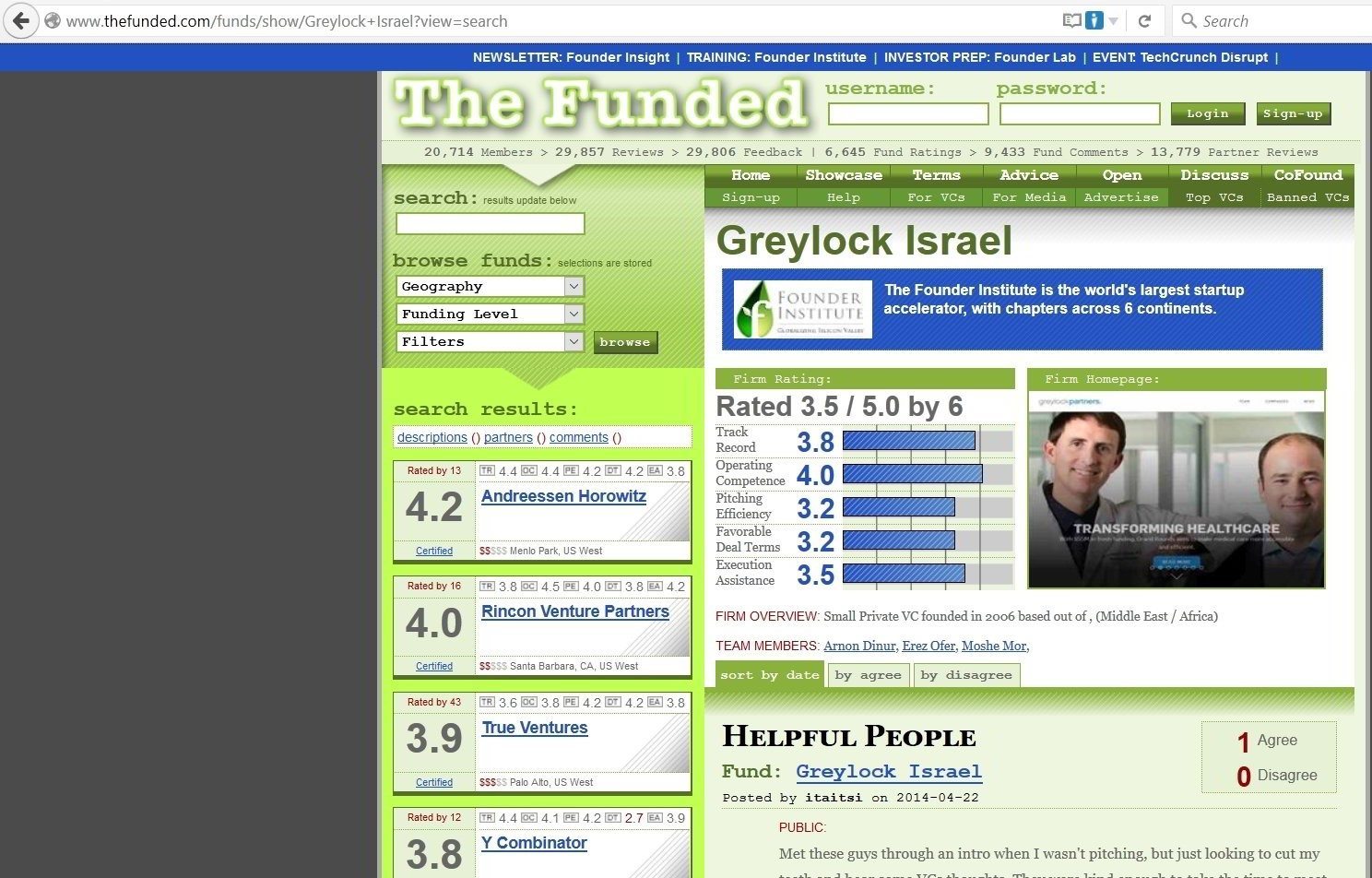
For VCs, you also want to know what their score is on TheFunded, where you can see reviews and scores of investors. It looks like this.
All this information helps me to eliminate investors which are not relevant. I will explain later how you should do that.
Stage 3 – Additional ways to increase your basic list
Search for any other lists you can find. I’m certain there are other resources out there I’m not aware of. Some lists are probably not in English.
Also, I built my ecommerce and retail list only using those two specific keywords. Because you know and understand your startup and the field you are in, I’m certain you can think of less general keywords.
For example, if you are developing a more secure payment terminal for physical stores, you should probably check out “payment” and “cyber-security”, and if you are developing an inventory tracking service for physical goods you should probably check out “logistics” and “big data”.
You should also know quite well who are your competitors and other major players in your field. Check out their profiles on CrunchBase and AngelList and see under which fields they are described.
Once you figure out additional keywords and find more lists, look for investors who have a presence in your geographical area – they have offices nearby or invested in a startup located in your geographical area (not necessarily in the same field as you) or they say on their website that they invest in your geographical area.
If you locate additional investors that are not in your basic list and that invest in your geographical area, add them to the basic list and fill in all the relevant details you can find, just like you did in the previous 2 stages.
Stage 4 – Narrowing down the list of investors
Now that you have a basic list of a number of possible investors for your startup, it’s time to start removing from the list investors who are not relevant for a variety of reasons.
1. Stage of your Startup
My example list refers to 4 main stages of startups as they are commonly referenced on the websites of investors:
Pre-seed – You have an initial idea and a one-pager/executive summary/pitch deck. That’s it.
Seed – You have a team, a much more developed idea, and often some kind of initial version of the product. Maybe you already had a soft launch/beta a few months ago and have a small amount of users/customers.
Early stage – You launched your product some time ago (at least 6 months) and have data about usage of your product, engagement, and some initial idea whether there is genuine demand for your product and potential for high profitability and growth.
Growth stage – You have proof of concept of your business (and not just of your product), your data shows that there is genuine demand for your product and that the product is fulfilling a major need of the customers, and you have potential for significant growth.
Each stage has its own rules when it comes to investors.
For example, investors active in the initial stages are more open to risk but often lack the funds needed for later stages.
And investors active in later stages have lots of funds, but in order to make the funds work, such investors need to invest significant amounts in each of their investments, and the opportunity to do that arises only at the later stages.
See which of the 4 startup stages you’re at, and remove from your list all the investors who don’t invest at that stage, just remember one thing: the first two stages are not that far off from each other, so an investor willing to invest in one of the stages will probably be willing to invest in the other as well.
2. Milestones
Some investors (especially angels) ask that you achieve a certain milestone before you reach out (proof of concept, working prototype, good team, initial paying customers, prototype, etc.)
There’s not much point in approaching those investors unless you achieved the milestone they request. Remove their names from the list and save them for later.
3. Amount of investment
If you are looking to raise an amount significantly lower than the minimum amount an investor is looking to invest, remove the name of that investor from the list.
If you are looking to raise an amount higher than the maximum amount an investor is looking to invest, simply raise your round from a number of investors. Just try not to raise your round from too many investors, as that could lead to problems.
4. Date of latest fund raised
Managers of successful venture capital funds (ones that provide good ROI or look like they will potentially do so) tend to raise new funds every 3-4 years.
If a VC hasn’t raised a new fund in the last 5 years, it probably means the VC isn’t doing so well and doesn’t have enough funds for new investments. Consider removing these VCs from your list.
5. Size of latest fund raised
This part is complicated, and mainly refers to VCs who don’t publish the minimum and maximum range of their investments.
Consider the amount you want to raise compared to the size of the fund.
A fund is usually supposed to last for 7-10 years, and during that time is supposed to make a number of investments every year. A VC doesn’t want to invest all the funds in the first few years because a good investment opportunity might come at a later date. A VC also doesn’t want to save all the investment capital for later years, because he/she might miss a good investment opportunity today, and also has to show the LPs that he/she is actually doing something.
A VC would also probably prefer to leave a part of the fund for follow-on investments in portfolio startups that are doing well. If you invested in Facebook’s seed round, wouldn’t you like to keep investing?
Due to these reasons, a small fund can’t invest too large an amount into your startup – because otherwise there will be no funds left for other investments.
What this means is that if you are looking to raise $5m, a VC with a fund of $20m is not a good fit for you (because you are asking for a quarter of the fund), unless you want that VC to be just one of a number of investors in your round.
On the other hand, VCs with large funds prefer not to make many small investments in many different startups (500 Startups are an exception to the rule).
VCs usually lack the manpower and time to keep track of a large amount of small investments. They would prefer to keep investing in the more successful members of their portfolio, because otherwise the ROI the VC delivers is not that great.
Let’s assume that a $1b fund invested $1m in your startup. After 3 years you sold the company, and all the investors got 10X on their investment. That is a pretty good outcome, but the fund only made $10M, which is just 1% of the whole fund. It’s not enough for a fund of this size.
This means that is you are looking to raise $500K, for a fund of a few hundred million dollars, that is too low a sum to be interesting – unless they are buying a kind of option to invest in your startup in case it takes off (but until that fund makes a large follow on investment they are not likely to give you too much attention or support, as they are too focused on larger investments).
And that is why the optimal investment amount of each VC depends on the size of the fund.
6. Score on TheFunded
The site allows entrepreneurs who had an interaction with an investors to review the interaction and give a score to the investor.
If an investor gets a really low score (let’s say below 3) or the reviews are really bad, consider removing that investor from your list.
Of course, it depends on the amount of alternatives you have.
7. Invested in competitors
Don’t forget to check whether an investor invested money in companies you are or will be competing against (now or due to a possible pivot).
If the answer is yes, you should probably remove such investors from your list. They are extremely unlikely to invest in you, and will probably just pump you for information and then take it to the competitor they already invested in.
Stage 5 – Building a list of partners and employees of relevant VCs
Now that you have a list of the most relevant investors for your startup, it’s time to start working on reaching those investors.
At this stage, many entrepreneurs would just cold email the offices of everyone on the list, ask them for “a cup of coffee” and hope this will lead to something.
I propose to do something different that should prove to be much more effective. What you really want is to get someone to introduce you to the relevant investor.
These kind of connections are considered of much higher quality (because you have been pre-approved by someone the investor personally knows and hopefully trusts) and therefore of much higher chance to lead to a meeting.
But first you have to make some preparations.
What you want to do now is to build a separate list of specific people you want to reach.
If there are any Angels in your list of investors, add their names to a separate list of names.
Now increase the list of names by adding to it the names of specific people who manage and/or work at relevant VCs – you want the names of every partner, associate, analyst and any other position that has something to do with investment.
You can see who these people are by going to the website of the investor and checking out CrunchBase and AngelList.
Stage 6 – Building a list of founders/officers/directors
There is just one final list to build before you start asking for introductions.
The best reference you could possibly get to an investor is from someone who made lots of money for that investor.
So start looking at companies that previously raised funds from an investor you want to reach (they don’t have to be in the same field as you).
Look at companies that already exited, and also at companies that are currently in the investors’ portfolio. Preferably concentrate on the companies that didn’t crash and burn.
Figure out who are the founders, officers and external board members of those companies, and add all of their names to your third and final list.
Understand that it is perfectly legitimate to reach out to these people (directly or through introductions) and ask them to take a look at your idea and give some advice.
It should be easier than reaching out directly to investors, because unlike investors, these people aren’t constantly bombarded by pitches, plus you are both brothers-in-arms in the war for startup success. If they like your idea, ask them to introduce you to their investor.
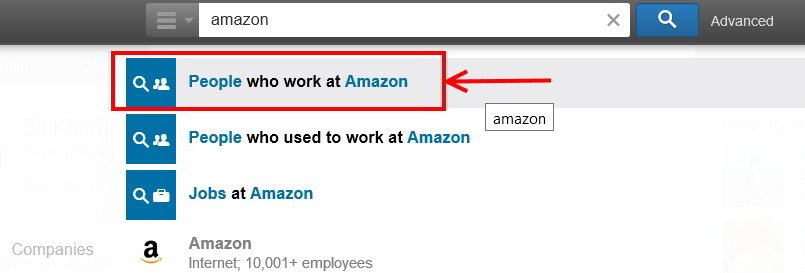
Once again, CrunchBase, AngelList and websites of investors are your best sources of information for constructing this list. LinkedIn is also extremely useful for this purpose (just input the name of a company in the search box, and choose “people who work at”).
Stage 7 – Reaching out to people
Your first list tells you who the most relevant investors for your startup are.
Your second list tells you the exact people you ultimately want to reach in order to pitch your startup. These are you Primary Targets.
Your third list tells you the best people to refer you to the people in the second list are. These are your Secondary Targets.
Now it’s time to find a way to reach these targets and pitch them your startup.
Log in to your social media profile(s) of choice, and start looking for people who can connect you to your Primary and/or Secondary Targets. These are your Connectors.
Once again, an excellent tool for this job is LinkedIn.
The tech community is allegedly quite small, so there is a pretty good chance that if you know some people who are part of the community you can find plenty of Connectors.
Of course, understand that just because two people are connected on social media, this doesn’t necessarily mean that the relationship between them is at a level that allows to make introductions. Also, a Connector may not feel comfortable with making the connection if he/she is unsure about your ability to deliver. But it never hurts to try.
If you currently don’t know enough Connectors, spend time at various tech conventions, meetups, etc. Network and connect to as many people as you can.
Whenever you locate a Connector, ask them for an introduction. Always remember that not all Connectors are of equal value.
If a Connector can introduce you to a number of Targets (and you should know this if you followed my instructions), ask the Connector for all the introductions in one go. This way you won’t have to bother the Connector every time you need a new introduction.
To make sure that the introduction is relevant both to you and to your Target, and to increase the chance that the Connector will make the introduction you are asking for, please follow some basic etiquette rules:
- Know exactly what you are asking for, and don’t make the Connector do work you should have done yourself earlier.
- Always choose the double opt-in – the Target should give an OK before the Connector makes an introduction.
- Preferably have the Connector forward to the Target some kind of short document describing your startup – one-pager, executive summary, pitch deck, etc. This should be done before an introduction is made, so that the Target understands whether the connection is relevant to him/her as well. Also, write a short paragraph or “blurb” in third person so they can easily forward it to the Target.
- If you asked a number of Connectors to introduce you to a Target, and some kind of initial contact with a Target is made (e-mail, phone call, scheduled meeting, etc), notify the other Connectors that you no longer need their assistance with that particular Target. Don’t let Connectors waste their time otherwise they will be less willing to help with additional Targets.
Materials you forward to the Target
Definitely spend the time and effort to prepare good short documents describing your startup (don’t send a 50 page business plan this early in the process).
These are the documents your Connector will be forwarding to the Target, and it would be a real shame if you end up doing all the hard work of getting to that point only to fail just because you have really bad documents that fail to explain some very basic things about your startup, and also make your Connector look bad for even forwarding them.
I have seen way too many of these documents where the founders are marketing the product or the technology instead of the startup itself, or where founders omit basic things like the amount they are raising or the progress they made so far, or where it is impossible to understand what exactly is the product supposed to do or what problem it’s supposed to solve.
These are all great ways to show that you either have no idea what you’re doing or completely don’t value the Target’s time. Not a good impression to make.
Please remember that a professional investor gets approached hundreds or even thousands of times per year by startups seeking investment, and the investor has neither the time nor the strength to start digging through your text and try to figure out what is it that you want. Investors have enough alternatives to invest in.
After seeing plenty of these documents (some made by the founders themselves and some made by freelancers or agencies), I was really impressed by the work done by Donna Griffit.
Donna recently launched her own startup – Invisu – that helps startups prepare their pitch documents. The service allows you to open a profile with all the information relevant for investors and send links to the profile – this way you can track the usage and outcome of each link sent.
The issues with this system
This system is obviously not perfect. Some of the issues are a result of the system itself, and some issues are due to a severe market failure that exists in the interaction between startups and investors due to lack of full, reliable and affordable information.
- It’s difficult to find sufficient information about investors. The existing sources of information tend to be partial, unless you are willing to pay a lot.
-
You can never be sure about the reliability of information on the internet. Inaccuracies are definitely possible. Sometimes investors just give out incorrect information about themselves (like claiming they are active in early stages when in fact they only invest in later stages).
-
There is no consistent terminology – the same terms are interpreted differently by various investors. It is especially noticeable when it comes to description of stage of investment and field of investment. Some investors prefer to describe their focus using unique terms which are impossible to compare to the terms used by other investors, and frankly are just really hard to understand. Sometimes the descriptions given by investors are much too general – if an investor claims they invest in software, would they be willing to invest in every kind of software there is?
-
Not all investors have a presence online, and are therefore more difficult to locate. This is especially true for Angels.
-
It’s not always easy to find the right Connector for a specific Target that you want to approach.Many entrepreneurs, especially ones that are just starting out, just don’t have the right network to reach the people they want to reach.
-
Not every Connector you contact will be willing or able to introduce you to your Targets. Realise that you are asking a favor, and not everyone will want to help you out or have the time to do so. And sometimes a social media connection is just not that strong in real life.
In Conclusion
This system is the best way I know of finding the most relevant investors, conducting effective outreach to those investors and increasing your chances of getting funded.
This isn’t a perfect system, but it is still much better than what many entrepreneurs are doing – which is either cold emailing to all investors, hoping to get lucky or to hang out at a bunch of random places where investors might be and hoping they will meet someone who might help them out.
The purpose of the system is to take smart action – know exactly what do you want, who exactly do you want to reach, and who exactly can help you with that.
Of course, if you know of a better way, I would love to hear all about it, so please drop a comment below.
Stay updated on the go with our mobile app.
Get latest insights with smoother, more personalized experience through TIA mobile app.
Recommended reads
 Recession Run: 500 Global’s investment plan in SEA
 To take VC money or not: Indonesia’s profitable bootstrapped startups at a crossroads
 Singtel pours additional $100m in VC arm Innov8
 Y Combinator cuts cohort size by 40% amid market downturn
 Thai startup media firm launches early-stage accelerator program
 US investor Franklin Templeton opens inaugural Asian fintech incubator in SG
 Y Combinator rolls out launchpad to help backed firms blast off
 1337 Ventures opens applications for 43rd cohort of digital accelerator
- Balance of power tilts in favor of self-sustaining startups
 Sequoia names 15 startups in Surge’s 7th cohort





Editing by Sim Yan Ting
(And yes, we’re serious about ethics and transparency. More information here.)






📅 Upcoming Events
30-31 March 2027
Upskill Fest