Louis Coppey · · 9 min read
How your AI startup can compete with bigger companies and their data
This is written by Louis Coppey with help from those at Point Nine Capital.
One thing that you learn quickly when you enter a venture capital firm is that investments are about finding moats, or competitive advantages. Why? It’s simply because moats increase a company’s bargaining power with both their suppliers and their customers, helping the firm increase prices, reduce costs, and generate higher profits.
The network effect in marketplaces is a great example of moats. Take Airbnb for example: the more places there are to rent, the higher the demand for the platform, attracting more homeowners to rent out their places.
This mechanism generates a winner-takes-all dynamic. Very often, the largest player in a market with such a dynamic becomes far larger than its competitors. That’s why investors love marketplaces—if you’re lucky enough to pick the market winner, there’s a very good chance that you’ll meet high returns.
Moats in AI companies
Now, the interesting point is that AI brings a new type of network effect that some call the “data network effect.”
Machine learning algorithms need data to work. While the relationship is not linear (more on that later), an algorithm’s prediction/classification increases in accuracy as they ingest more data.
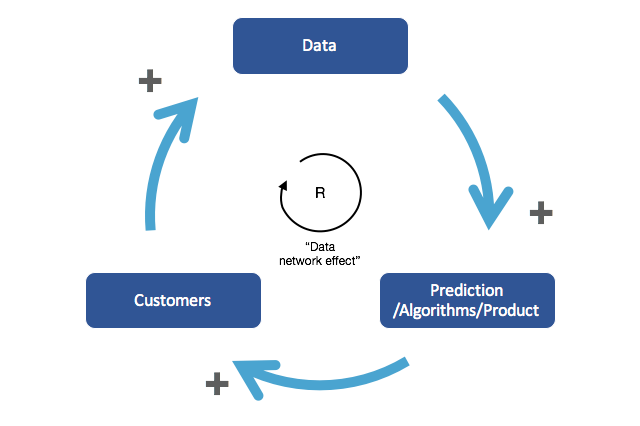
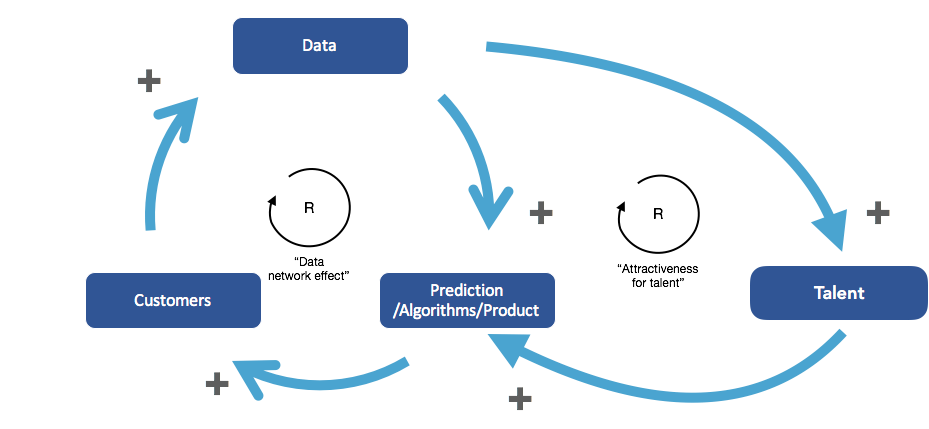
So, as a company adds more customers, it gains more data to train and refine their algorithms. With more data, the accuracy and the overall quality of the product increases. With a better product, customers are more willing to purchase and contribute their data. This mechanism helps AI companies move along the customer adoption lifecycle.
Another self-reinforcing feedback loop is the “talent attraction loop.” The more data the company owns, the more attractive it is for a data scientist to work for them. This means the team has a higher chance of attracting great talent.
The problem is that a startup initially owns no (or very little) data and relies only on a small number of talented individuals. Just like it takes time and resources for the network effect of a marketplace to kick-in, the reinforcing loop at play for AI companies requires initial data.
And who owns this data? Incumbents.
That’s why several industry observers, including Marc Andreessen, have stated that incumbents have an unfair advantage to ride the AI wave.
A working framework
The new moats
Learning curves
Limitations





Stay updated on the go with our mobile app.
Get latest insights with smoother, more personalized experience through TIA mobile app.