Terence Lee · · 4 min read
Swiff launches mobile credit card reader, but can it compete with PayPal?
With the open nature of the Internet, every tech startup faces the risk of being quickly rendered obsolete by well-moneyed technology giants.
For example, when Facebook Timeline launched, a small Chicago-based startup called Timelines.com sued, claiming that the social network could “quite possibly eliminate its entire business.”
Swiff, a Singapore-based startup that just launched its mobile credit card reader today worldwide, also faces competition from some of the world’s biggest tech companies. It’s not the first to do this either; Square, founded by Twitter creator Jack Dorsey, launched in 2009.
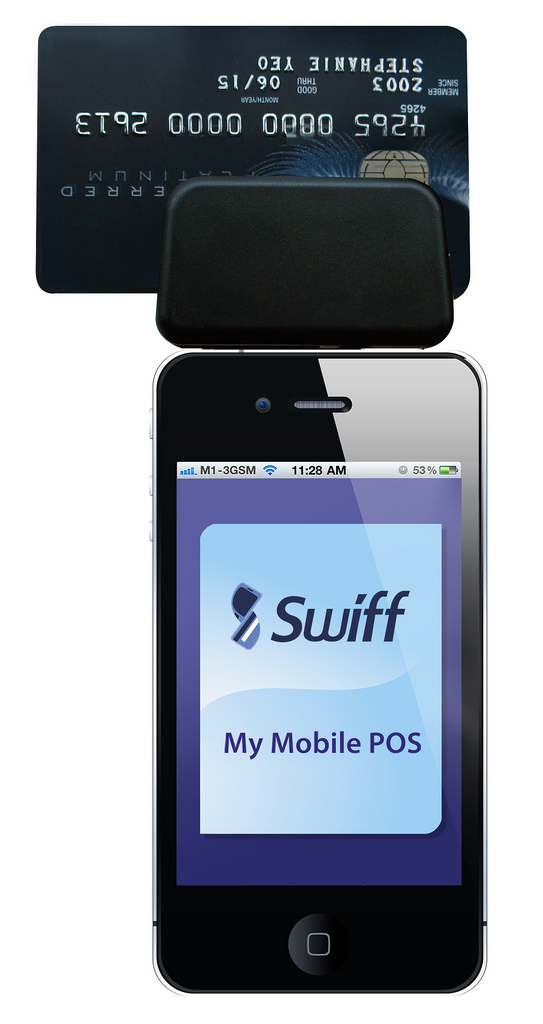
The reader, attached to a mobile device, essentially allows merchants to collect payments without the need for expensive POS equipment, bringing cost savings and convenience. It is available on iOS, Android, and Blackberry.
The last time SGE featured Swiff was in October last year, and back then, there weren’t any players in this space in Asia.
But this month, PayPal launched PayPal Here, a similar service. It is already available in Hong Kong, Australia, Canada, and the US, and will hit other countries soon.
I spoke with Swiff COO Etienne Van den Bogaert, and he claimed that PayPal and Swiff are not exactly competitors.
While PayPal is taking market share away from banks by eliminating them out of the transaction equation entirely, Swiff works in partnership with banks instead to market its card reader to merchants. Transactions are made directly with the bank too.
In essence, it has a different go-to market strategy from PayPal or Square. So, instead of selling its card reader directly to restaurant owners and retailers, it is counting on the banks to reach out to users instead. Sounds good in theory, as it could save a lot of time and effort in the long run.
Currently, HSBC Bank has signed on as a partner, and talks with other merchant banks are still ongoing. The payment solution accepts credit cards from MasterCard, Visa, and American Express.
Their cooperation with banks can benefit merchants. By transacting directly with their bank, merchants can consolidate all the transaction details in one place, as opposed to PayPal, which actually holds money separate from the user’s bank account.
But that aside — I’m not convinced that both companies aren’t competing. Since every restaurant can only have one payment platform, it’s very likely that if they’re presented with either PayPal Here or Swiff, they’re going to have to choose.
Nevertheless, I think there’s going to be enough room for three or even four big players in Asia, and Swiff is in position to capture sizable market share.





Stay updated on the go with our mobile app.
Get latest insights with smoother, more personalized experience through TIA mobile app.