 Terence Lee · · 6 min read
In Singapore, a quest to build the mother of all robotics systems

Pulkit Jaiswal, the 22-year-old CEO and founder of Singapore-based startup SwarmX, believes that the drone industry is still in the “dark ages.”
Sure, drones have come a long way. They’ve shed their label as killing machines and captured the public imagination with their potential to deliver packages, take stunning footage, and even do search and rescue.
But most are just expensive, remote-controlled toys. Drone races are becoming a thing. Photographers mount cameras onto their manually-operated quadcopters.
It’s true autonomous drones are being employed in enterprises, where they’re starting to be used for security and surveillance. But operating them is labor intensive and costly.
SwarmX’s mission is to change that. It wants to make entire drone fleets – and not just individual drones – easy to command.
Consider how assignments are carried out today. A drone operations team deploys on-site. They survey the environment and plan the mission. The drones take off, visit the set waypoints, and return to have their batteries and memory cards swapped by hand. The cycle repeats itself again and again.
That’s not all. Missions occur in the middle of nowhere. Without sophisticated computers and fast internet connections out in the field, the team must return to headquarters just to process and upload the data to the cloud and send it to clients.
The size of the data and the huge amount of junk within is a huge problem. “If you do 10 flights, 45 to 50 minutes each, you’re gathering about a terabyte of information already. Most of it is completely useless to the client,” says Pulkit.
Inspired by bees
Pulkit looked to nature for a fix. In particular: bees and their hives. SwarmX’s innovation lies not in its aerial drones, but the platform surrounding them.
One key piece of this system is a literal Hive – a weatherproof docking bay for drones. Once the robot lands, the door opens, and the landing pad slowly descends into the Hive with the drone, like in a sci-fi movie. The landing is made using precision infra-red sensors, which Pulkit says are more accurate than GPS.
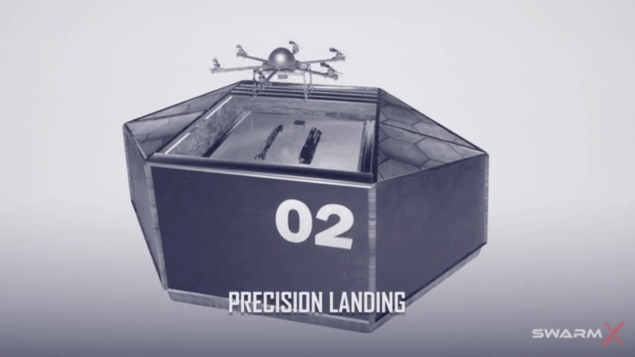
Once inside the metal cocoon, the drone charges its batteries through a conduction plate. A full charge takes 45 minutes. In that time, it transfers data to a processor in the Hive, converting it into a smaller format, at hundreds of megabytes instead of gigabytes.
Beginning of a dream





Stay updated on the go with our mobile app.
Get latest insights with smoother, more personalized experience through TIA mobile app.










📅 Upcoming Events
22 October 2026
Payoneer x CSPN Summit 2026