Yanting Sim · · 7 min read
How a team of academics built a billion-dollar blockchain startup in Singapore

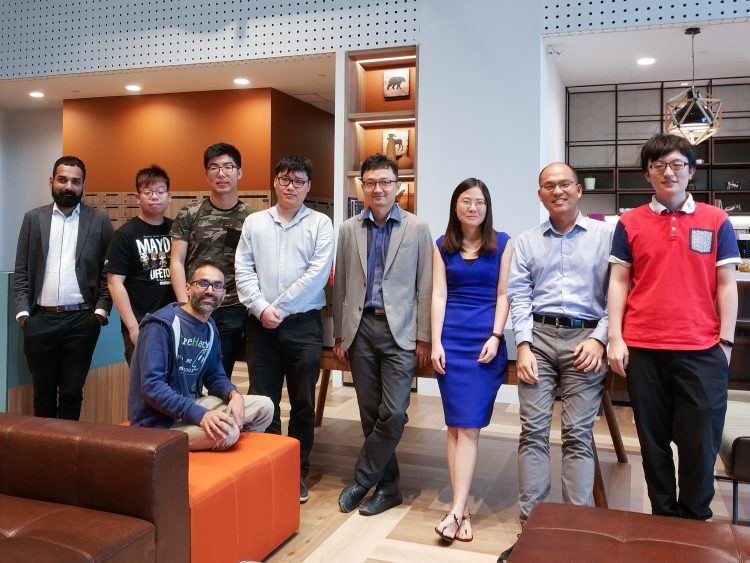
The Zilliqa team / Photo credit: Zilliqa
Zilliqa CEO Xinshu Dong typically comes across as smart and shy, with a knack for dry humor. But mention their US$1 billion market cap, and his tone immediately shifts to one of caution.
“Hitting the billion-dollar mark is nice, but it has never been our priority,” he says. “I see it as a natural consequence of what we have been working on at Zilliqa, and that number is just a way to represent the confidence people have in us.”
The team celebrated the milestone with a few champagne emojis in their group chat.
Zilliqa, a public blockchain network, hit its billion-dollar market cap in May this year, a little under a year since its founding. It is one of the first Singapore-based blockchain startups to achieve the feat.
Tech in Asia sat down with Dong and En Hui Ong, head of business development at Zilliqa, to find out more about the team and their journey so far.
The Zilliqa story
In 2016, Prateek Saxena, an assistant professor in the NUS School of Computing, noticed a problem with existing blockchain networks. They processed transactions too slowly, were unable to scale as the network expanded, or compromised on security for speed and scalability.
That same year, Saxena co-wrote a research paper called Elastico with Loi Luu, his PhD student at the time. The paper explored how a concept in database architecture known as sharding could be applied to blockchains to make them scalable.
Shortly after, Saxena founded Anquan Capital to develop this idea into a commercially viable solution. Luu went on to start Kyber Network, a decentralized exchange for cryptocurrencies.
Dong, a senior research fellow in NUS School of Computing at the time, joined Anquan Capital as the head of engineering.
While the Anquan team had interesting use cases in financial services, ecommerce, and advanced manufacturing sectors, they quickly realized the need for a better platform to scale their blockchain network. Without this, the technology would have remained as a private blockchain in commercial deployments. After several rounds of discussion, the team decided to build their own public blockchain.
The project, named Zilliqa, officially kicked off on June 1, 2017.
Challenges of turning research into reality
Dong reveals that turning an idea from a research paper into reality is more difficult than most might imagine.
“A research paper in computer science is about 10 to 15 pages, written about the researcher’s immediate scope of work,” says Dong. “It can be a starting point, but it’s not meant to be a solution that can be readily applied in the real world.”
Dong gives the example of research solutions within controlled settings versus those in realistic settings, as in the case of a public blockchain.
“In a public blockchain, we have very adversarial circumstances where any node can be malicious, with up to one-third of the nodes being arbitrarily malicious,” says Dong. “Existing building blocks are not necessarily designed for these hostile environments. As such, there are many things you need to strengthen and change when you want to borrow and apply those ideas.”
On top of this, research papers tend to include assumptions that may not necessarily hold when applied to real-world settings. Or they may focus on a very specific scope of the research topic, such as security, while paying less attention to other factors, such as performance, that have to be considered in a live system.
These were the things the Zilliqa team had to work on to bring several research ideas to life, including that from Saxena and Luu.
Overcoming the odds
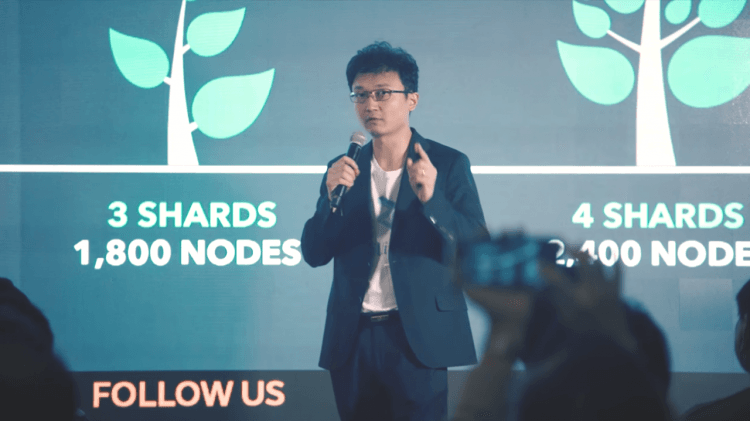
Zilliqa CEO Xinshu Dong / Photo credit: Zilliqa
Dong attributes Zilliqa’s success to three main factors.
1. A team with complementary skill sets
Dong explains that while academic research for blockchain only started recently, the fundamental technologies underpinning it are not completely new.
“The areas of expertise at its foundation are networking, distributed systems, cybersecurity, and cryptography,” says Dong. “In our team, we have almost 100 percent coverage on all these areas to build a good blockchain protocol. We’re really fortunate to have been able to assemble such a team.”
A majority of the team comes from academic backgrounds, and Dong admits that they have not had years of experience turning research ideas into reality.
“I believe it’s more about having analytical skills,” he says. “We can sit down and look at the protocols, propose different ideas and critique each other until we reach a point where we can show very rigorously that we have a solution that is fast, scalable, and secure.”
On top of these, Dong attributes the success of Zilliqa to the extreme focus and dedication of the team to deliver a good technical solution.
2. Strong community support
The Zilliqa community evolved from a Slack channel the team created in its early days.
“Not being very well known in the beginning was a double-edged sword,” says Ong, who’s in charge of the startup’s business development. “While there were few people in our Slack channel, the only people in the channel were those who really understood our technology and goal. That was why the conversations we had there were very deep and technical. And these are the people who’ve been on the same journey as us to date.”
Ong believes that deeply involving the core team in community building efforts early on helped build a community that was well-informed of the protocol and could contribute with feedback and new ideas.
“Community members could interact with them directly on Slack for technical questions, which resulted in very high-quality discussions,” she says. “We invested a lot of everybody’s time to grow the community, and it paid off.”
On how initial community members heard of them, Dong laughs and says that it remains a “mystery”. “We had a website, wrote some articles, and that was it,” he says. “We also had some early backers who might have spread the word to their friends and communities.”
Zilliqa currently has 5,900 members on its Slack channel and over 30,000 members on Telegram.
3. No bandwagons and airdrops
Dong says that the team believes in doing things very carefully and properly.
“We don’t jump on bandwagons,” he says. “Since our early days, we have been open to ideas on how to do things, but we always had our independent assessment before making decisions. We think about solutions very carefully and go with the one that we believe is most feasible. This applies not just for technical development, but in all other aspects, like community building, business development, and marketing.”
This also means that sometimes, Zilliqa chooses to do things “at a slightly slower pace than many other projects.” As Dong explains, “We’re willing to make that sacrifice, because we don’t want to jump or rush into things before we know how to do it well.”
An example of this would be Zilliqa’s approach to marketing.
Ong explains that marketing in this space is very different from that in traditional businesses. As blockchain platforms like Zilliqa are very community-centered, one needs to think of ways to grow the community.
“One way is to give out free tokens – aka airdropping – to existing communities and drive them to your community-based channels,” she says. “Airdropping is effective in the short term, and is hence pretty popular. But it comes with its downsides. The most prominent downside is that this approach is not very organic, and drives interest only momentarily. A team relying on this approach may not be able to build a strong community that the project will need in the future.”
Ong says that Zilliqa doesn’t airdrop because the team believes in the value of its project.
Once the community has been set up, sharing frequent updates on the progress of the project both on the technical and business sides is essential.
Progress on the technical side is fairly easy as it only requires the team to release updates on the project development. It could either be in the form of a bi-weekly blog update or organizing regular developer-oriented meetups, which most projects, including Zilliqa, are doing.
On the business side, it has almost become a norm to announce partnerships. But Ong muses that many in the industry like the idea of announcing partnerships without really understanding what it entails.
“Some partnerships can just be in name, but people don’t really know what they’re partnering on,” she says. “We want to make sure that when we announce a partnership, there’s something we’re planning to collaborate on, or with an intention to join efforts structurally. Otherwise, there really is no point. It’s about quality, not quantity.”
All of Zilliqa’s partnerships entailed several rounds of discussions to understand what their partners did, and exactly how they could work together to build something new and exciting.
“We have been conservative in announcing partnerships, and we intend to continue being so,” says Ong.
Zilliqa has only announced a few partnerships to date, one being with Mindshare, a global media agency, to address challenges in the digital advertising industry.
They have also partnered with two blockchain projects that are distributed storage providers. Partnerships with these projects will allow decentralized app developers on Zilliqa to outsource their backend database storage in a secure and decentralized manner.
Advice for new founders
Dong leaves new founders of blockchain startups with some advice.
“All blockchain startups should start with a clear mission,” he says. “It doesn’t have to be a completely new idea, but it has to be of value to the ecosystem. Otherwise, others will think you are just trying to ride out the hype, and this can quickly be destructive to your credibility and reputation.”
Zilliqa
Zilliqa is a public blockchain platform designed to scale to thousands of transactions per second.
- Location
- Singapore
- Founded
- 2017
- Employees
- 11 – 50
- Website
- www.zilliqa.com
- Latest Funding
- Token sale
- Hiring
- 0 positions
Stay updated on the go with our mobile app.
Get latest insights with smoother, more personalized experience through TIA mobile app.
Recommended reads
 Indonesian AI startup goes global
 Forrest Li on scaling Sea, building smarter bots, and founder grit
 An AI assistant that joins sales calls and scores team skills
 Beyond the check: Why VCs need more than capital
 SGX’s CEO says it doesn’t need a unicorn to win
 SMEs want AI too, but not the kind Big Tech is selling
 Oatside’s alt-milk rise hits a profitable gear
 Alibaba’s financial health in 12 charts
 Asia’s telcos bundle AI into mobile plans. Will it pay off?
 M-Daq chases bigger clients as revenue falls, losses grow





Editing by Jack Ellis and Eileen C. Ang
(And yes, we’re serious about ethics and transparency. More information here.)