
Business travel is on the rise, with the global market estimated to reach over US$1.7 trillion by 2023, up from US$1.3 trillion in 2017, according to consultancy firm Allied Market Research. The forecast also found that Asia Pacific accounted for 42 percent of total business travel revenue, making it the biggest business travel market in the world.
As such, there’s a growing need in the region for efficient travel booking and expense management solutions. Vijay Aggarwal, co-founder and chief technology officer of business travel management platform Travelstop, believes that close to 90 percent of business travel in Asia goes unmanaged.
“It is an exciting time to be in this space as emerging economies start increasing their spend on business travel in the region, driving it close to US$900 billion by 2025,” says Aggarwal, citing Travelstop data. “There is a huge market opportunity to drive disruption and add value to a rapidly growing space globally.”
Finding inspiration
Aggarwal and his co-founders found the inspiration to build Travelstop when they experienced firsthand some difficulties when traveling for their previous jobs. Going on a work trip meant they always had to deal with the inevitable: booking airlines and hotels and then filing claims for out-of-pocket expenses. Though they’re relatively straightforward processes, they can be a pain when mishandled.
They thought, what if they could make the business travel experience more efficient by leveraging technology? And Travelstop was born.

Vijay Aggarwal, co-founder and chief technology officer of Travelstop / Photo credit: Travelstop
Aggarwal believes that the ideal process for business travel should be simple enough to be flexible and manageable, while also allowing for some degree of command and control. Instead of worrying, “employees should be able to focus on the purpose of their business trip, while companies should be able to benefit from improved employee productivity and cost savings,” he says. Adopting a platform like Travelstop can help both employees and employers manage the entire life cycle of business travel in a single place.
To help make the most out of work travel, Aggarwal shares some tips on how to effectively manage a business trip.
1. Plan ahead with a travel app
When it comes to travel planning, there are often hundreds of flight and hotel booking options to choose from. According to Aggarwal, it can take “several hours” just to research and book the right transport and accommodation online.

Photo credit: scanrail / 123RF
But technology has made the process easier with travel and expense apps that can make personalized recommendations. These apps become more accurate with repeated use, and they provide information that goes beyond listing down the best airlines or hotels to book.
Travelstop, for instance, provides users with details about relevant travel policies that they should follow while making bookings. Aggarwal says that “pre-approved budget workflows” also give people some level of freedom when choosing flights and accommodations. This way, they can avoid violating travel guidelines and exceeding their budgets at the same time.
2. Keep track of on-the-go expenses digitally
Instead of asking people to keep paper receipts for each expense made during a business trip, Aggarwal points out that it is more efficient to save and upload pictures of these documents into an online expense report at their own time.
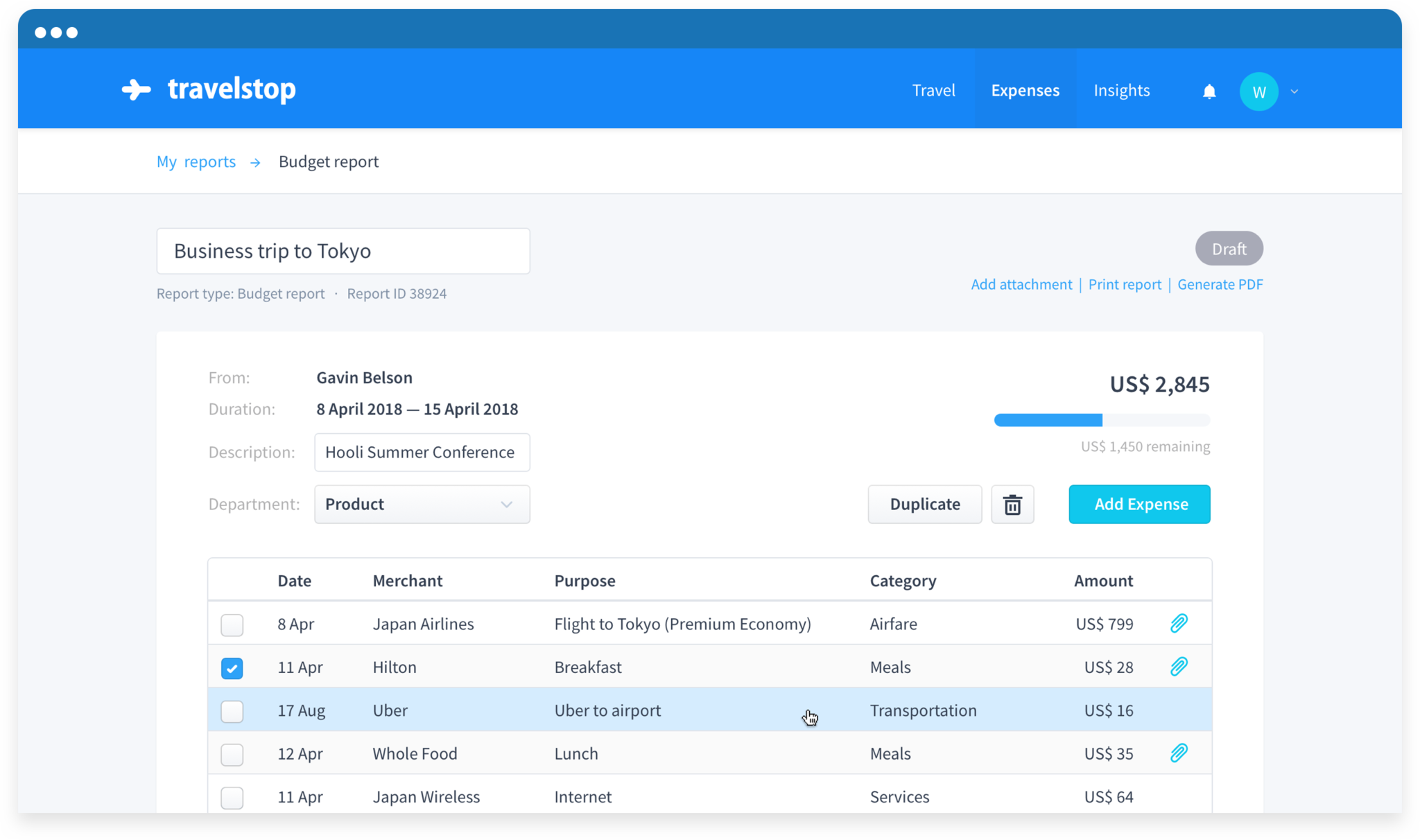
Photo credit: Travelstop
“The concept of requiring employees to manually enter expenses in an Excel sheet and physically stick receipts on a piece of paper to claim expenses is probably one of the most outdated and ineffective business process that companies tend to follow these days,” he contends.
In addition to being very time-consuming, Aggarwal thinks that this approach is a “complete waste of resources for the company.”
“An ineffective expense management process that involves manual and paper expense reports can have a negative impact on employee productivity and morale, and can instead lead to an increase in costs as a result,” he observes.
Using an automated and digital expense management tool can help streamline this process.
3. Let data do the work
Travelstop’s research shows that travel and expense spend is generally in the top five items on a company’s profit and loss statements. Given that, Aggarwal laments that employers “often lack a good understanding of travel and expense spending within their company and cannot make data-driven decisions” about effective policy implementation.
The goal, he suggests, is to either reactively reduce spending or proactively control costs by implementing effective policies around business travel and expenditure. Travelstop provides data-driven tools that can help with this. Expenses can be reviewed by the organization, department, team, or individual to make better decisions for cost savings. Doing so can yield insights into various aspects of a business trip, from identifying which departments spend the most to generating quarterly expenditure overviews and more.
Instead of implementing travel policies that are “ad hoc and arbitrary,” companies need to structure their cost-saving measures and decisions around verifiable data, suggests Aggarwal. This enables them to not just save money but also ensure that every dollar going towards business travel is spent effectively.
Travelstop is an AI-powered software-as-a-service platform that simplifies business travel and automates the expense management of high-growth companies in Asia.
Visit the Travelstop website to learn more.
Stay updated on the go with our mobile app.
Get latest insights with smoother, more personalized experience through TIA mobile app.
Recommended reads
 Indonesian AI startup goes global
 Forrest Li on scaling Sea, building smarter bots, and founder grit
 An AI assistant that joins sales calls and scores team skills
 Beyond the check: Why VCs need more than capital
 SGX’s CEO says it doesn’t need a unicorn to win
 SMEs want AI too, but not the kind Big Tech is selling
 Oatside’s alt-milk rise hits a profitable gear
 Alibaba’s financial health in 12 charts
 Asia’s telcos bundle AI into mobile plans. Will it pay off?
 M-Daq chases bigger clients as revenue falls, losses grow





Editing by Nathaniel Fetalvero, Eileen C. Ang, and Charmaine de Lazo
(And yes, we’re serious about ethics and transparency. More information here.)




