Nathaniel Fetalvero · · 8 min read
10-year challenge: The Tech in Asia story
This article is an excerpt from an episode of Startup Snapshot, a Tech in Asia podcast that features the leaders and innovators in the Asian startup scene, and discusses the highs and lows of their founder journeys. It is heavily revised from the original transcript. Listen to the full episode on Spotify, Apple Podcasts, or Google Podcasts.
Willis Wee was in his third year at university when he started Tech in Asia in 2010. At the time, the startup scene was young, and terms such as total addressable market, product-market fit, and product management were still relatively alien to budding founders.
This led Wee to the traditional entrepreneurial track of trying, failing, and understanding why he failed, and then trying again. While difficult, Wee says the experience made him “a lot more resilient” as a founder and CEO, which drove the business to achieve some success, with initiatives such as the first Tech in Asia Conference in 2012 (then known as Startup Asia).
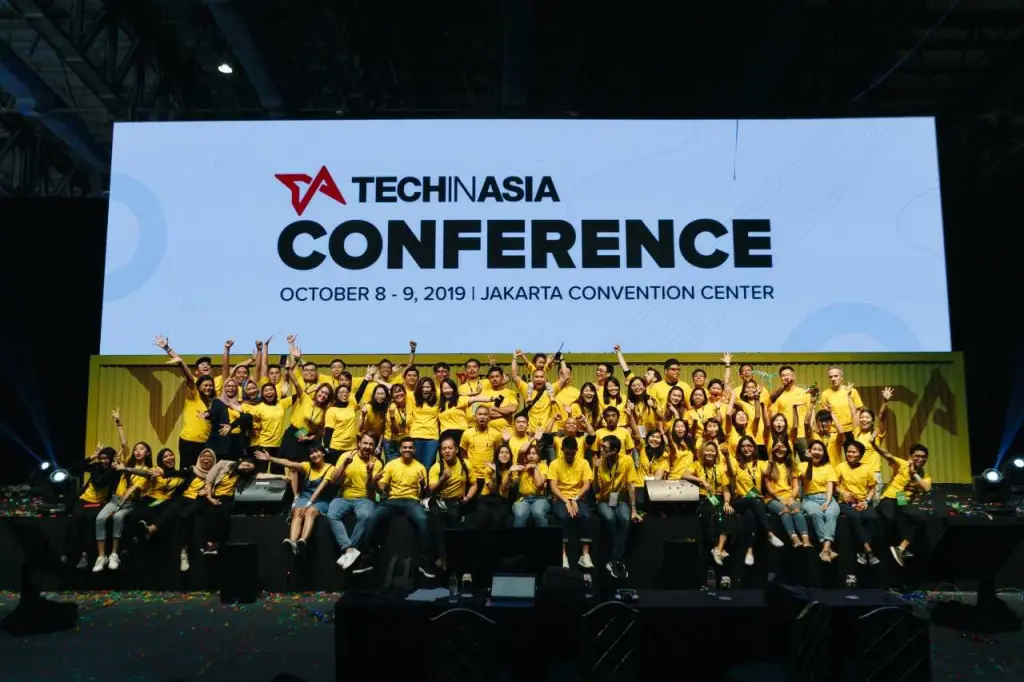
The Tech in Asia team at the conference in 2019 / Photo credit: Tech in Asia
But in 2018, Tech in Asia hit a rough patch: The team had to ditch a number of projects – including an initial coin offering – that left the company with a dwindling runway. Wee then had to make the difficult decision to layoff a large portion of its staff.
On this episode of Startup Snapshot, the CEO shares the highest and lowest moments of the Tech in Asia story and how the rollercoaster journey shaped him as the company’s founder.
You previously talked about how you’ve grown as a founder since starting Tech in Asia. How were you like when you first started?
This is very embarrassing. I would say that nine years ago, I was probably very ignorant, very arrogant as well because I was scoring A’s, taking special papers, and just excelling both in academics as well as my extracurricular activities. So I thought I knew everything.
I vividly recall there was one time when we actually got revenue and we were very close to profitability during the first two years of Tech in Asia. One of the partners [at East Ventures], Batara [Eto], was very upset because I clearly didn’t know the difference between recorded revenue and cash flow. He was telling me – in a very nice way, at the beginning – “You have to be very clear. This is unearned revenue, and you haven’t collected the cash from your receivables, so it can’t really help you in terms of your cash flow to pay your bills.”
I was like, “Who cares? It’s recorded as revenue; it’s profitable!” Thinking back, it’s very embarrassing because Batara is one of the most respected entrepreneurs of our time – he founded Mixi, which had one of the biggest IPOs for a social media company.
So he got really upset: He flipped and told me, “Willis, just get your shit together.” I remember at that point in time, I didn’t know that I was in the wrong, and I was still trying to argue for the sake of winning. Thankfully, Willson [Cuaca] was there. He was very nice, very calm, and he was just trying to break us up and telling us to cool down.
That was one of the hardest lessons I learned. It really humbled me a lot.
Was that your wake-up call – your investor scolding you – or were you still running free and recklessly as a founder after that?
Yeah, I think reckless is definitely the right word to describe me. Back then, you have to understand that there were very little resources (I think Paul Graham of Y Combinator was just starting to write his essays). No one could tell you what was total addressable market, what’s product-market fit, how you get to product-market fit, what’s product management – all these were very alien topics 10 years ago.
A lot of the entrepreneurs that started 10 years ago in the startup scene – we were really just learning from failures: We try, then we fail, then we try to understand why things fail, and then we just keep trying again. There were no guidelines, there were no protocols on how to do things right. I think that was pretty difficult, but it also perhaps made me a lot more resilient.
You mentioned Y Combinator, which you attended in 2015. How was your experience there?
One of these projects was Tribe. What happened there?
Tech in Asia invested significantly in that project, which led to its runway becoming incredibly short. As a consequence, you had to lay off 30% of the workforce. How did you feel about that?
When did things start looking up again?





Stay updated on the go with our mobile app.
Get latest insights with smoother, more personalized experience through TIA mobile app.