Rebecca Liew · · 6 min read
These 3 startups switched up their game plans in the face of Covid-19

In these uncertain times, what formula can startups use to survive?
With Southeast Asian startups streamlining their operations through cost-cutting measures and fewer venture capital firms investing, it might seem like there is none.
But these three Southeast Asian startups may know the secret. They’ve figured out how to turn adversity on its head and are now thriving amid the shifting market behaviors brought on by Covid-19. Here’s how they did it.
1. Carsome: Simplifying the car trading process and upskilling employees
When Malaysia-based car trading marketplace Carsome suffered revenue losses of around 80% between March to May 2020, CEO and founder Eric Cheng thought to channel resources into the business’ product and technology developments.
“Fortunately, we’d just raised a [series C] round last year, so we didn’t have to resort to massive cost-cutting measures,” he says. “Instead, we strengthened certain areas to give us a good restart post-lockdown.”
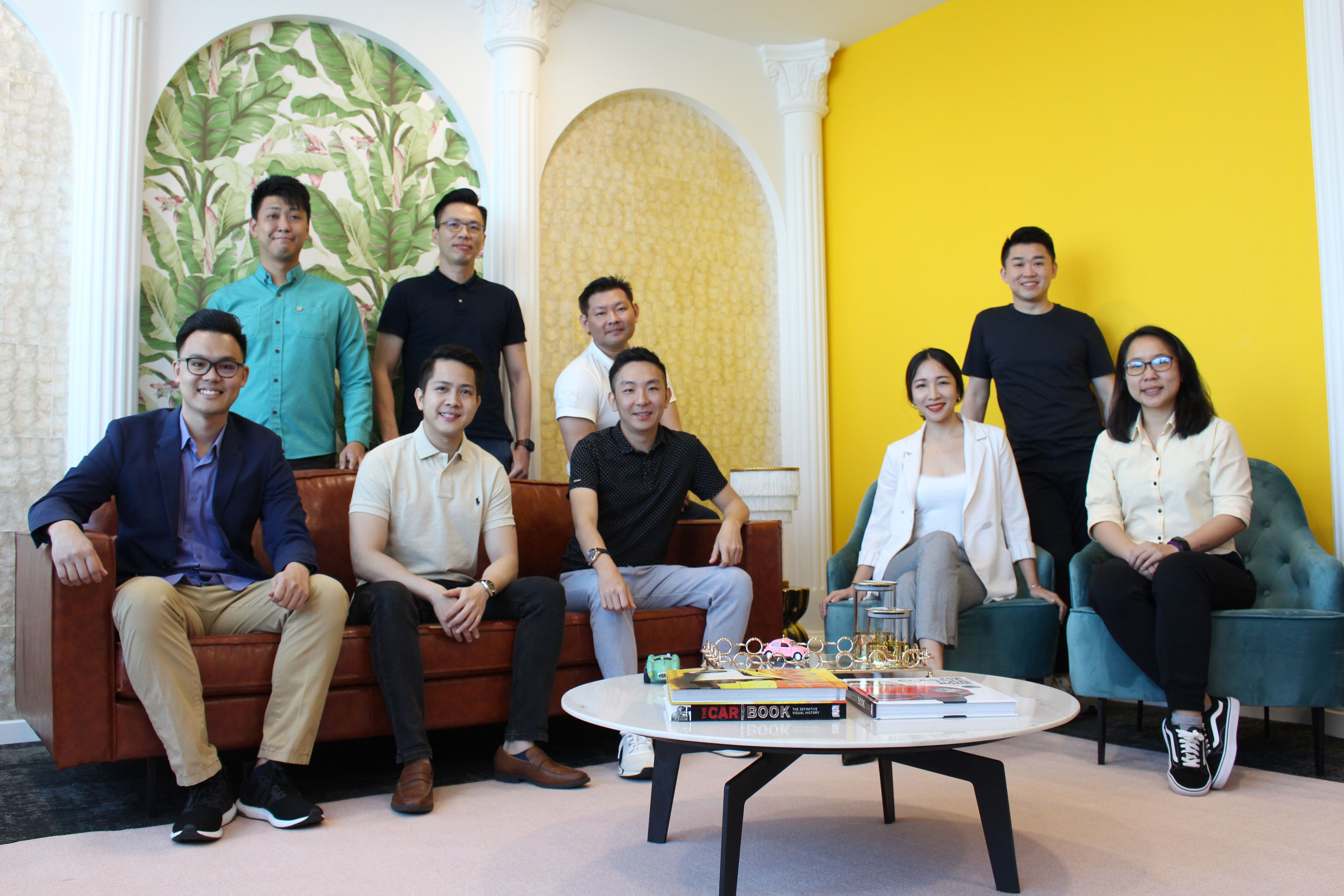
Carsome CEO and founder Eric Cheng (center, in black) with the team. / Photo credit: Carsome
To that end, Carsome, which helps customers buy or sell used cars, launched two mobile apps to streamline its manual processes.
The first, Carsome Carpartner, allows the company’s partners to make appointments and get price checks easily. The second, CarsomeGo, lets dealers bid for cars in a matter of minutes. Not only have these apps expedited productivity for the brand’s technicians and inspectors, they’ve also cut down trading and bidding times.
As a result, Carsome’s revenue streams have seen a steady, V-shaped recovery, from achieving 30% of its pre-Covid levels in June to complete recovery the following month.
In Q3, Carsome’s revenue grew even further, with an over 20% to 30% month-on-month increase from August to September. This is thanks in part to the launch of the company’s business-to-consumer (B2C) segment, which allows consumers to browse for cars online before booking in-person test drive sessions.
Another factor in its recovery: upskilling its employees in essential areas, from inspection and operations to product knowledge. The effort has mostly paid off, leading to a roughly 20% uplift in productivity across the board, says Cheng.
“One of the biggest gains is understanding Gobi Partners’ knowledge of various markets,” Cheng explains. “As our first investor, they’ve been guiding us since our early days to accelerate our growth.”
2. Transportify: Planning ahead and making bold decisions
Paulo Bengson, Philippine country head of logistics startup Transportify, knows the company is among the luckier ones. If anything, the logistics sector has burgeoned amid the pandemic and particularly in the Philippines.
“We’re fortunate to be operating in an industry that has not been obliterated by the pandemic,” Bengson says of the startup’s B2C transport and logistics business model. “[But] the Philippines was the most abrupt in terms of the way the environment changed. In early February, we decided that we would work from home starting on March 16 for the safety of our employees, whether or not the government mandated it.”

Photo credit: Transportify / Deliveree
By the time parts of the Philippines began going into lockdown, the company had already spent six weeks restructuring its operations and identifying new areas of focus to fit the new normal. One of those areas, for instance, was office and gym equipment delivery.
Knowing that deliveries are an essential service, the company also made the bold decision to expand across the Philippines’ Luzon region and maintain its marketing spend.
“Costs for digital marketing were going down especially on Facebook ads,” Bengson says. “We broadcast messages that we thought were important. The first was that we’re open [for business] and that we can deliver anywhere.”
Of course, Transportify – which operates under the name Deliveree in its other markets – faced the same snags that other logistics providers did, such as vehicles not being able to get past checkpoints. In response, the company issued digital ‘certificates-on-demand’ that its drivers could show to checkpoint personnel. Overcoming this hurdle allowed the company to make timely deliveries, an assurance that kept customers coming back.
According to Bengson, the company’s growth during the lockdown months was “bad,” but things quickly looked up. “In the span of seven months since February, all of our markets are either profitable or very close to it,” says the executive.
He attributes part of Transportify’s success to Gobi Partners, which was the key institutional investor that backed the company in its a series A funding round in 2017, followed by a second investment round shortly after.
“They believe in our team’s ability to execute and have been very supportive in terms of introducing us to many potential strategic and financial partners,” Bengson adds. “It’s something they’ve been doing even before the pandemic. That level of support has not changed, [and] we are where we are because of that.”
3. Travelio: Identifying and adapting to consumers’ shifting needs
Travelio has been called Indonesia’s answer to Airbnb but with a difference: The company offers whole apartment home rentals in 25 cities across the country, both furnished and unfurnished.
The co-founders behind the platform know a thing or two about embracing change.
“The biggest step we took early on was pivoting from [being] a hotel booking website to a property management and online home rental marketplace,” shares Hendry Rusli, CEO and co-founder of Travelio.

Travelio CEO and co-founder Hendry Rusli (third from left, seated) and co-founder Christina Suriadjaja (fifth from left, seated) with the team. / Photo credit: Travelio
Today, the company operates with a primary focus on its namesake property management service, Travelio Property Management. The startup also has plans to branch out to other verticals such as buying and selling properties.
Naturally, the Covid-19 pandemic has thrown a spanner in the works.
“We were down by 50% to 60% on daily stays in April, but the traction for monthly and yearly stays helped sustain us during this period,” Rusli says. For that reason, Travelio’s sales growth almost tripled in Q1 and Q2 year on year from 2019 to 2020.
To recapture and even expand its slice of the market, the company reassessed its spending and identified the shifting needs of its consumer base. It also drew from customer feedback and expanded its ancillary revenue streams by launching online grocery store TravelioMart as well as disinfection services. By August, Travelio’s revenue streams recovered to pre-Covid-19 levels.
All these decisions were made after consultations with its investor Gobi Partners, says Travelio co-founder Christina Suriadjaja.
“Gobi Partners definitely helped in the macro view of the company,” Suriadjaja shares. “They gave suggestions and [provided] research based on what’s happening in other portfolio companies [and] advised that we focus on creating an asset-light business model, which allowed us to stand out.”
For other startups that may still be struggling amid the pandemic, she advises, “Be adaptable and flexible so your business can withstand any type of economic crisis or pandemic.”
Gobi Partners is one of the longest-standing venture capital firms with a Pan-Asian presence across North Asia, South Asia, and the ASEAN, with over US$1.1 billion in assets under management (AUM). The firm, which has offices in Kuala Lumpur and Shanghai, supports entrepreneurs from the early to growth stages and focuses on emerging and underserved markets.
Founded in 2002, Gobi has raised 13 funds to date, invested in over 270 startups, and spans 12 locations across Bangkok, Beijing, Ho Chi Minh City, Hong Kong, Jakarta, Karachi, Kuala Lumpur, Lahore, Manila, Riyadh, Shanghai, and Singapore.
To learn more about Gobi Partners and how it can help your startup, reach out to the team on its website.
This content was produced by Tech in Asia Studios, which connects brands with Asia’s tech community. Learn more about partnering with Tech in Asia Studios.
Stay updated on the go with our mobile app.
Get latest insights with smoother, more personalized experience through TIA mobile app.
Recommended reads
 Life’s a game, and AI agents are Animoca’s new play
 Indonesian AI startup goes global
 Forrest Li on scaling Sea, building smarter bots, and founder grit
 An AI assistant that joins sales calls and scores team skills
 Beyond the check: Why VCs need more than capital
 SGX’s CEO says it doesn’t need a unicorn to win
 SMEs want AI too, but not the kind Big Tech is selling
 Oatside’s alt-milk rise hits a profitable gear
 Alibaba’s financial health in 12 charts
 Asia’s telcos bundle AI into mobile plans. Will it pay off?





Editing by Nathaniel Fetalvero and Jaclyn Teng
(And yes, we’re serious about ethics and transparency. More information here.)