- Premium Content It takes our newsroom weeks - if not months - to investigate and produce stories for our premium content. You can’t find them anywhere else.
 Terence Lee · · 5 min read
A smart home company is quietly penetrating a quarter of condominiums in Singapore

Sketch of a condominium in Singapore / Image credit: HDB
If you live in a condominium in Singapore, you might have heard of HiLife. Set up in 2015, HiLife is fast becoming the main way residents interact with their homes through their mobile phones.
The company claims that it’s penetrating a quarter of all condos in Singapore, including upcoming developments it’s involved in. It has gone from negligible revenue last year to US$9.4 million in contract value this year, and has also embarked on regional expansion. It’s likely the leader in Singapore’s smart home integration space. A competitor, Habitap, lists only 11 clients on its website.
Here’s what you might not know: HiLife is actually a subsidiary of Qingjian, a decades-old Chinese property developer with projects in China and the rest of Asia. Its profitable Hong Kong-listed entity, CNQC International, made about US$1.3 billion in revenue in 2017.
If it plays its cards right, HiLife could be a successful case of corporate reinvention – it started out as a division within Qingjian. “China, in terms of the internet, is one of the most advanced countries in the world. And Qingjian is from China. So we wanted to create a unique selling point in Singapore and do something that’s different from other developers,” Alex Feng, HiLife’s managing director in Singapore, tells Tech in Asia.
Qingjian began by offering HiLife within its own residential projects. But it soon started hearing from other interested developers. As Feng recalls, “We stepped back to think: Can we do this bigger? Can we open up our solutions to others?”
The team looked at Chinese smart home companies like Terminus, Haier, and Orbivo for inspiration. Then it decided to spin out HiLife as a separate company.
Data vs paperwork
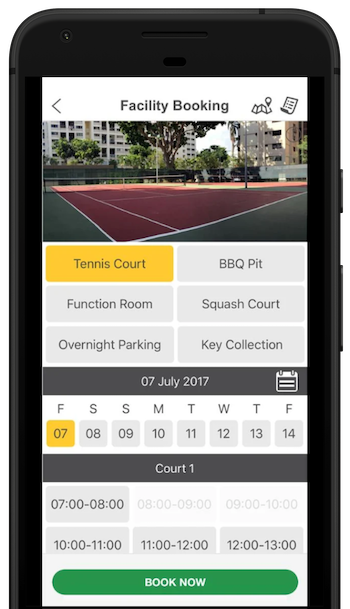
The HiLife app
Feng joined soon after that. A Singapore resident for many years, he was an operations manager at Alibaba’s Tmall and a vice-president at Lazada, where he worked on improving seller experience on the marketplace. He left Lazada to join a startup before working at HiLife.
While the company has many facets, it can be summarized as a platform for managing “smart” homes. It’s involved in setting up the hardware and software that allows residents to manage their homes with their mobile phones – think digital locks, remote air-conditioning control, and various sensors.
Its app also allows a condo’s residents to book facilities and pay bills, as well as receive announcements from the managing agent of the residence. On the other side, managing agents can remove paperwork and digitize their workflow, and they get access to data on the residents and the property that they can use to run the residence better.
The company said around 300,000 households in Singapore will adopt HiLife this year, counting both completed and upcoming residential developments. However, while the app has social features like a marketplace and discussion forms, it only has between 30,000 to 50,000 monthly active users, a company spokesperson says. The low app store ratings may have something to do with this, though the spokesperson claims they may be faked.
Nonetheless, it’s clear most of HiLife’s revenue isn’t coming from the residents themselves, but from the maintenance and setup fees that it charges to property developers and managing agents for its hardware and software.
Aggressive expansion
Stay ahead in Asia’s tech landscape
This is premium content. Subscribe to read the full story.
It has gone from negligible revenue last year to US$9.4 million in contract value this year.
We know this is not ideal. ⌛ Sign up in 20 seconds. Cancel anytime.
Our subscriber community includes professionals from these companies:





Stay updated on the go with our mobile app.
Get latest insights with smoother, more personalized experience through TIA mobile app.