Malavika Velayanikal · · 5 min read
What makes this Indian real estate portal uncommon: the CommonFloor story

When Sumit Jain started up CommonFloor on December 22, 2007, along with IIT Roorkee batchmate Lalit Mangal and another techie friend Vikas Malpani, he never dreamt it would one day be a real estate portal – and one of India’s leading ones at that.
It was only meant to be an online space where people living in large apartment complexes could interact and collaborate to solve problems they had in common. In fact, the three friends came up with it after failing to solve a sewage problem, which eventually forced them to leave a rented apartment they were sharing in Bangalore.
They had tried to engage the other residents through Yahoo Groups, believing there would be strength in numbers, but the experience left them frustrated. “An email that goes out to everybody doesn’t solve anything. We needed a better way to collaborate with our neighbors. So we decided to create a platform that would provide more targeted communication to begin with, and then other shared services,” recalls Jain.
For example, an email meant for apartment owners would not also go to tenants, or if it was a matter for Block A, that’s where it would be confined. Of course, for this to work, the residents had to sign into the portal with their property and other details, but since it was a closed network, most people didn’t mind. An outsider would still have to knock and be admitted, just like in the real world.
It turned out that apartment complex dwellers were only too happy to have an online facilitator like this for their interaction, problem-solving, and a host of other reasons. Within 45 days of its launch, 100 housing societies had adopted CommonFloor.
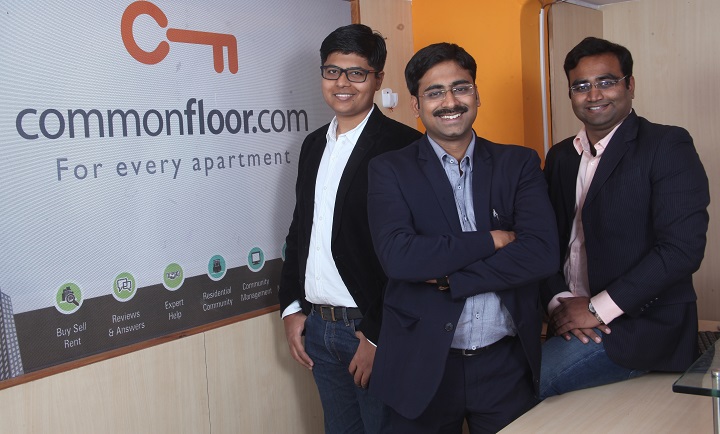
(From left:) Lalit Mangal, Sumit Jain, and Vikas Malpani, founders of CommonFloor
A platform for high net-worth people
The portal evolved quickly as new uses emerged, from lists of vendors to property management and society accounts. For example, a security agency’s service could now be rated easily, and also shared with other apartment complexes. This became an incentive to provide better services for everyone – from chauffeurs and grocers to landscape designers and water suppliers.
One day a businessman living in one of the complexes asked if he could put up an ad on the network to sell trinkets he sourced from his native Rajasthan. This opened the first significant monetization avenue for CommonFloor because suddenly there was a realization that it was a platform for high net worth people to whom businesses would want to make offers. “For starters, it took care of our server charges,” says Jain.
By then, VCs had grown interested too: “We got three emails from different VCs in one day,” recalls Jain with satisfaction, proud of the fact that their startup was sought out by VCs rather than the other way round.
They settled for seed funding from Accel Partners, who advised the young CommonFloor founders to focus on building the product and not get sidetracked by money-making opportunities.
It wasn’t until 2009 that they started noticing a number of people putting up queries about properties available for rent or sale. The penny dropped. The next year CommonFloor started listing properties with the consent of owners who were happy to do this on such a relevant community-based portal rather than going to multiple brokers or general purpose public advertising outlets.
Soon it became a full-fledged real estate portal connecting property seekers, owners, dealers, and builders. What makes it different from every other portal is a network of more than 100,000 apartment complexes in 120 towns and cities across the country that use CommonFloor for community-based activities.
Its roots go down to a reading community





Stay updated on the go with our mobile app.
Get latest insights with smoother, more personalized experience through TIA mobile app.