- Insights This article was written by a TIA community member. Insights pieces undergo the same rigorous editorial process that newsroom-produced articles have.
 Jason Acidre · · 6 min read
6 lessons we learned reviving our nearly bankrupt startup
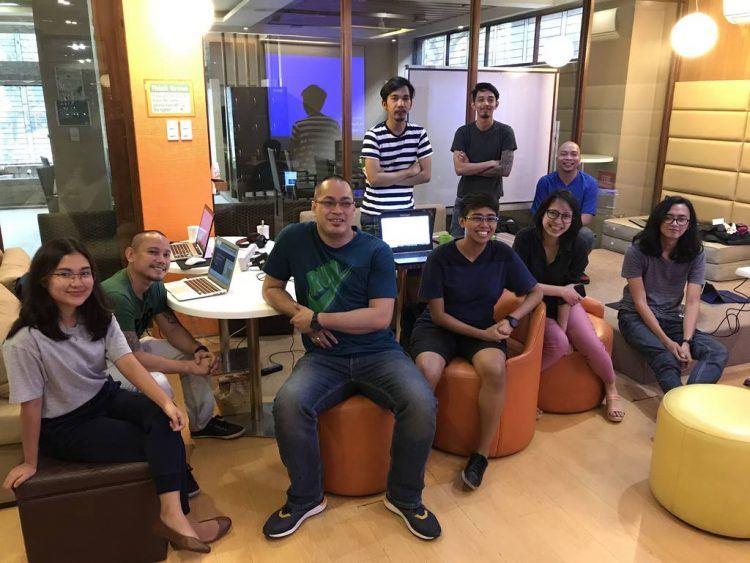
Our team at Avaris (formerly Xight Interactive)
Our company, Xight Interactive, was founded in 2011. It was an end-to-end digital marketing agency, providing services to small and medium businesses, startups, and enterprise-level brands in the US, Canada, the UK, and Australia.
The first two years were very profitable, given that the initial capital my co-founder JP Prieto and I shelled out was only about US$4,000 (or P200,000). We reached ROI after just a few months of operating.
But in 2015, the company reached its breaking point. Here’s what happened:
- We downsized the workforce from nearly 40 people to 15.
- We lost over 80 percent of the contracts we were handling for the year.
- Every aspect of the business was just stressful, and it took a toll on everyone. People had been doing almost the same thing every day for four years straight.
- In the last quarter of 2014, we weren’t able to pay two months’ worth of salaries and had to take personal loans to cover the compensation. Luckily, our team stuck with us through these trying times, even though we were seriously considering giving up (some of our advisors even suggested that we shut shop).
Here’s a general timeline of how the company performed through the years in terms of cash flow and stress level:
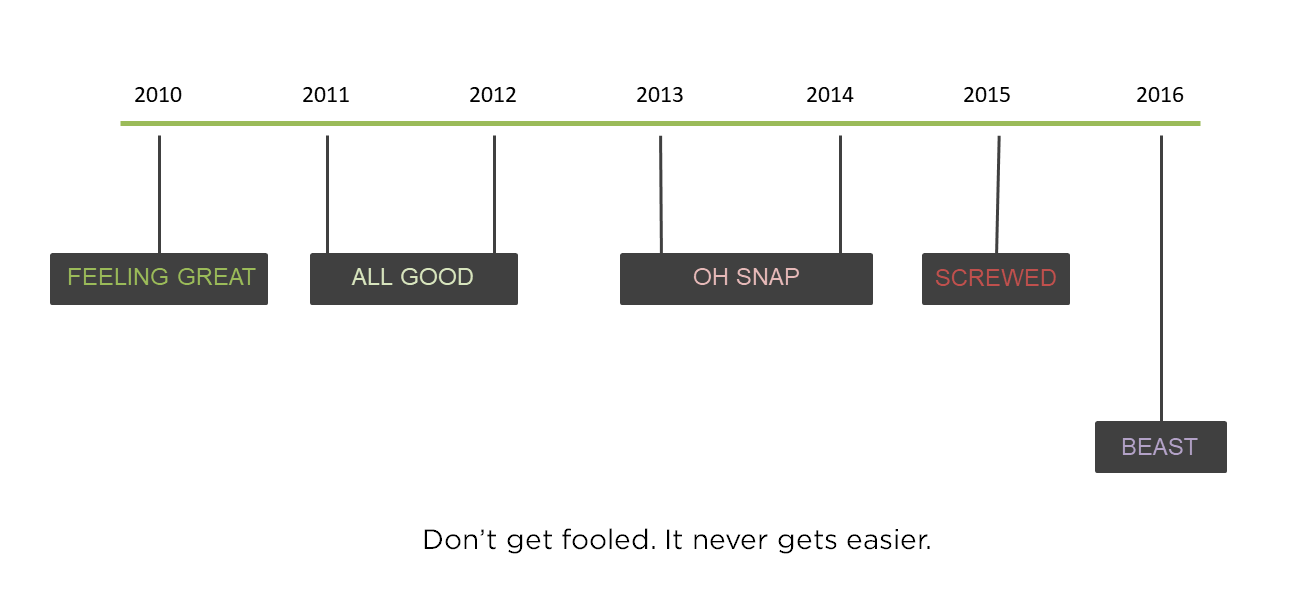
Don’t get fooled; we struggled a lot in the early stages. The key challenges and major pain points that we failed to address in the company’s first four years were:
- In a service-oriented business model, onboarding too many clients means serving too many bosses.
- We were providing several types of services which were not really part of our expertise.
- We looked at scalability the wrong way. In a service-based or consulting business model, your product is your time, people, and process. The more time you spend with your clients, the more money comes in. The more talented people you have, the more you can provide better services. And having the right processes in place should help make everything nearly automated. We only focused on the latter, but it was the wrong move.
- We were winning at client acquisition but failing at client retention. Juggling too many clients will only lead to low-quality output, especially if you don’t have the right talent to work on all the projects in hand.
- The company’s culture wasn’t controlled well, so it eventually became similar to a typical Filipino family’s culture. We all stuck together no matter what, and our foundation was loyalty to one another. The biggest downside of this was that it bred tolerance to bad working habits, and that severely made an impact on everyone’s productivity.
In the third quarter of 2015, we decided to have a massive reset, bet on ourselves for one last time, and bootstrap our way out of this vicious cycle. Our first major step was to move to a new office (in a co-working space) and keep one client that was paying us US$3,000 per month (enough to pay seven people, including both founders).
It was a fresh start, where we could bring along the debt, experience, and a newfound grit to take us forward.
6 lessons we learned
1. Targeted marketing gives you the power to charge higher fees
We’ve never had a sales team ever since we started. Around 70 percent of our prospective clients find us through my blog, Kaiser the Sage, where I mostly publish our case studies. The remaining 30 percent come in through referrals. We also invest a lot in developing our own web properties (e.g. Grit) to show our approach to digital marketing.





Stay updated on the go with our mobile app.
Get latest insights with smoother, more personalized experience through TIA mobile app.