Adinda Pryanka · · 3 min read
This startup bypasses ASML to slash chip iteration times
This article is a part of Startup Spotlight, a series that features young, up-and-coming startups.
This article is brought to you in collaboration with the Slingshot deep tech startup competition, held at the Singapore Week of Technology and Innovation.

Jonathan Traudt (left) and Imad Agha (right)/ Photo credit: Jonathan Traudt and Imad Agha
AI startups face a massive bottleneck when turning chip designs into actual silicon. Imad Agha, a photonics professor, partnered with physicist Johnathan Traudt to build a new lithography system. They launched Nabu Optical Systems to make chip prototyping affordable.
😟 Problem
Lithography mask sets cost between US$100,000 and US$1 million, with lead times of up to nine months. This locks edge AI startups and university researchers out of rapid chip iteration.
Incumbent ASML dominates 90% of the market with equipment costing over US$12 million. Export restrictions and sovereignty initiatives further limit access to manufacturing.
💡 Solution
Nabu Optical Systems replaces mask-based lithography with a direct-write system. Its features include:
- The ANU-1 tool uses a patent-pending photothermal resist to eliminate beam noise and edge bleeding.
- The integrated laser and lens stack achieves 180-nanometer resolution today with a lab-tested path to 50 nanometers.
- The maskless process reduces prototyping iteration costs to *near-zero* and cuts turnaround time from months to days.
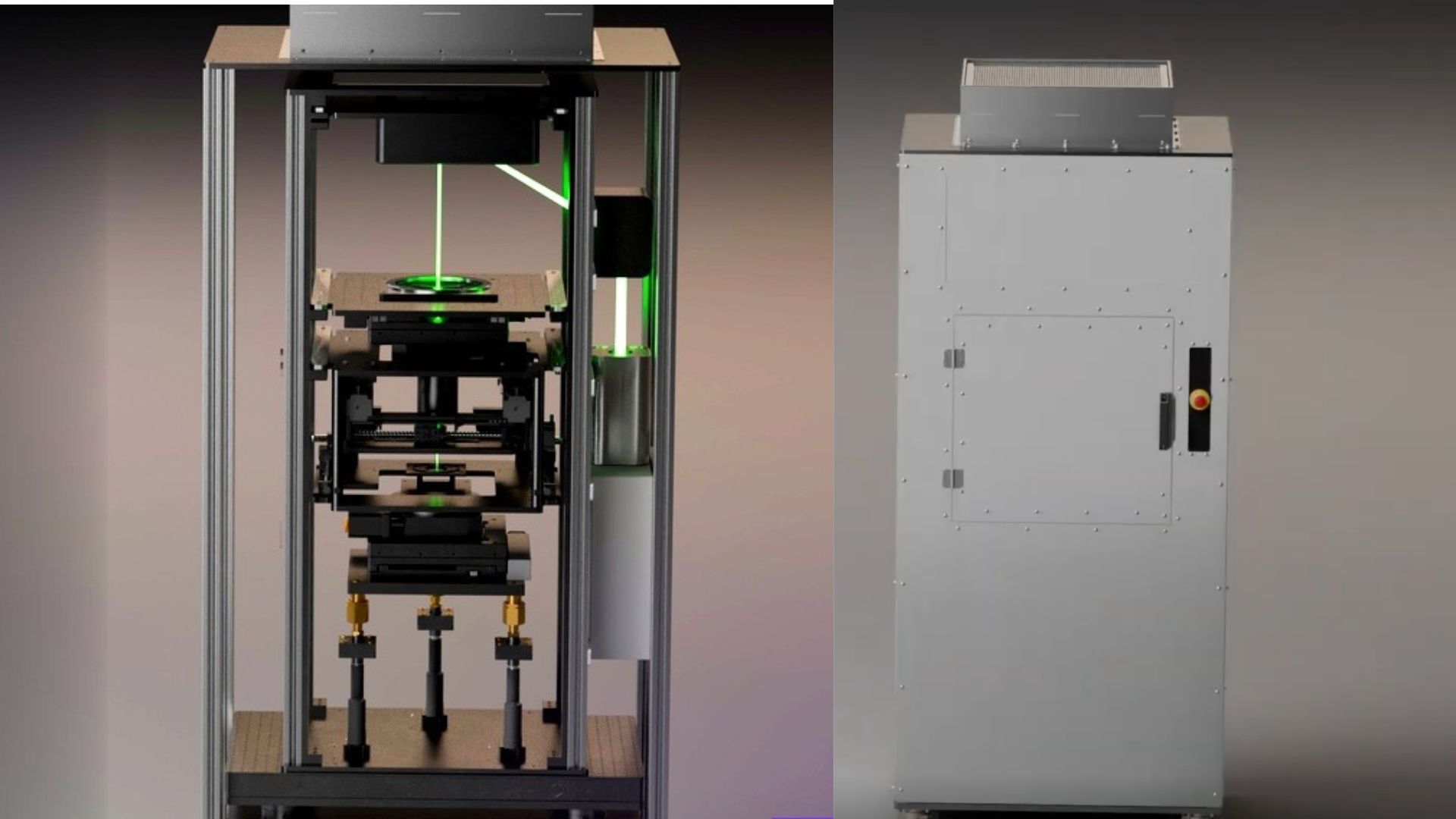
Image credit: Nabu Optical Systems
📊 Market size
The startup targets an initial entry market valued at US$470 million in 2026. This expands to US$2 billion in the industrial segment by 2027.
The total addressable market for affordable maskless prototyping is projected to reach US$11 billion by 2029.
🤝 Team
- Imad Agha. Co-founder and CEO. He is a photonics professor with over a decade of experience in laser-material interactions.
- Johnathan Traudt. Co-founder and CTO. He is a physicist who built the initial ANU-1 hardware.
🚀 Traction
- Completed the first ANU-1 tool by April 2026.
- Booked two tools for 2027 delivery.
- Partnered with Ohio State University, A*STAR, and CSEM to validate the technology across academic and manufacturing uses.
- Achieved a processing speed of 10 wafers per hour.
🏆 Competition
💰 Financials
🚩 Risks









📅 Upcoming Events
30-31 March 2027
Upskill Fest