
Summary:
- Sumsub’s WTF Summit brought together over 500 global leaders from tech, fintech, crypto, and regulatory sectors to develop actionable anti-fraud strategies and enhance digital trust across Asia Pacific.
- Experts emphasized the importance of connected data, AI-driven behavioral analysis, and cross-industry collaboration to effectively combat increasingly organized fraud networks.
- The event also gave way to two major announcements: Sumsub’s research partnership with NTU on anti-deepfake watermarking and the integration of the firm’s Non-Doc Verification solution with Singpass for faster, safer document-free verification.
- Get the lowdown on the latest fraud trends in Sumsub’s Identity Fraud Report 2025-2026.
Riding the escalator to Andaz Singapore’s conference floor, I wasn’t sure what to expect.
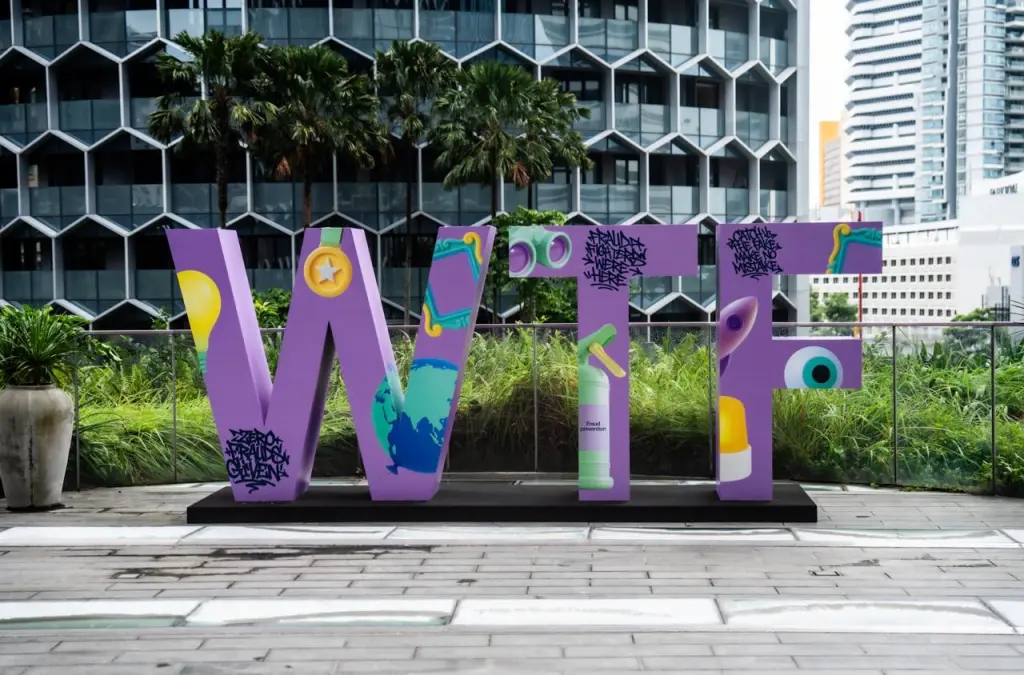
Typically, industry events in the city-state take place in grandiose venues like Marina Bay Sands or the Singapore Expo. However, Sumsub’s What the Fraud (WTF) Summit was held right at the heart of the Bugis area. This puzzled me at first, but as soon as I reached the top of the escalator, I saw why.

That’s a big WTF. / Photo credit: Sumsub
Much like the counter-culture history of the Bugis neighborhood, Sumsub’s WTF Summit felt like a far cry from the “standard” industry conference. It was loud, didn’t take itself too seriously, and most importantly, was unapologetic about the vibe it was giving.
Arriving at the registration area, I immediately noticed a sea of bright yellows and blues, an almost ceiling-height mirror to lean into the idea of liveness detection in fraud prevention, and someone dressed in a Gorilla suit called “The Beast” – representing malicious fraudsters – roaming around.

I’m not sure if The Beast can read, to be honest. / Photo credit: Sumsub
All this set the stage as I embarked on a full day of sessions helmed by leading fraud experts.
Establishing an anti-fraud strategy
One highlight of the morning was a session titled “Cyber-fraud Fusion – The Future of Online Fraud Detection.”
It featured Amaresh Mohan, chief risk officer at Flutterwave; Simon Liu, chief data and AI officer at TrustDecision and adjunct associate professor at Nanyang Technological University (NTU); Juon Qiang Yin, head of group investigations and fraud advisory at DBS Bank; and Karthik Ramanathan, senior VP of network services for Asia Pacific at Mastercard. Pasi Koistinen, chief information security officer at Coinhako, moderated the discussion.
I settled in the conference hall to listen as the panellists opened the session with a discussion on the tech and capabilities businesses need to combat fraudsters. Liu, in particular, kicked off with a compelling statement.
“If you don’t have connected data, there’s really a lot of things you cannot do,” he said.
I learned that many large financial institutions and even corporations are employing a technique known as entity resolution. It works by unifying disparate streams of customer data – like emails, behavioral patterns, and IP addresses – into a single source of truth.
One might wonder: How does AI, the current darling of tech, play into the fight against fraud?
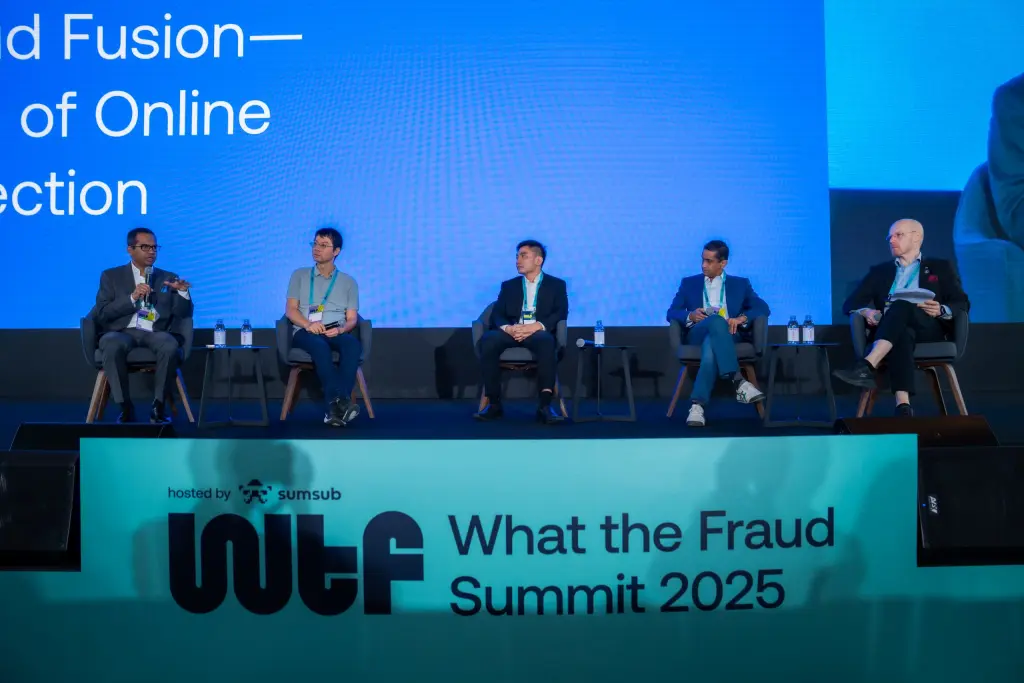
Photo credit: Sumsub
According to TrustDecision’s Liu, one key area is in sequential modelling, or the use of AI to analyze legitimate users’ interactions from start to finish. Taking a closer look at how they typically log in, browse pages, and check out or log out makes it easier to spot fraudsters who might be behaving differently.
Bridging the data divide
DBS Bank’s Yin noted that even if organizations have the right ideas, one main hurdle remains: The different arms in a scam operation – including contacting victims, facilitating transactions, and funneling proceeds – may come under one umbrella, yet many firms still struggle because they’re in different markets or industries.
“To match the level of vertical integration in scam syndicates, we need enough industries across international borders to come together to address every part of the scam chain and life cycle,” he said.
Yin then discussed the need for safe harbors for data sharing or consortiums to empower organizations that are willing to work together and put in the effort.
However, he clarified that industry representation alone isn’t enough. After all, fighting fraudsters requires the participation and accountability of entire industries, like in the case of banks checking suspicious transactions made by consumers.
Each industry needs to step up. In some instances, regulators may need to assign liabilities to each sector, motivating them to contribute so the entire consumer ecosystem can have end-to-end fraud surveillance, detection, and mitigation.
Meanwhile, Flutterwave’s Mohan said he hopes governments and operators who exchange signals – from telcos to financial services – will be more engaged in the fight against fraud.
Mastercard’s Ramanathan agreed, saying, “No one single entity makes the rules, but we need all the different players to agree on shared responsibilities.”
Fighting fraud autonomously
In the afternoon, I attended a session titled “On the Path to Anti-Fraud Superintelligence.” It was presented by Pavel Goldman-Kalaydin, head of artificial intelligence at Sumsub.
This session made a bold prediction of what the anti-fraud fight could look like in the future. According to the presenter, staying ahead of fraudsters basically involves anticipating what they would do next.
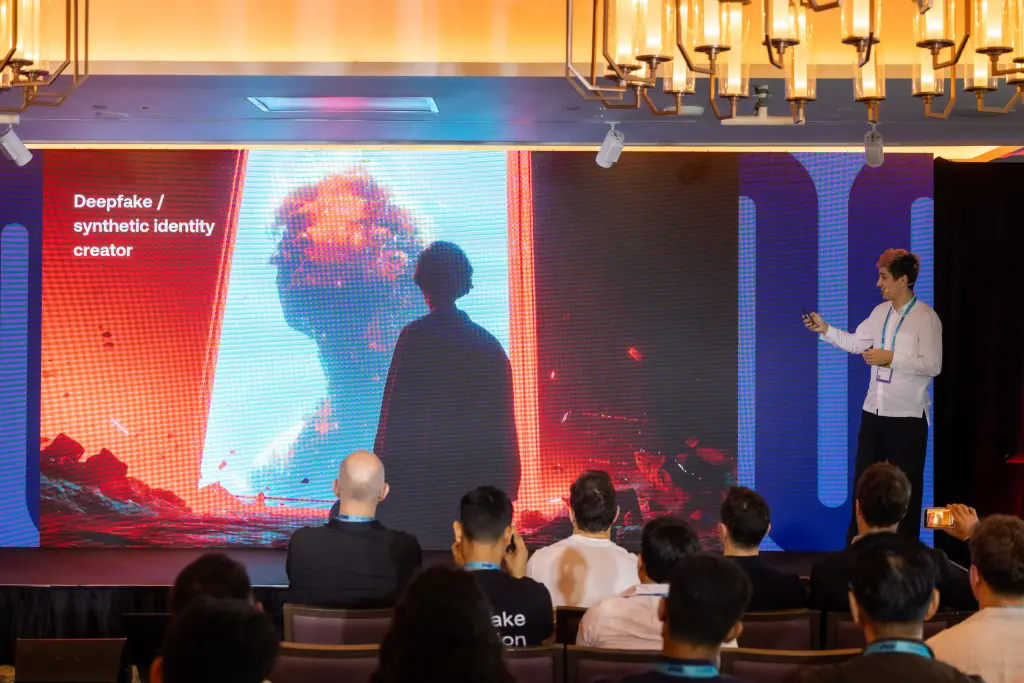
We’re talking about superintelligence vs superintelligence. / Photo credit: Sumsub
The issue, I learned, stems from the advancement of agentic AI, particularly its ability not only to automate processes but also to respond to feedback. This allows fraudsters to adjust their angles of attack very quickly until they find one that can successfully circumvent the anti-fraud measures in place.
In fact, just a couple of days before the summit, Anthropic released a report detailing the first “purely autonomous cyber security attack” based on its infrastructure. Goldman-Kalaydin called this whole movement “fraud superintelligence.”
Avoid getting blindsided. Read about the latest fraud trends in Sumsub’s Identity Fraud Report 2025-2026
He then proposed a thought framework that can be used to fight these fraudsters – something that goes beyond “tasks that humans can do” and “human tasks that can be automated” and brings us to “new tasks that humans can do with the help of machines.”
“The real progress is to build things that we [currently] know nothing about yet,” Goldman-Kalaydin said.
When it comes to preventing fraud, he predicted that detecting never-before-seen schemes might be possible in the future, on top of the tried and tested method of tracing an attack’s path to find out the vulnerabilities the fraudsters took advantage of.
“You have to build systems that will automatically perform ‘scientific research’ that can then build detection capabilities for fraud that hasn’t been seen before,” Goldman-Kalaydin explained. “This is the only way for us to move from fraud superintelligence to anti-fraud superintelligence.”
Shaping the future of fraud prevention
Besides hosting engaging sessions, Sumsub also made two major announcements at the WTF Summit.
The first one was about the company’s collaboration agreement with NTU to jointly advance research on watermarking personal images as a new defense tactic against deepfake fraud.
Inspired by a tool called Glaze, the idea is to create watermarks that are imperceptible to the human eye and implement them in people’s online photos. This way, fraudsters can’t use genAI to take those photos and impersonate their human subjects with deepfakes.
The second announcement was on the integration of Sumsub’s Non-Doc Identity Verification solution with Singpass, Singapore’s national digital identity platform. This would enable companies that use Sumsub’s solution to tap into Singpass, allowing their users to verify their identities through the platform without the need for any physical documents.
According to Sumsub, this would reduce average verification times from 30 seconds to 4.5 seconds while ensuring that businesses stay compliant with local regulations.
Hopefully this is how most would-be fraudsters feel. / Photo credit: Sumsub
Indeed, learning about these developments gave me more confidence and insight into how consumers like myself can be protected from malicious actors.
That, coupled with hearing about all the steps all those organizations are taking, left me with a single thought as I headed out after the conference: It sounds like it’d suck to be a fraudster.
Sumsub is at the forefront of helping businesses navigate the dual challenge of sophisticated fraud and digital exclusion with its full-cycle verification platform.
Get the lowdown on the latest fraud trends in Sumsub’s Identity Fraud Report 2025-2026.
This content was produced by Tech in Asia Studios, which connects brands with Asia’s tech community. Learn more about partnering with Tech in Asia Studios.
Stay updated on the go with our mobile app.
Get latest insights with smoother, more personalized experience through TIA mobile app.
Recommended reads
 SG minister highlights AI adoption pitfalls in SEA
 Anthropic CEO sees AI fuel growth, not employment
 ‘Not how humans act’: how agentic AI is changing cyberattacks
 ASEAN gets a tailored risk tracking tool
 This startup’s AI refuses to answer legal questions without proof
 A Mythos quest? SEA fighting AI threats with obsolete security
 India tech titans caught snoozing by AI
 The digital conscience proposed by Anthropic CEO
 Killing ‘zombie’ projects: PH bets big on offshore wind
 This system is tackling Indonesia’s $422m payment fraud





Editing by Winston Zhang and Mina Deocareza
(And yes, we’re serious about ethics and transparency. More information here.)




📅 Upcoming Events
22 October 2026
Payoneer x CSPN Summit 2026