 Stefanie Yeo · · 6 min read
This startup aims to change up coding education. I gave its platform a go

We live in a world where almost everything is driven by code. Everywhere I look – from the traffic lights on the street to the apps on my phone – I see something powered by code. It’s safe to say we wouldn’t have gotten this far without it.
Having coding knowledge is an essential skill in our increasingly digital world. And as companies embark on digital transformation journeys, employees need to upskill and learn how to navigate this unfamiliar world.
While picking up coding may teach us new skills, such as learning a new programming language, it also gives us the right mindset around digitalization – something that will be increasingly important as AI takes the world by storm.
“If [companies] don’t provide anything like digital training, there’s no way they can hire computer engineers because the culture is not there,” shares Jae Won Kim, CEO of South Korean AI-powered coding edtech platform Elice. “You need to adapt these learnings in order to show that you’re working on digital transformation.”

Jae Won Kim, CEO of Elice / Photo credit: Candice Lee for Tech in Asia
That’s where Elice comes into the picture. The firm aims to make it easier for organizations to teach computer science and digital literacy skills by providing the right infrastructure and resources.
How easy could it be? I decided to try it out for myself.
print (“Hello, world”)
I started off by logging into the Elice platform and enrolling in the firm’s Introduction to Python course.
After an introductory video and a brief explanation of how the platform worked, we embarked on the first class: basic data types in Python.
The class was broken up into several smaller segments, and each one followed a pretty standard format: a short video lecture introducing the key concept, a multiple-choice quiz, and then a hands-on segment to apply the concept.
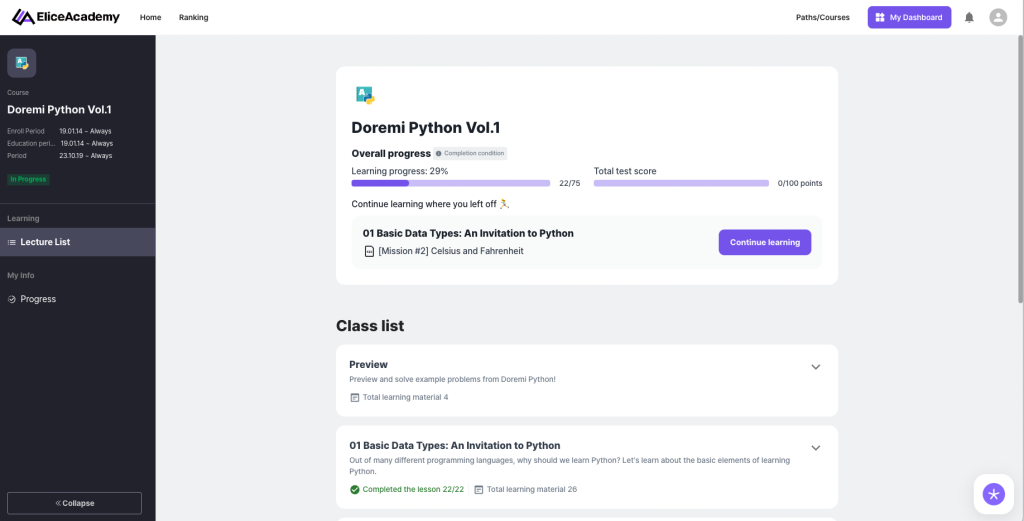
A look at Elice’s platform / Screenshot by: Stefanie Yeo
I also got immediate feedback on all my assessments, be it the quiz or the programming assignment.
“With any kind of education, you need feedback,” says Kim. “In order to get feedback promptly, you need automatic grading, which is what we did with Elice.”
What I found especially helpful was the platform’s built-in chatbot, which could analyze my code and point out specific errors that I had made. For example, in one assessment where I had to “steal” jewels from Tweedle-Dee and Tweedle-Dum, it noted that I had forgotten to assign a slice – which indicates what data I want to extract – to the appropriate variable, which was why my code didn’t work.
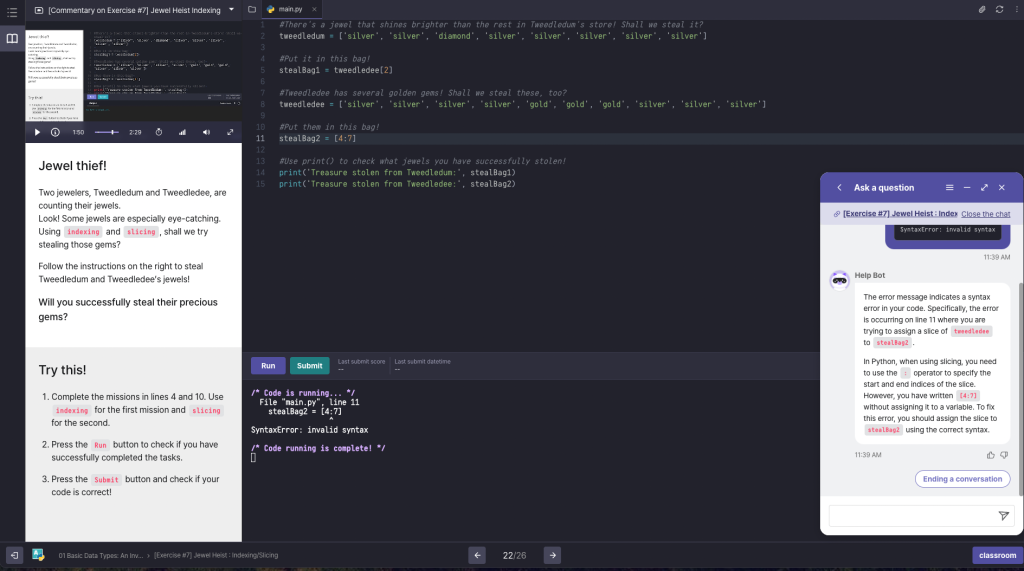
I struggled to steal the metaphorical jewels in this assignment / Screenshot by: Stefanie Yeo
In another assessment, where I had to write a formula to convert temperature from Celsius to Fahrenheit, it pointed out that I was missing a square bracket, helping me debug my code. It even noticed that I hadn’t followed instructions to name the variable “c” and had instead called it “C.”
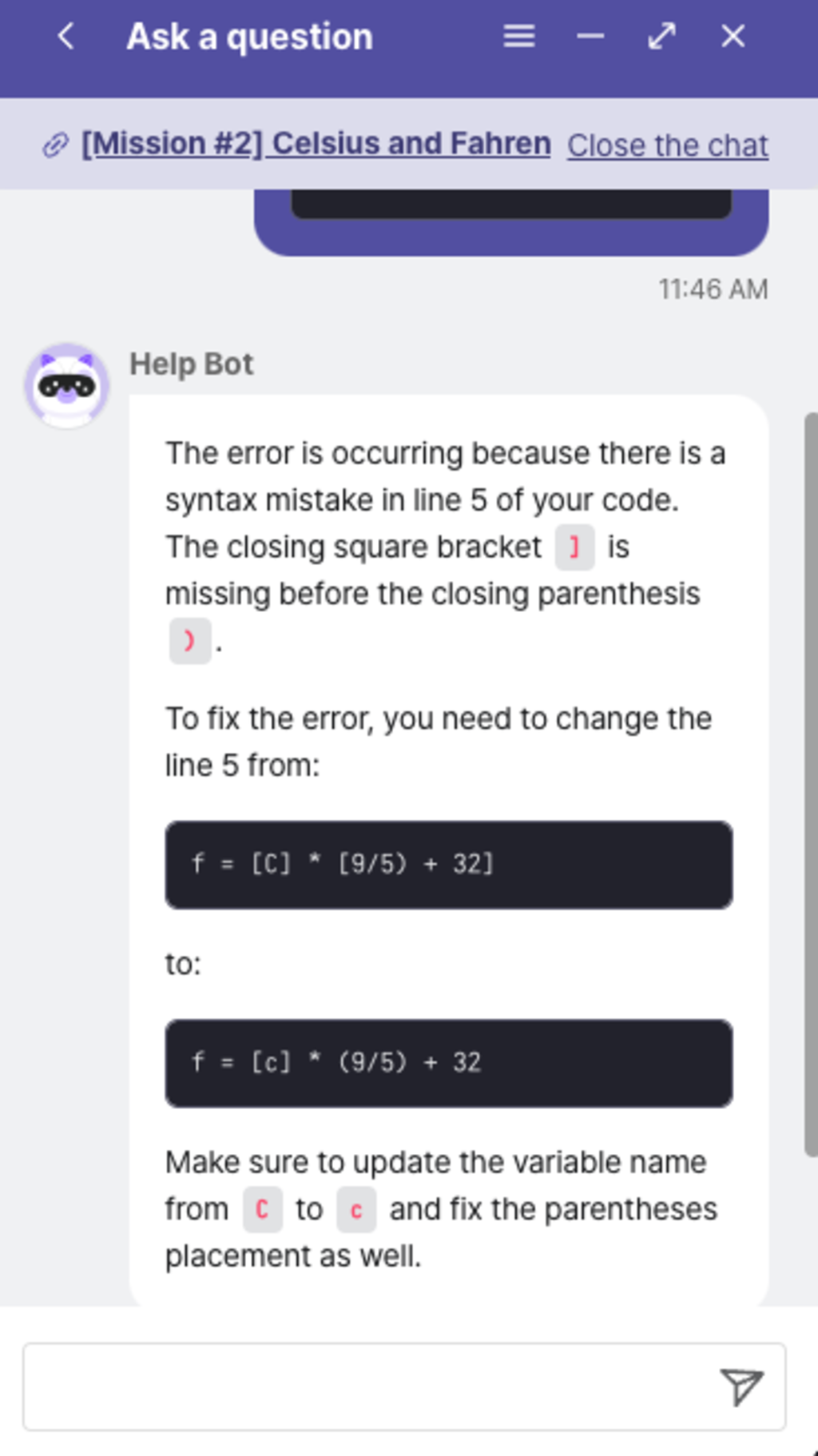
Who knew a bracket could cause so many problems? / Screenshot by: Stefanie Yeo
You can also ask the chatbot other kinds of questions, such as the objective of a particular assessment or to explain what the assignment is.
And all of this is powered by AI.
“We used to have a help center, where if students had questions [with the assignments], they could ask and the tutors online would help answer these questions,” explains Kim. “However, with the advent of large language models (LLMs), we’ve been able to train our LLM to answer our programming assignments in a very detailed manner.”
This helps Elice hit its “one minute” target, a goal the company set because it believes that students need to receive feedback within one minute to be motivated to make corrections and keep learning. Otherwise, if they’re stuck and unable to progress, they may lose interest in continuing on with the course.
While the AI handles the majority of the queries and corrections for students, there are still humans on hand to give more detailed explanations when the chatbot’s answers aren’t sufficient.
I concluded the class feeling quite satisfied at having understood the basic data types involved in Python.
You want it that way
Overall, using Elice to learn coding was a pretty great experience. It was easy to navigate, and I liked that the classes were broken up into smaller segments so that I could pause the course as and when I needed to. Being able to receive immediate feedback and guidance also helped me learn quicker.
The course I took was a “default” option on the platform, but lessons can be tweaked to meet different organizational needs.
You need to adapt these learnings in order to show that you’re working on digital transformation.
For example, a university could replace Elice’s in-house teaching materials with lectures from one of its professors. It can also use the firm’s test proctoring service, along with its automatic grading technology, to run programming exams. An events company aiming to upskill staff could swap out the scenarios used in the assessments for something more relevant to its needs, such as calculating manpower allocation.
“We aren’t focused on how to deliver the actual education,” shares Kim. “We provide the content and platform features, so instructors or leaders can use it to deliver this knowledge in the best possible way for their organization’s culture and needs.”
The firm also offers solutions around project-based learning. After employees learn the basics of coding, Elice supports companies in helping them apply their new knowledge to real-world situations and practical applications.
“A lot of the companies we work with want to do data analytics projects or other coding projects,” Kim adds. “We can provide an environment for this to help them collaborate and develop something new.”
Next up
Elice has seen success in South Korea, having worked with institutions such as the Korea Advanced Institute of Science and Technology, Seoul National University, and Yonsei University, as well as major Korean companies like SK Group, LG, and Hyundai.
Now, it has its sights set on expanding to Southeast Asia. With the region’s rapid digitalization – its digital economy grew to US$200 billion in 2022 – and its ongoing tech talent shortage, Kim thinks there’s significant opportunity for Elice to come in and help address these hurdles.
“Places like Grab or Sea, that’s where the engineers already are,” he shares. “We want to tackle the traditional industries, like finance, transportation, or agriculture, and help them address the tech gaps and see the opportunities for digital transformation.”
Ultimately, Elice wants to empower more people to learn about coding and hopes to drive a more digital future for Asia.
“We want to transform the classroom so that we deliver better digital learning,” Kim says. “That’s how we will have better talent and better products to compete on the global stage.”
Elice is an AI-powered, hands-on coding education platform in South Korea. It is helping to lead the digital transformation of the Korean government, large companies, and universities, and is looking to bring its solutions to Southeast Asia.
Find out how Elice can help power computer science in your organization on its website.
This content was produced by Tech in Asia Studios, which connects brands with Asia’s tech community. Learn more about partnering with Tech in Asia Studios.
Stay updated on the go with our mobile app.
Get latest insights with smoother, more personalized experience through TIA mobile app.
Recommended reads
 SEA financials tracker: Moladin’s revenue rises 6% in 2025
 Flipkart’s costly late push into quick commerce and food delivery
 Inside Singapore’s government team that kills its own products
 Once an IPO hopeful, SCI Ecommerce nears collapse
 Who’s betting big on ChatGPT ads? Not Asian brands
 VC tracker: Granite Asia launches US$50 million fund
 GCash trims IPO ambitions to meet market realities
 Igloo CEO eyes global M&A: ‘We have an appetite to grow more’
 Why SBI paid a premium for Ajaib amid a tough market
 OpenAI warns building for today will cause technical debt





Editing by Jonathan Chew and Jaclyn Tiu
(And yes, we’re serious about ethics and transparency. More information here.)



📅 Upcoming Events
22 October 2026
Payoneer x CSPN Summit 2026