 Nadine Freischlad · · 5 min read
Uber was catching up with rivals in Southeast Asia. Now the gap could be widening

Image uses photo from Pixabay.
Uber famously quit China in 2016, after selling its business unit there to incumbent Didi. Yesterday, it exited Russia after a deal with local ride-hailer Yandex.
As the company stares down controversies and competition at home and abroad, investors are reportedly making the case for Uber to cut deals with other local competitors, including in Southeast Asia.
Here, Grab and Go-Jek have diversified, moving from ride-hailing into payments and commerce, in an effort to capture more high-frequency transactions and revenue.
Uber hasn’t gone down that route. Additional services like UberEats food delivery have not been widely introduced in the region. While Grab and Go-Jek gained traction in their respective markets, Uber has trailed behind by most measures. It did make up ground in 2016, but the gap could now be widening again.
A swift Uber exit from Southeast Asia isn’t likely – Andrew Macdonald, the ride-hailing firm’s general manager for Latin America and Asia-Pacific just yesterday informed Tech in Asia about plans to enter a new country in the region, Cambodia. It just launched in Myanmar in May.
In the long run, it’s a possibility.
Here’s a look at Uber’s traction in Southeast Asia, compared to its local rivals.
Top ride-hailing app by MAU
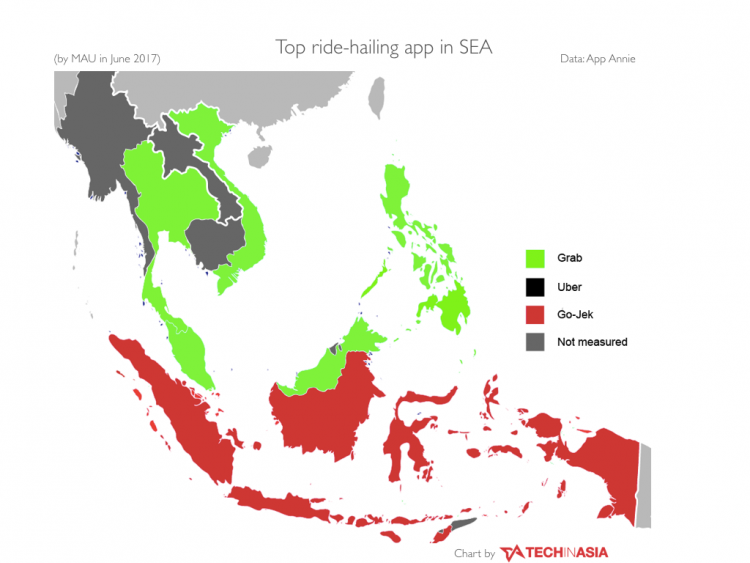
In a snapshot of monthly active users (MAU) in June, Grab takes the lead in most parts of Southeast Asia, except in the region’s biggest nation, Indonesia. Uber doesn’t win any country by its MAU count, according to new data from app measurement company App Annie.
Myanmar, Cambodia, Laos, and East Timor were not considered, as Uber is not available there or has just recently launched there.
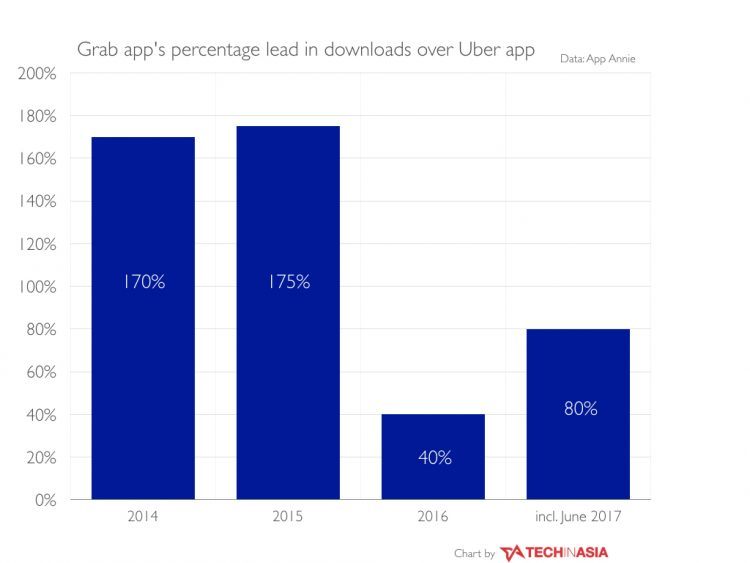
Grab leads Uber in app downloads
App rank
Play Store
App Store





Stay updated on the go with our mobile app.
Get latest insights with smoother, more personalized experience through TIA mobile app.









