Eva Xiao · · 7 min read
How blockchain in space aims to challenge the dominance of Google and Amazon in internet services

CubeSats deployed outside the International Space Station in May 2017. Photo credit: NASA.
From ecommerce to social networking to cloud computing, the lion’s share of internet services depends on a few, multibillion dollar corporates. Amazon, Facebook, Google, and others are emerging as the foundation of the internet industry.
For blockchain startups aspiring to create decentralized applications, this dominance poses a serious problem, believes Zheng Zuo, the 25-year-old CEO of Spacechain. Launched in April, the Singapore-based company wants to fire off its own satellites to create what Zheng thinks will become a truly decentralized ‘data distribution’ network.
“You can run a decentralized ecommerce platform, but in the backend, you’re using [Amazon Web Services],” he tells Tech in Asia during a trip to Beijing, adding that Facebook and Google are even laying down their own fiber optic cables. If blockchain companies reach a point where they threaten the profits of large players, it’s possible that they could shut down or be refused service.
“It’s their technology infrastructure,” he says. “After we all start depending on this centralized service, it’s hard to realize true decentralization.”
I think blockchain needs an alternative backup [system].
Until recently, the satellite industry was mostly limited to government entities, contractors, and major commercial players. One key reason is cost. Big, geostationary satellites that orbit at altitudes of more than 35,000 kilometers above Earth can cost hundreds of millions of dollars to manufacture, maintain, and launch.
The emergence of smaller satellites at lower orbits has helped changed that. In particular, CubeSats – petite satellites about the size of a tissue box – have significantly lowered the barrier to entry, although it’s still no minor undertaking to start your own space venture. Developed by Stanford University and California Polytechnic State University, CubeSats have made it possible for university students to build their own orbiters. ArduSat, an Arduino-based twist on CubeSats, is even bringing the technology to high schoolers.
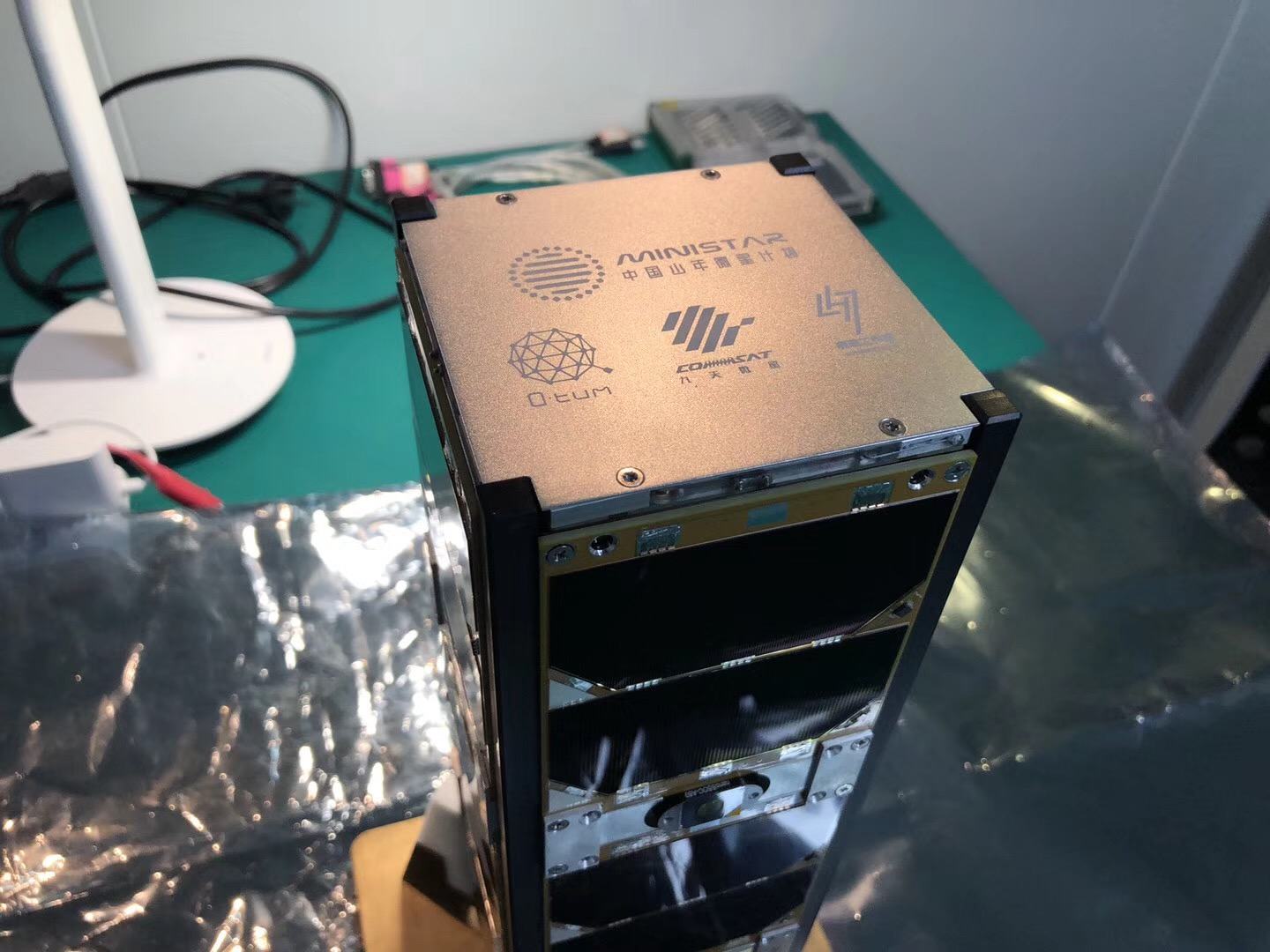
Spacechain’s satellite. Photo credit: Spacechain.
Startups are jumping into the aerospace industry as well. Both Elon Musk’s SpaceX and OneWeb are planning to launch their own constellation of low-orbit satellites to create a worldwide broadband network. Zheng thinks that space – the so-called final frontier – can play a role in the development of the blockchain industry.
“I think blockchain needs an alternative backup [system],” he explains. Spacechain plans to run a server on its own CubeSat, which developers will be able to use for their own software applications or data storage. “[Developers] can create backups for a lot of projects.”
“And it’s physically untouchable,” he adds with a grin.
Blockchain optional
If all goes as planned, Spacechain will launch its first CubeSat into space next February. The inaugural satellite will use the Qtum network, an Ethereum-like blockchain developed by one of Spacechain’s investors and partners, Qtum Foundation. The company’s CubeSat plans to run a Qtum node from space.
Science experiment





Stay updated on the go with our mobile app.
Get latest insights with smoother, more personalized experience through TIA mobile app.