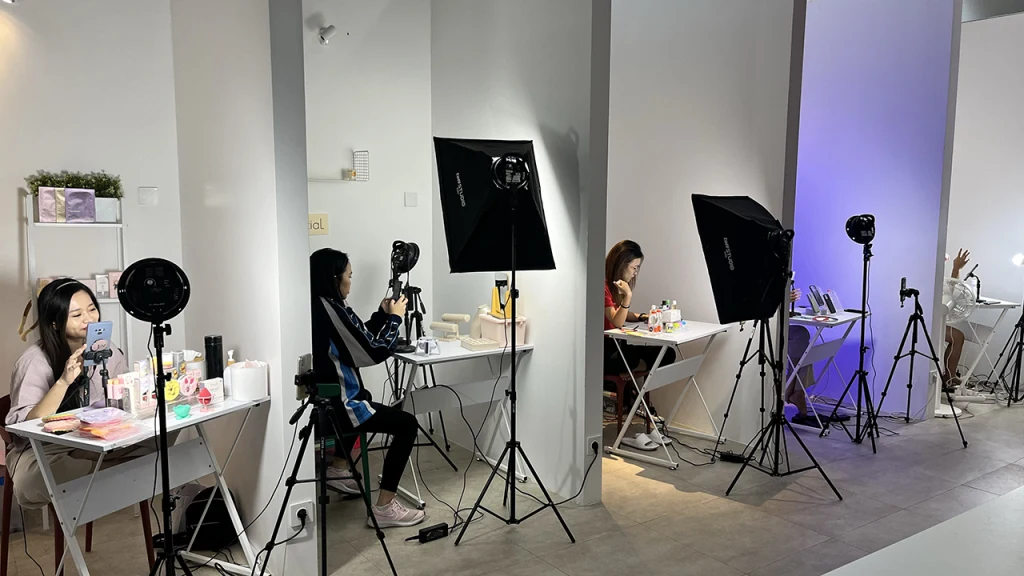
Live selling activity at Social Bread’s creator hub / Photo credit: Tech in Asia
Remember Barack Obama’s deepfake video that was posted five years ago? Well, we’ve come a long way since then – from deepfakes being created for revenge porn or political misinformation, to now a possibility of them affecting the income of livestreamers on apps like TikTok.
TikTok Shop’s presence in Southeast Asia has recently led to a live-commerce boom and livestreamers are making some serious cash. However, as time goes on, it’s possible these sellers might face challenges from genAI-based deepfakes.
To give an idea of how huge the creator economy has become in the region, there are “livestreaming factories” popping up in Indonesia. Content creators get the equipment and space they need to sell everything from beauty products to food and drinks on the app everyday.
A creator working for five hours a day, seven days a week, can make around US$650 on a monthly basis in Indonesia, which is much higher than the average monthly salary of US$197 in the country.
That said, this revenue might be affected in the near future as some Chinese firms have created a way to clone a human streamer for just US$1,000, according to a MIT Technology Review report. This genAI bot streamer can then be put to work 24/7.

Video of an AI streamer / Credit: MIT Technology Review
Silicon Intelligence is one such company in China that offers a basic AI streamer for a one-time cost of US$1,000, while the more advanced bots go for a couple thousand dollars.
With this tech, humans only need to enter the information about the product being sold and the AI streamer does the rest. The report also mentioned that more advanced AI streamers can even take care of answering live comments in real time.
There are many companies in Southeast Asia that are hiring creators on a contract basis to help them sell their products on TikTok Shop 24/7.
These firms could easily make the switch to AI streamers, resulting in reduced job opportunities for the human ones. In fact, China already is seeing a decline of 20% in earnings for these creators compared to last year.
Popular Chinese ecommerce platforms like Taobao and JD.com are already using these AI streamers during the post-midnight hours – a period that makes it harder for platforms to justify their spending on human streamers.
That said, there’s one thing AI streamers are struggling with: forming a real, genuine connection with fans like actual human creators do. Fans usually buy from creators they trust and follow.





Stay updated on the go with our mobile app.
Get latest insights with smoother, more personalized experience through TIA mobile app.