Kaya Domingo · · 6 min read
The “passport” that could be key to future overseas travel

Until this year, a return to work in January often entailed a lot of conversations about overseas trips taken during the holidays. But due to Covid-19, those have been replaced with talk about vaccination and speculations over when borders will finally open again.
Taking into consideration that different countries have had varying levels of success in their efforts to contain the pandemic, travel traffic might not return to pre-Covid-19 levels until 2023.
“The entire situation is about matching the risk levels of people and the risk appetites of countries,” says Quah Zheng Wei, CEO of document lifecycle management company Accredify, which aims to empower firms to create, issue, and verify digital credentials. “When those cannot be harmonized, travel restrictions are going to be stricter than what they’re supposed to be.”

Quah Zheng Wei, CEO of Accredify / Photo credit: Accredify
As things currently stand, a lack of harmonization is clearly prevalent, with 49 countries’ borders remaining completely closed.
Traveling in the safe lane
Aside from essential or business travel, flying overseas remains restricted. But bit by bit, countries such as Singapore are working on reopening their borders for leisure travel.
Tourism encompasses a prominent portion of Singapore’s service and economic sectors, contributing to 4% of the nation’s gross domestic product. In the last quarter of 2019 alone, 19.1 million international tourists visited the country. That means the longer borders stay closed, the larger the losses would be.
To revive the tourism sector, Singapore has taken steps to create Safe Travel Lanes, which lessens the hassle of Covid-19-induced travel restrictions.
The Reciprocal Green Lane, for instance, accommodates corporate professionals and diplomats looking to enter Singapore for work. This allows inbound travelers from approved countries to skip quarantine on arrival, provided they test negative for the virus before entering Singapore.
In September 2020, Singapore also welcomed its first leisure travelers to have arrived under the Air Travel Pass (ATP) Scheme at Changi Airport. The scheme allows visitors from low-risk countries to enter Singapore as long as they adhere to measures dictated by the government. Some of these include submitting to polymerase chain reaction (PCR) tests – used to detect the presence of the virus – upon arrival, staying within booked accommodations until tests come back negative, and attaining documents such as the ATP approval letter, health declaration forms, and visas.
The most anticipated of Singapore’s efforts was the Hong Kong-Singapore travel bubble, which was postponed after Hong Kong’s fourth wave hit and Covid-19 cases around the world continued to rise. Despite this stumble, it’s likely that more travel bubbles will be formed between more countries, especially as the Singapore government continues to explore options with other low-risk travel bubble partners.
What to expect when borders open
When the time comes for leisure travel to resume, vaccinations alone will not be enough for a smooth and complete reopening of borders, says Quah. He believes it will take a mix of vaccinations and continuous PCR tests over a long period of time before normalcy returns. Until then, PCR test results would likely remain a common prerequisite for future travelers, among other documents.
This is where Accredify’s Digital Health Passport (DHP) comes into play. A free-to-use mobile application, the DHP acts as a digital repository where travelers can store their digital PCR tests. Accredify issues digital PCR test results to travelers, which gets rid of the hassle of paper documentation since the contents of the documents are made accessible through individual QR codes.
The company had started off with digitizing physical discharge memos into a verifiable format, facilitating foreign workers’ re-entry into the workforce and their dormitories, eventually completing about 3.5 million verifications on a single-use case. Making the transition to Covid-19 test results was a natural next step.
When it comes to attaining PCR test results, Singaporeans can book an appointment via the DHP at any of Accredify’s partner clinics to take the test. During their appointment, they would need to indicate that they would be traveling. Through the Accredify system, the clinic will then issue a verifiable PCR test result, also known as HealthCerts, which is a Ministry of Health-mandated schema that Accredify helped to co-create alongside GovTech Singapore.
The test result would then go straight into the traveler’s DHP. A QR code would then be generated.
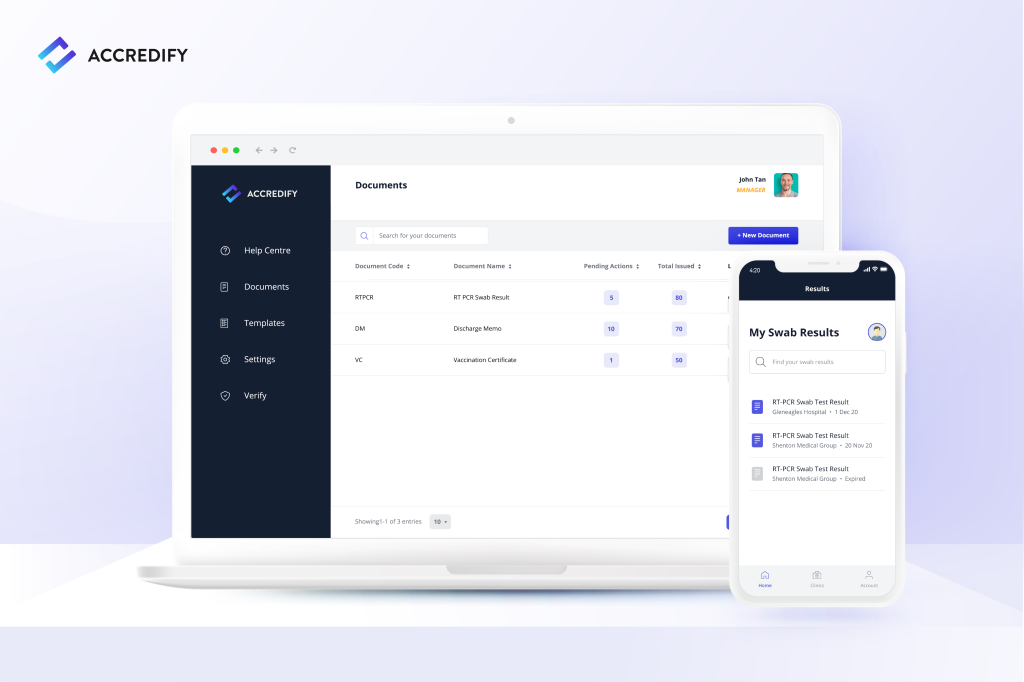
Photo credit: Accredify
There would then be two possible scenarios. The first would be where a traveler would scan a generic DHP QR code at immigration to view their PCR test results. While contactless, this process still involves a middleman, namely immigration officers and authorities.
The second involves integrating with Accredify’s system so processes can be carried out on the back end. From the traveler’s point of view, they would only need to scan their passport and indicate that they’ve successfully cleared their healthcare processes. The QR code would then be scanned by the Immigration and Checkpoints Authority (ICA) and relevant details can be verified by Accredify, thus allowing the traveler seamless passage.
Travel made possible through blockchain
While the DHP makes travelers’ journeys easier, its benefits for governments and corporations are varied. For one, its blockchain-based technology ensures that documents stored within the system are tamper-proof, safeguarding the authenticity of stored documents – particularly important with the issue of forged Covid-free certificates beginning to rear its head.
Organizations looking to work with Accredify can also be assured of privacy. Every medical record issued with Accredify is cryptographically signed and a unique fingerprint is generated from the medical record’s contents for storage. This fingerprint, also known as a hash, is an alphanumeric sequence of characters. This means that no personal or medical data is stored in Accredify’s system, making it impossible for any unauthorized third party to decipher or access an individual’s personal data.
Lastly, the blockchain acts as a decentralized ledger for storing medical records, which allows data to be shared among parties that are not directly connected. For instance, without the DHP, a Singaporean traveler may bring their locally issued PCR test results to Hong Kong. To confirm the document’s legitimacy, Hong Kong authorities would have to take the extra time to get in touch with the hospital that issued it in Singapore. With blockchain, these steps are minimized and the process of data sharing is made simpler for all parties.
“As a decentralized and permissionless wireless network, when [officers] incur the proof [of documentation] on the blockchain, it can’t be authenticated by just anybody,” says Quah. This protects both the healthcare provider and the individual: It reduces the need for cross-border data sharing, protecting healthcare providers from potential personal data breaches. Individuals, on the other hand, will be sure that no one but themselves can share the data.
Quah hopes that in the future, traveling would be free of manual health documentation checks. He envisions a fully digitalized process where even DHP QR codes would no longer be required.
“The end goal of the entire experience is that in Singapore, one would already have the DHP before traveling,” he muses. “Say I’m going to Hong Kong, and these are the documents I need to collect. Once I’ve collected them all, ICA would have already cleared me even before I step into Changi Airport.”
Development continues on the DHP. Accredify is currently developing a template for tamper-proof Covid-19 vaccination records, and its tamper-proof PCR swab results are now among those accepted by Singapore Airlines as part of its digital health verification process for travelers.
Looking further ahead, the firm intends to expand the scope of the DHP beyond travel. Within the next 12 months, Accredify aims to bring its document verification solutions into other verticals such as employment.
“Health overlaps with a lot of things,” says Quah. “At the end of the day, we will always be centered around the individual and their verifiable credentials.”
Accredify is an information technology and services company that supports organizations in their document lifecycle management and ensures that their documents are easily verifiable.
You can find out more about how Accredify’s Digital Health Passport works on the company’s website.
This content was produced by Tech in Asia Studios, which connects brands with Asia’s tech community. Learn more about partnering with Tech in Asia Studios.
Stay updated on the go with our mobile app.
Get latest insights with smoother, more personalized experience through TIA mobile app.
Recommended reads
 Is Dubai stealing Singapore’s thunder in crypto?
 SG’s crypto brain drain and India’s new digital rupee
 SG minister highlights AI adoption pitfalls in SEA
 Australia to roll out trial program for CBDC
 The Philippines pauses digital asset licenses for 3 years
 SG exchange gets nod from MAS to offer crypto services
 The digital conscience proposed by Anthropic CEO
 Indonesian regulator halts new crypto exchange registrations
 Binance seeks Japanese operating license
 Bank of Thailand partners with 2C2P, others to launch CBDC trial





Editing by Winston Zhang, Nathaniel Fetalvero, and September Grace Mahino
(And yes, we’re serious about ethics and transparency. More information here.)