Adinda Pryanka · · 3 min read
Solid-state cooling materials tackle data center heat loads
This article is a part of Startup Spotlight, a series that features young, up-and-coming startups.

Photo credit: Passive Edge Tech
Industrial facilities often discard ambient nighttime cold and off-peak power while sizing cooling equipment strictly for peak summer loads. Qian Huang launched Passive Edge Tech to capture this wasted thermal energy through dedicated materials engineering.
😟 Problem
Cooling infrastructure consumes around 40% of data center facility energy. AI server racks now generate over 100kW of heat, marking a tenfold increase over legacy rack densities. Existing liquid cooling systems struggle to absorb these intense load swings.
💡 Solution
The startup manufactures phase-change materials and solid-state thermal modules to store cooling capacity. Hardware and material products include the following functions:
- The material layer features a conductive solid-state material held in a 3D graphite network to prevent chemical leakage.
- System layer uses containerized cooling batteries that charge from ambient air, LNG cold energy, or low-tariff power, and hold energy with near-zero active power.
- Nano-encapsulated coolants integrate sub-200 nanometer phase-change materials directly into existing industrial coatings and polymers.
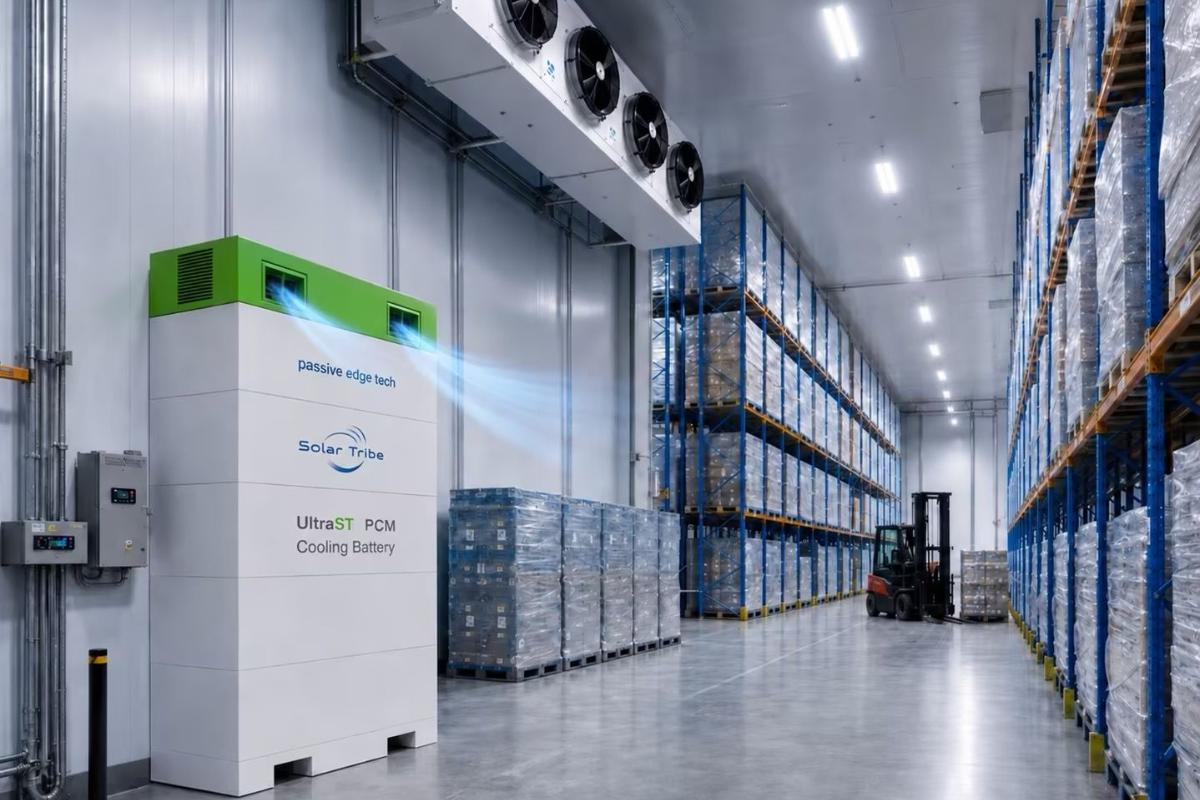
Photo credit: Passive Edge Tech
📊 Market size
Heat accounts for roughly 50% of global energy consumption and 41% of associated emissions. Global cooling demand is projected to triple by 2050 under current industry trajectories.
🤝 Team
Qian Huang. Founder and CEO. Holds a master’s degree from the University of Alabama at Birmingham and leads commercial strategy.
🚀 Traction
- Maintains an operational production capacity of 1,000 tonnes per year for pure phase-change materials.
- Deployed in over 1,000 edge compute nodes in China, achieving up to a 30% reduction in cooling energy.
- Achieved over 20% cooling cost reductions for a district cooling operator using LNG cold energy across Singapore and China.
- Provided over 16 hours of off-grid cooling with zero spoilage.
🏆 Competition
Traditional alternatives include chilled-water tanks, paraffin-based materials, and containerized liquid cooling vendors. The startup’s materials are three times more energy-dense than water and charge significantly faster. The company supplies upstream components directly to partner manufacturers.
💰 Financials
The company prices raw materials by weight and hardware modules by stored energy capacity. Clients typically progress from paid engineering reviews to pilot deployments. Management is currently raising a US$5 million pre-A round following an undisclosed angel investment.
🚩 Risks
- Passive Edge’s proof points span different operating contexts, which may signal flexibility but also raises the risk that each site needs bespoke engineering. Thermal storage deployment depends heavily on site infrastructure and integration economics, as a DOE-linked assessment notes.
- Passive Edge’s upstream role creates a value-capture risk. If partner manufacturers own the customer, certification, integration, and service layers, Passive Edge may be benchmarked on material cost or energy capacity. Research on OEM dominance shows how downstream integrators can retain power over suppliers even when suppliers provide important technical inputs.





Stay updated on the go with our mobile app.
Get latest insights with smoother, more personalized experience through TIA mobile app.