
Container ports are an essential part of international trade. From cars to laptops and everything in between, many of the things we use in our daily lives made their way to us by water, transported in a shipping container.
The scale of the shipping industry is staggering: about 90% of all consumer goods travel by ship, and in 2017, 1.83 billion tonnes of goods were shipped by container.
However, sustainability is a huge concern. The International Maritime Organization (IMO), which is responsible for regulating shipping activities, is making a concerted push toward making shipping more environmentally friendly, in line with the United Nations’ sustainable development goals.
Shipping as an industry accounts for 3% of global carbon emissions at present, and if changes aren’t made, that number is set to rise to anywhere between 50% and 250% by 2050.
Container ports, in particular, contribute a significant amount to the shipping industry’s carbon footprint. In 2011, shipping emissions from ports were responsible for 18 million tonnes of carbon dioxide emissions – equivalent to that of nearly four million passenger cars.
While shipping companies are taking steps to make their vessels and processes greener in the wake of new environmental regulations issued by IMO, countries are also working toward reducing the environmental impact of their ports.
One solution that some cities are implementing is the development of smart ports. Much like smart cities, smart ports make use of emerging technologies in order to work more efficiently and sustainably.
Reducing the carbon footprint
“Smart ports focus on two things: decarbonization and increasing operational efficiency,” explains Sylvie Ouziel, international president at Envision Digital, a global provider of AI-driven IoT technologies.

Sylvie Ouziel, international president at Envision Digital / Photo credit: Envision Digital
Decarbonization refers to reducing or eliminating the amount of carbon dioxide produced when generating power by tapping into renewable sources of energy.
Ports are an ecosystem unto themselves. They have complex anchorage and docking systems, as well as a network of forklifts, cranes, and other machinery required to transport containers within the port.
Ports also require a large amount of energy not just to run their operations but also to provide power to the rigs and ships that they host, making decarbonization especially important.
Many countries have begun embarking on smart, sustainable port projects. For instance, Qatar launched its sustainable mega port development in 2016, and in 2017, a Ship Emission Management System was rolled out in Johor, Malaysia to monitor carbon emissions from ships docked in its waters.
In Singapore, Envision Digital is working with PSA Singapore, one of the nation’s main port operators, to develop smart ports in the country.
Green power
These smart ports will make use of AI and IoT to help streamline its operations and reduce its carbon footprint in a bid to be more sustainable and efficient. Envision Digital refers to the combination of the two technologies as AIoT.
“When it comes to energy, AIoT can detect energy waste such as unnecessary lighting or inefficient machinery cooling systems, and adjust system parameters accordingly,” Ouziel explains.
What this means is that the system will essentially be “self-fixing” and can address any abnormalities or inefficiencies on its own, ensuring that power is used only where it is needed.
AI and IoT can also help drive the use of renewable energy in smart ports.
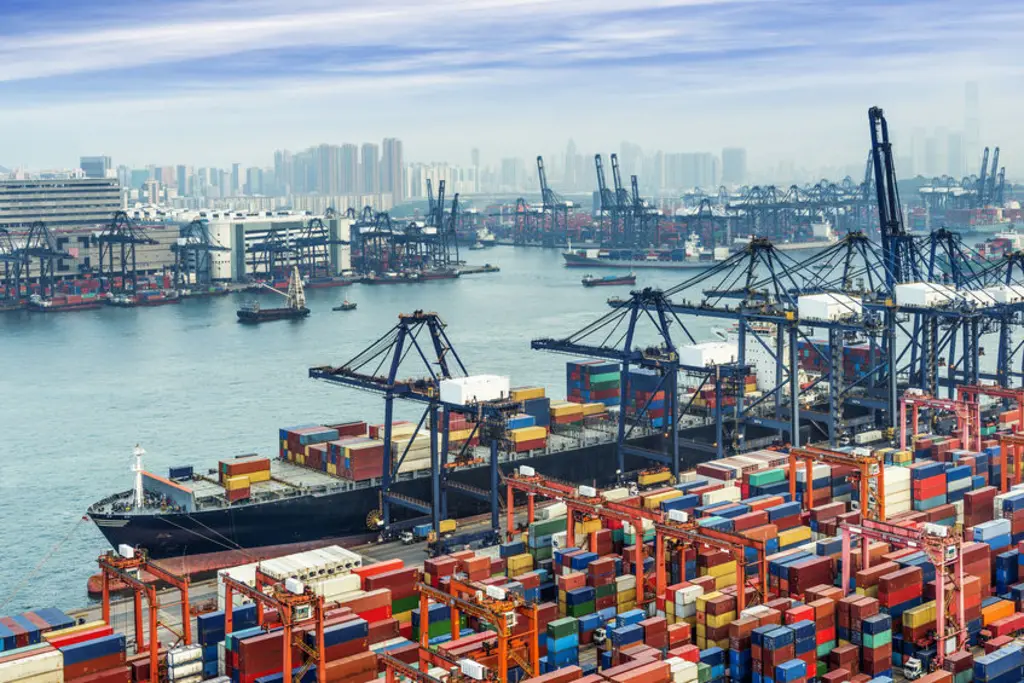
Photo credit: hxdyl / 123RF
“Some Asian ports are currently deploying solar panels and other green energy solutions,” Ouziel says. “AI can inform the system with high-resolution high-accuracy weather forecast in order to anticipate the demand and supply of intermittent electricity.”
Intermittent electricity refers to renewable sources of energy, such as solar or wind, which vary in their availability based on external conditions. By examining weather patterns, AI and IoT can determine how much electricity such renewable sources can generate, and help ports determine how much energy they would need from different sources.
These systems can also help optimize electricity consumption. For example, if the solar panels generate more electricity than is needed on a sunny day, the excess can be stored for use at night.
AI and IoT also have an important role to play in optimizing the different machines used in container handling at ports.
“Cranes, forklifts, and other machines can exchange information in real time regarding their location and status so that the most suitable equipment is deployed with the least cost and energy consumption,” Ouziel explains.
The use of such technology is more efficient than centralized planning, as it allows multiple machines belonging to different operators to exchange information while on the move. This helps cut down the port’s carbon emissions while ensuring that vehicles are deployed effectively.
These smart ports will also make use of remote cranes and automated guided vehicles powered by similar AI and IoT technologies in its operations to reduce manpower and increase operational efficiency.
Beyond sustainability and efficiency, AIoT can also improve port safety.
“AI enables the use of real-time image analysis to detect dangerous situations, such as the removal of a safety barrier, and can be complemented with other kinds of IoT devices such as sensors,” says Ouziel.
Smart ports: an inevitability
The use of AIoT in smart ports will go a long way in reducing their environmental impact. Ouziel estimates that through smart consumption, renewable energy, and more efficient processes, ports can reduce their carbon footprint by 20%.
As container shipping is set to continue to grow and remain a key part of trade for the foreseeable future, building sustainable smart ports is the way forward.
While there are many difficulties in making shipping sustainable, such as the high capital investments required for smart ports and the training required to use new technologies, Ouziel is confident that cities will be able to rise to the challenge.
“When it comes to the question of whether ports can be fully sustainable, it’s a matter of when, not if.”
Envision Digital is a global AIoT technology leader headquartered in Singapore. It aims to help enable energy transition and digital transformation across multiple industries around the world.
Find out more about Envision Digital on its website.
Stay updated on the go with our mobile app.
Get latest insights with smoother, more personalized experience through TIA mobile app.
Recommended reads
 ‘Not how humans act’: how agentic AI is changing cyberattacks
 ‘Good morning, Dave’: The new world of physical AI in daily life
 Southeast Asia pulls ahead of global average on AI adoption
 How AI agents will be the new software buyers
 Robots still struggle with touch. Sharpa wants to fix that
 Investors pour in as quantum threat nears reality
 Nvidia CEO urges rethink of corporate structure
 TiDB is engineering the infrastructure for AI’s agentic future
 Why ‘vibe PMing’ is the future of product management
 A solo founder’s fix for unreliable generative AI models





Editing by Nathaniel Fetalvero and September Grace Mahino
(And yes, we’re serious about ethics and transparency. More information here.)







📅 Upcoming Events
22 October 2026
Payoneer x CSPN Summit 2026