Malavika Velayanikal · · 5 min read
Snapdeal acquires FreeCharge: here’s everything you need to know about India’s biggest acquisition
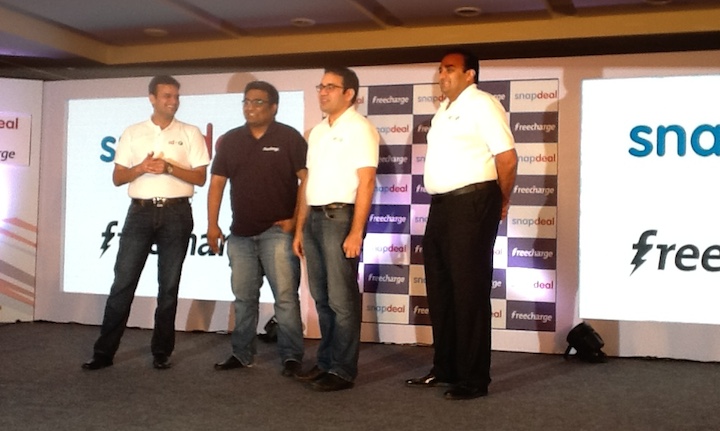
Rohit Bansal, Kunal Shah, Kunal Bahl and Sandeep Tandon – co-founders of Snapdeal and FreeCharge
Between ecommerce marketplace Snapdeal and mobile top-up site FreeCharge, there are 40 million mobile transactors. And their apps have been downloaded by 30 million users across India. Kunal Bahl, co-founder of Snapdeal, hopes to add another zero at the tail of both those numbers in three to four years.
These are the numbers he gave out at a press conference in Bangalore today to announce possibly the biggest acquisition in the digital history of India. The number that he did not disclose was how much Snapdeal paid for FreeCharge, one of India’s hottest mobile startups which raised US$80 million just two months ago. All that Bahl would say is that the majority of the deal was in stocks.
“That the FreeCharge shareholders and investors chose to take stocks and continue in the company shows they like the partnership,” Bahl said.
The other Kunal in this deal – Kunal Shah, co-founder of FreeCharge, who was sitting next to Bahl – seconded this. “This will have a multiplicative effect on our growth. The partnership was more important to us than just raising money.”
A new digital commerce ecosystem
Both the Kunals shared their thoughts on how this would cross-pollinate their sites to build something larger: a digital commerce ecosystem. For example, FreeCharge today crossed 10 million downloads on Google Play. It handles hundreds of thousands of transactions per day. Most of its users have put their credit or debit cards into FreeCharge. Soon they will all be able to go to Snapdeal and buy products there too.
Bahl also pointed out that the bulk of the users on FreeCharge are youngsters aged 18 to 25, whereas those on Snapdeal are in the 25-35 age bracket. To him, FreeCharge represents the gateway for early adopters of digital commerce. Recent data from Visa shows that 60 percent of all card activity begins as a phone credit top-up.
Snapdeal wants to facilitate the transition of this large, young user base on FreeCharge whenever they graduate to transactions other than top-ups.
The deal is just as sweet for FreeCharge. Shah pointed out, for instance, that more than two-thirds of its current users are urban, whereas Snapdeal has a large user base in tier-two cities. So there are huge untapped markets for both companies which become more accessible to each other when they work in tandem.
Alok Goel, who took over from Shah as CEO of FreeCharge when he moved from bus ticketing service RedBus, has been entrusted with overseeing the various ways in which Snapdeal and FreeCharge can leverage their synergies.
As a business, FreeCharge is now a subsidiary of Snapdeal. But the app continues as a separate brand with the same name. And the FreeCharge management team remains the same too. As for its 200 employees, they have no fears of losing their jobs because the Snapdeal chief says FreeCharge will have to hire more people now that it is getting into a faster growth path.
FreeCharge has a uniquely Indian business model of rewarding users with discount coupons for using it to top up their phones. It is therefore sitting on a goldmine of data, because it knows the spending habits of its users – the discount coupons they opt for, brands they like, and so on. These would be precious insights for an ecommerce store like Snapdeal for targeted marketing. So the full ramifications of Snapdeal plus FreeCharge will emerge in the days to come.
For now, it’s clear that the deal will be a game changer in the mobile commerce space.





Stay updated on the go with our mobile app.
Get latest insights with smoother, more personalized experience through TIA mobile app.