Sumit Chakraberty · · 8 min read
Silicon Valley is passe. Indian startups turn to China for inspiration.
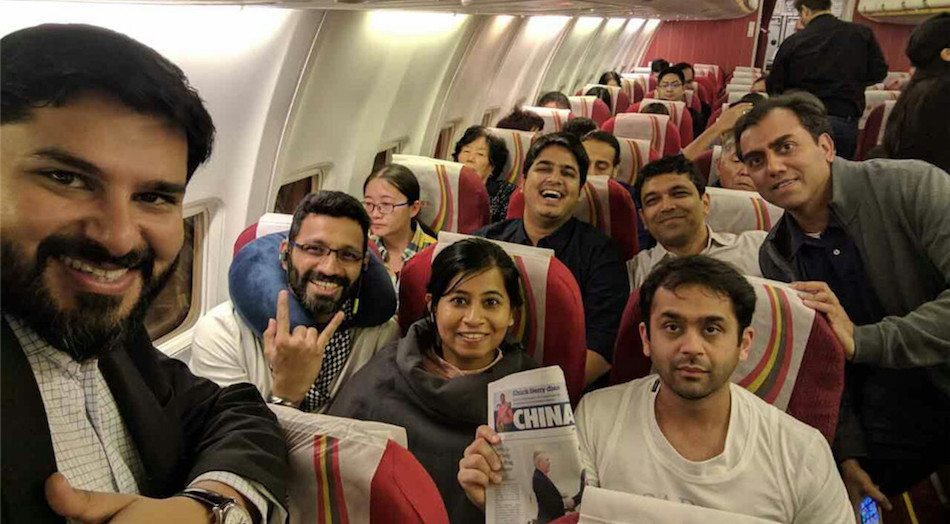
Indian founders and investors on a flight from Hangzhou to Shenzhen. Blume Ventures’ Sanjay Nath leans over from the right. Photo credit: ZDream Ventures.
Two busloads of Indian founders and investors went around China’s major tech hubs recently. In the first part of this series, we explored the potential they saw for Chinese investments to rise in India – as well as challenges.
Today, we look at some of their takeaways from the trip: an environment in which businesses scale at breakneck speed; pragmatic governance that enables it; and risk-taking entrepreneurs who innovate with local business models.
Balancing act
The ecosystem in which a startup grows has a lot to do with its fortunes. The five-fold difference in size between the Chinese and Indian economies has an obvious impact. So the public infrastructure and purchasing power of consumers brought ‘oohs’ right from the time we landed in Guangzhou Baiyun airport and took the connecting flight to Beijing, where a politburo meeting of the Communist Party of China had just ended. We heard the air was cleaner than usual because industries around Beijing had been ordered to shut for a week before the meeting.
There are no comparables in the scope of scale development at this point of time.
It’s easy to attribute China’s success to the absolute power of one-party rule, compared to the democratic political system in India where decision-making tends to be mired in argument – a sour-grapes reaction that usually crops up in a discussion on China. But it becomes apparent during the trip that there’s more to it than that.
Entrepreneurship – triggered by economic reforms and growth – is playing a larger role in changing China and making it a more conducive environment for startups to thrive. A visible manifestation of it was in the WeChat ‘red packets’ that started getting passed around in the group soon after arriving in China. Mostly it was a game, but also useful when somebody was stuck without cash in a cab.
The ease of mobile payments in China is taken for granted now, but the advent of Alipay – and later WeChat Pay – was disruptive to traditional banking. The government chose to be a spectator – and in doing so, allowed the disruption.
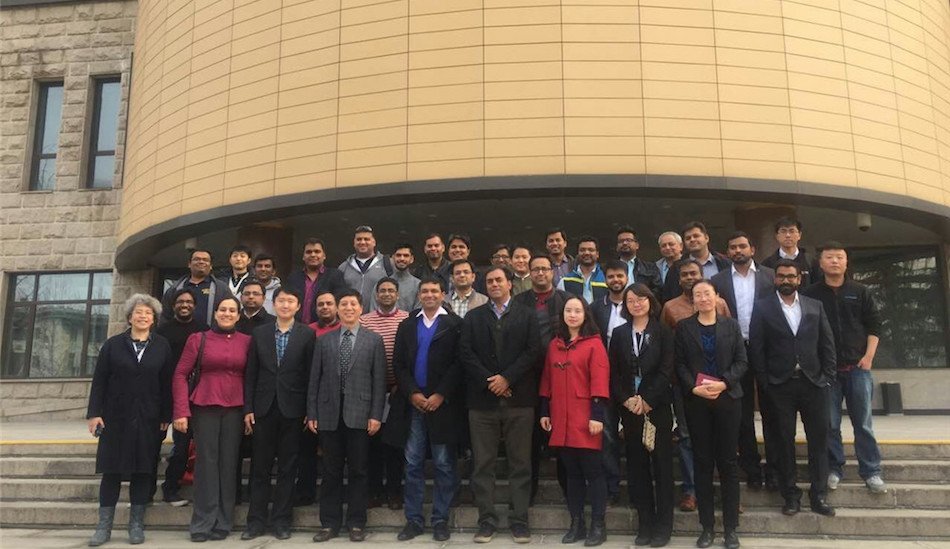
The China Academy of Information and Communication Technology (CAICT) hosted the Indian startup founders. Photo credit: ZDream Ventures.
It doesn’t mean the government is hands-off. Just that it takes a pragmatic view on what it takes for China to grow – and entrepreneurship forms a big part of that. It knows it has control and can step in when it wants.
When to do that is becoming an increasingly complex balancing act. For example, ride-hailing app Didi Chuxing may lose many of their drivers from new regulations enforcing hukou, which ties people to their residential domains for work.
However, Shanghai-based business strategy consultant Edward Tse contends that disruption will continue to spread to more industries as entrepreneurship is now entrenched in the system. In his book, China’s Disruptors, he recalls a speech back in 2013 at the China Entrepreneurs Forum – also known as the Chinese Davos. Mtone Wireless chairman Victor Wang argued for a transformation in governance, from a passive acceptance of entrepreneurship to actively supporting it. He concluded his talk with a warning on the cost of not doing this – and a slide showing a bomb.
The effects of a win-win are palpable in China.
No comparables, only lessons
Copycats and connections





Stay updated on the go with our mobile app.
Get latest insights with smoother, more personalized experience through TIA mobile app.