 Stefanie Yeo · · 5 min read
How SMEs can lay the foundation for their digital transformation

The Covid-19 pandemic has accelerated digital transformation around the world, and small and medium-sized enterprises (SMEs) have been able to leverage new technology to keep moving in the face of economic uncertainty.
As a matter of fact, digital transformations in SMEs could make a difference on a much broader scale, even beyond the pandemic. According to a survey of SMEs across Asia Pacific, commissioned by Cisco and conducted by International Data Corporation (IDC) earlier this year, the productivity boost SMEs experience from digital transformations could add up to US$3.1 trillion to the region’s gross domestic product by 2024.
However, many SMEs in the region are still in the early stages of their digital transformation journeys, if they’ve even started on them at all: 31% of the companies surveyed by IDC are still “digital indifferents” that have not yet embarked on any digital initiatives.
Roadblocks on the journey
According to Saurabh Srivastava, vice president of product at cloud-based business software provider Deskera, one of the biggest inhibitors SMEs face in their journey toward digital transformation is cost.
Traditionally, many enterprise solutions – think Oracle, NetSuite, and their equivalents – were geared for the size and scale of big corporations and thus have been priced accordingly. While more affordable solutions geared towards SMEs have since come to the market, especially with the rise of the “as-a-service” model, these solutions are often designed for specific use cases.
Companies usually end up needing to use different solutions in order to manage processes such as accounting, leave management, and invoicing, which drives up cost.

Photo credit: Kaspars Grinvalds / 123RF
According to Deskera’s calculations, using three different enterprise solutions could cost companies upwards of US$1,500 a month. While this doesn’t seem like a lot of money, it’s enough of a deterrent for smaller businesses that may be facing challenges with cash flow, especially in emerging markets like India. Therefore, it’s no surprise that many companies stick to traditional paper-based or Excel-based solutions to track their different processes.
Cost aside, having multiple solutions doesn’t really help SMEs with upping their productivity. These different solutions may not necessarily integrate with each other on the backend, which creates more work for employees.
“Before you know it, you’re spending so much time updating and maintaining this whole gamut of software applications, and you fall back into the same cycle of having to do things manually,” explains Saurabh.
And once SMEs decide to undergo a digital transformation, there are other challenges to grapple with. Businesses may face difficulty in getting employees on board with the new software, and if the leadership team isn’t aligned on what the objectives of digital transformation are, things could very well end in failure.
In order to address these different challenges, SMEs need to make sure they lay the groundwork first for digital transformations to take place.
Starting with the basics
Once SMEs decide to embark on a digital transformation, they first need to think about what they want to achieve through this process.
Successful transformations often begin at the top, as the company leadership sets out a clear direction for what the change process will look like. According to a survey by McKinsey, having senior management involved in the process is a key ingredient to success.
By encouraging teams to explore new solutions and challenge their old ways of working, management can lead by example and foster the mindset shift that’s required whenever new technology comes into the picture.
Once SMEs have figured out their goals for digital transformation, the next step is to identify the right tools to help them on the journey.
“There are a few checkboxes that [SMEs] should tick off, otherwise they may end up with a solution that does not fit their needs,” says Saurabh. According to him, there are three key things SMEs should look out for when choosing enterprise solutions to support their efforts.
Finding the right tools
First, given that cost is a concern, Saurabh recommends that companies look for solutions that offer a trial option. After all, there’s no point in paying for something upfront, only to realize that it doesn’t meet your needs.
Second, businesses should seek out integrated solutions that can fulfil multiple needs in their digital transformation journey. Not only would they be more cost-effective, they will also enable employees to work more efficiently,
“For example, if a software does invoicing but it doesn’t have an accounting option, then it won’t help [much] you as you’ll still need to transfer the data to another application,” shares Saurabh. “Both are important parts of your business. So even though that software might be an affordable tool, it would actually add to your work.”
Third, Saurabh encourages companies to seek out solutions that are intuitive and have plenty of support for users, as these can help address employee resistance toward the digital transformation process.
“It should be something that is intuitive, user-friendly, and designed with modern principles,” he says. Social media applications like Facebook and TikTok are very easy to use, and navigating the different functions of these apps comes naturally for people. In Saurabh’s view, there’s no reason enterprise software can’t follow the same principles to help increase adoption rates and get people onboard with new solutions at a faster rate.
Deskera aims to check all those boxes with its platform, which underwent a revamp recently.
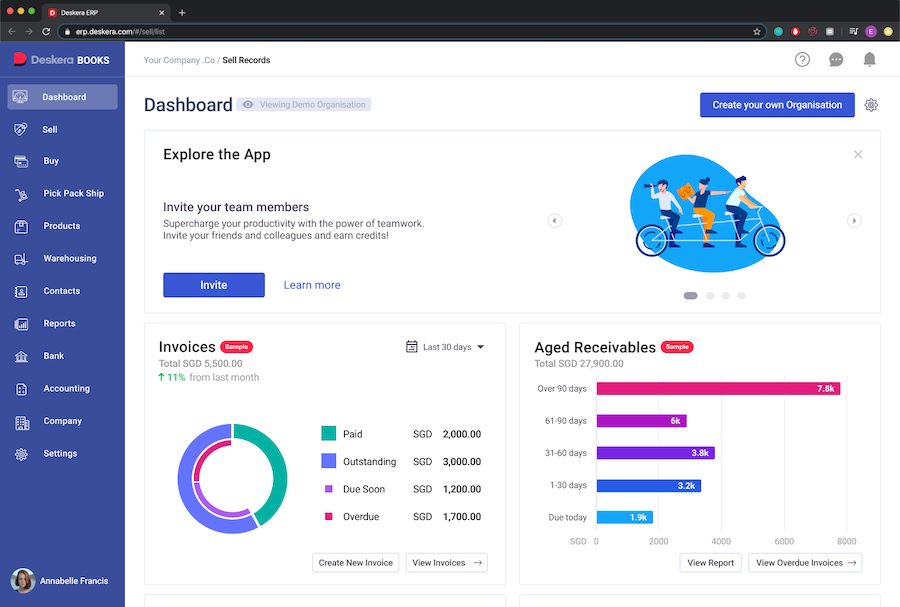
Photo credit: Deskera
Its product is an integrated solution that can help SMEs digitize their businesses across three aspects: finance and accounting, people management, and customer relationship management. It also offers additional tools to support different kinds of enterprises, such as a logistics management platform for ecommerce companies and inventory management applications for retail business, as well as the flexibility to configure the platform to suit a company’s internal processes.
“Let’s take your sales pipeline as an example. It doesn’t matter if it’s a five-stage, seven-stage, or three-stage pipeline; you set it up the way you want [on Deskera’s platform]. Once you have configured it, you can see your entire sales cycle from the top, which gives you a lot of flexibility,” says Saurabh.
The company’s platform also comes with a mobile app that allows leaders and employers to access information they need across all aspects of the business easily, wherever they may be. For example, managers can approve leave requests on the fly, and sales teams can create invoices through the app, which they can then send through channels such as WhatsApp.
With these features, Deskera wants to give SMEs full access to the resources they need in order to undergo a digital transformation and boost productivity.
Preparing for the future
Ultimately, SMEs need to begin laying the groundwork in preparation for the future, lest they get left behind. They have to seek out the right solutions and find the right tools in order to start working toward entering a new age of digitalization.
“It is difficult to make changes and to drive change, but as a business owner or leader, you have to adapt. If you don’t adapt, the business can’t survive,” concludes Saurabh.
Deskera is a cloud-based business software provider that enables businesses to run their operations more efficiently.
Find out more about Deskera on its website.
This content was produced by Tech in Asia Studios, which connects brands with Asia’s tech community. Learn more about partnering with Tech in Asia Studios.
Stay updated on the go with our mobile app.
Get latest insights with smoother, more personalized experience through TIA mobile app.
Recommended reads
 Forrest Li on scaling Sea, building smarter bots, and founder grit
 SGX’s CEO says it doesn’t need a unicorn to win
 SMEs want AI too, but not the kind Big Tech is selling
 Oatside’s alt-milk rise hits a profitable gear
 Alibaba’s financial health in 12 charts
 Asia’s telcos bundle AI into mobile plans. Will it pay off?
 M-Daq chases bigger clients as revenue falls, losses grow
 VC tracker: Accel raises US$3.5b, including US$550m for India
 Graas buys Temasek-backed Trustana in agentic commerce push
 Doctor Anywhere posts healthier operations in 2025





Editing by Nathaniel Fetalvero and September Grace Mahino
(And yes, we’re serious about ethics and transparency. More information here.)




