J.T. Quigley · · 4 min read
This sleep-tracking medical device is so good it’s being tested by Japan’s astronauts

Sleeping patterns can be a valuable indicator of overall health and wellbeing. Unfortunately, diagnosing sleep-related disorders often relies on invasive medical technology and admission to a hospital. Sleepwell, established in 2010, is a Japanese medtech startup born out of Osaka Bioscience Institute. It invented an alternative to the traditional EEG-based way of administering a sleep study, called Sleep Scope.
So what’s an EEG in the first place? Short for electroencephalogram, it’s a medical device that can detect abnormalities in the electrical activity of the brain. Small electrode pads are placed on a patient’s head to monitor brain waves, which are amplified and presented as a graph (either printed on physical paper or, more commonly, displayed on a computer screen). Data from an EEG can be used to identify a range of potential medical problems, from sleep disorders and mental illness to epilepsy and brain tumors.
Sleep Scope is the first – and only – compact EEG authorized by Japanese government’s FDA equivalent, the Ministry of Health, Labor, and Welfare. It’s comparable in size to a deck of cards and uses only two electrodes – one for the head and one for the neck.
“EEGs are usually very large, with multiple electrodes on the head, face, and body,” Sleepwell founder and CEO Masaki Yoshida tells Tech in Asia. “Our system is like an iPod Nano compared to a hi-fi home audio entertainment system.”
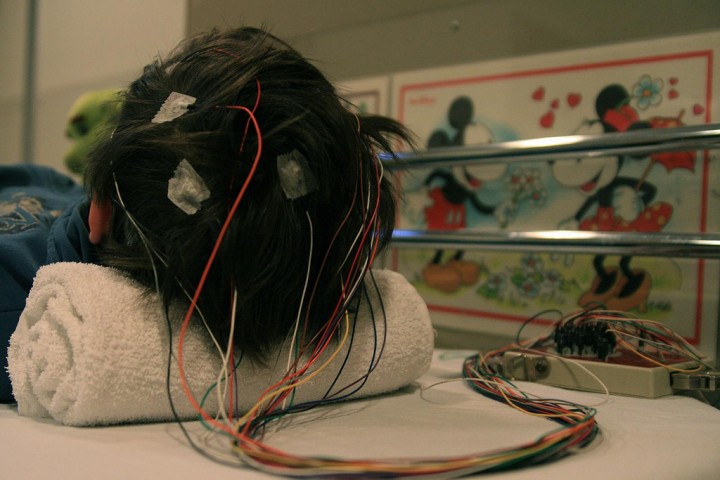
A child connected to a traditional EEG.
While traditional sleep studies require staying overnight at the hospital, Sleep Scope is easily portable and thus can be used in the comfort of a someone’s home. Yoshida says that this could lead to even more accurate results, because patients “are not covered in wires and sleeping in a strange observation room at a hospital.”
Sleep Scope can identify sleeping problems by collecting data on sleep depth, rhythm, and quality. It doesn’t tell users the exact reason, per se, but the data can be analyzed by a medical professional in order to make a prognosis. The startup holds a patent related to measuring depression and bipolar disorder indicators.
“If we administer a blood pressure test, we can find out about a person’s current state of health,” says Yoshida. “By monitoring sleep waves, we can get an idea about mental health issues.”
Yoshida also claims that his startup’s tiny device provides data that’s comparable to the commonly-used PSG sleep study (which utilizes a traditional EEG and other devices to monitor eye movement, muscle movement, and heart rate).
“There’s no difference when monitoring for wake, REM, and the three sleep stages,” he says, claiming that the results have been consistent across more than 22,000 tests in Japan. PSG tests, known as polysomnograms, can detect sleep disorders like insomnia, narcolepsy, and sleep apnea.
Far from Japan, Sleep Scope is being utilized by Antarctic researchers to examine the difference in sleep patterns during months-long periods where there is continuous sun or continuous darkness. It’s even helping Japanese JAXA astronauts monitor their sleep patterns from inside the International Space Station.
Rental model
Because Sleep Scope is recognized by the Japanese government as a medical device, it cannot be sold direct to consumers. So how does Sleepwell make money?





Stay updated on the go with our mobile app.
Get latest insights with smoother, more personalized experience through TIA mobile app.