China’s “great firewall” blocks a lot of foreign sites. But inside China, sites and apps are blocking each other too.
Users have found that their WeChat contacts could not see the links they shared from Haokan (a short video app created by Baidu), according to Chinese media reports.
Tencent responded by saying that Haokan has broken WeChat’s link-sharing rules with an “earning online” behavior. When we asked WeChat to clarify what that means, a spokesperson sent us a screenshot where Haokan’s app says users will be rewarded with cash for getting other users to sign up.
WeChat told Chinese media that it’s against WeChat’s link-sharing rules, but the term “earning online” or “wangzhuan” does not appear in the messaging app’s external link regulation.
Baidu posted a statement on Weibo saying that they’re “deeply sorry” about WeChat’s double standards, claiming that WeChat still allows similar behavior on its own short video app Weishi.
WeChat has essentially become China’s mobile operating system, where people can virtually find all the daily online services they need, but that’s largely for Tencent’s own ecosystem of services. Some of its rivals are walled off from the country’s biggest social network, giving Tencent tremendous power.
WeChat blocked Uber in 2015 because of its “malicious marketing.” Coincidentally (or perhaps not), Tencent backed Uber’s big rival Didi.
In the same year, it blocked music sharing from music apps such as NetEase’s Cloud Music and Alibaba’s Xiami Music. Tencent said at the time it was because of music piracy. In a statement, NetEase hinted that it’s more due to competition. “We have no reason to complain – it’s their [Tencent’s] turf after all. They have their own music apps, and they don’t want to lose market share.” WeChat removed the ban in 2016.
WeChat has also repeatedly blocked links from TikTok, the globally popular short video app from viral content king Bytedance. Tencent’s argument is that it filters out links that appear too many times in WeChat Moments, so that users don’t have to see the same content over and over again. As a solution, TikTok saves a video you want to share on WeChat to your local album so that you can manually upload the video (with a TikTok watermark) to WeChat.
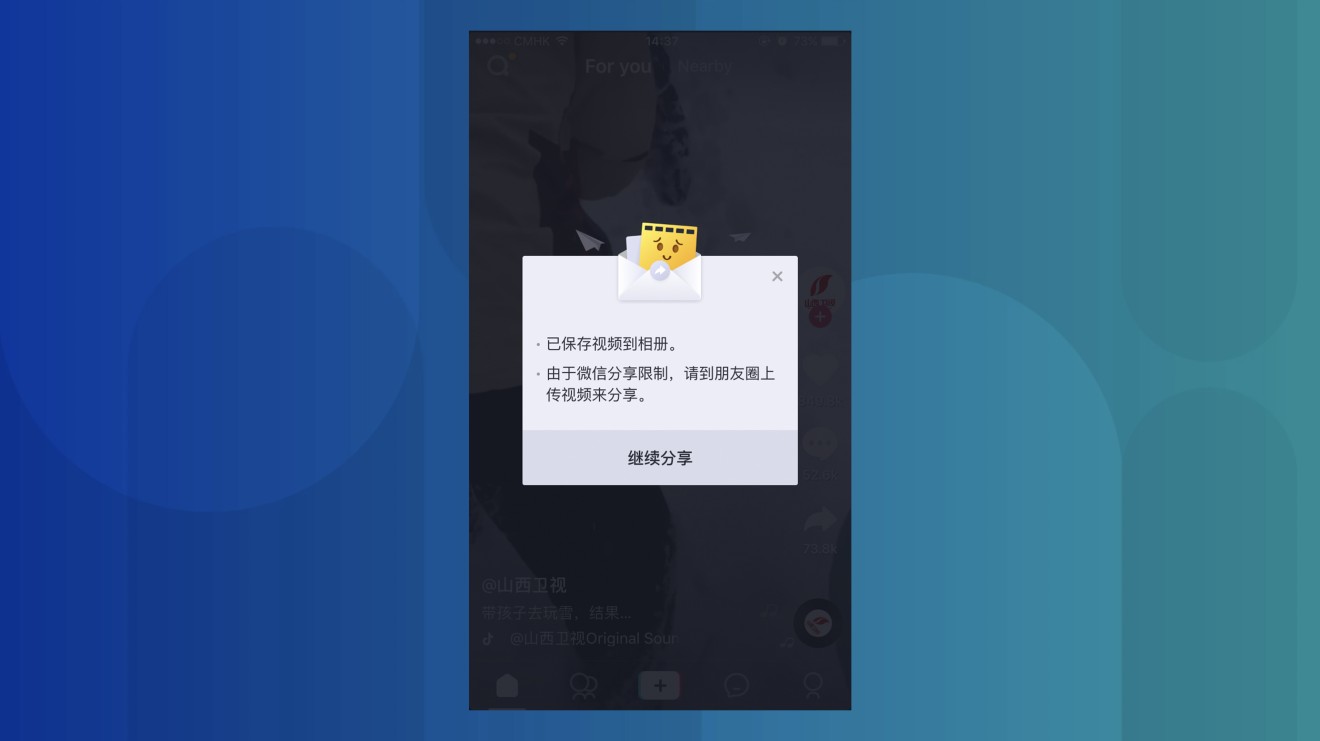
“Because of restrictions of sharing to WeChat, please upload the saved video to WeChat Moments,” TikTok says. / Photo credit: TikTok
Alibaba’s Taobao faces the same ban from WeChat when users want to share an item with their WeChat friends. Taobao has also been trying to make it easier: After you click “Share to WeChat,” Taobao generates a link for the item you want to share, automatically copies the link, and opens WeChat for you so that you can then select a chat window, paste the link, and send. It’s not nearly as slick as how sharing normally works, but it’s one way around it.





Stay updated on the go with our mobile app.
Get latest insights with smoother, more personalized experience through TIA mobile app.













📅 Upcoming Events
22 October 2026
Payoneer x CSPN Summit 2026