
Japan is the world leader in artificial intelligence, according to a recent study conducted by US-based research firm ESI ThoughtLab. And why wouldn’t it be? The nation has been pushing for AI and machine learning (ML) innovation as part of its “Society 5.0” initiative.
Indeed, AI and ML could play a key role in helping Japan address several challenges, especially with an ageing population and a shrinking workforce.
To learn more, we heard from three rising AI/ML startups in Japan at the forefront of the country’s AI/ML growth.
The following responses have been edited for brevity and clarity.
1. Umitron
Umitron, founded by Ken Fujiwara, Masahiko Yamada, and Takuma Okamoto, is an aquaculture technology startup that aims to address the challenges of farmers in the sector and improve the safety and economics of aquaculture operations.
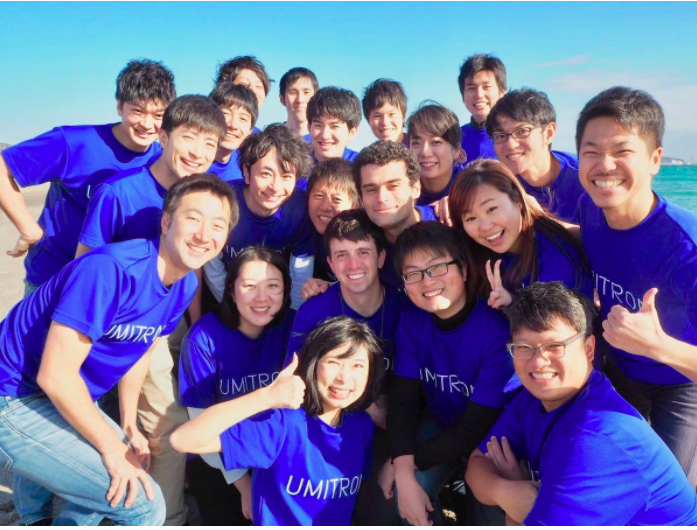
Photo credit: Umitron
What is your core business or tech use case for which you use an AI or ML-based solution?
We are working to solve the problem of rising feed costs. To do so, we analyze the behavior of fish during feeding using AI/ML from video images to judge whether fish are eating or not. Our AI/ML system then provides farmers with optimal feeding recommendations.
How has being on the cloud and Amazon Web Services (AWS) helped your startup scale fast?
Our system is built on a combination of AI/ML and internet-of-things (IoT) technologies. It has server-side ML services, as well as mobile apps that function as user-operated interfaces. The software on our devices collects data and performs image processing and analysis with AI/ML.
AWS provides managed services for the AI/ML and IoT aspects. This reduces the cost of operating the infrastructure and allows us to focus on developing software that solves the specific challenges of aquaculture. Since each service is on a pay-as-you-go scheme and has no initial investment costs, we have been able to build a service with a combination of multiple components from the start.
What are your plans for the future?
We recently launched Umitron Pulse, an ocean environmental data monitoring service for aquaculture farmers that uses satellite data. Environmental parameters such as water temperature and dissolved oxygen are related to the appetite of fishes, and this allows farmers to use the data they need to farm fish without specific sensors.
In the future, we would like to combine micro data, such as fish behavior captured by a camera, with macro ocean data from satellites to enable more optimal data operations for fish production.
2. SyntheticGestalt
Founded in 2018 and based in London and Tokyo, SyntheticGestalt has developed machine learning models for drug discovery. These models can propose novel preclinical candidates, which are chemical compounds discovered through research that have the potential to become a new drug for the treatment of a particular disease.
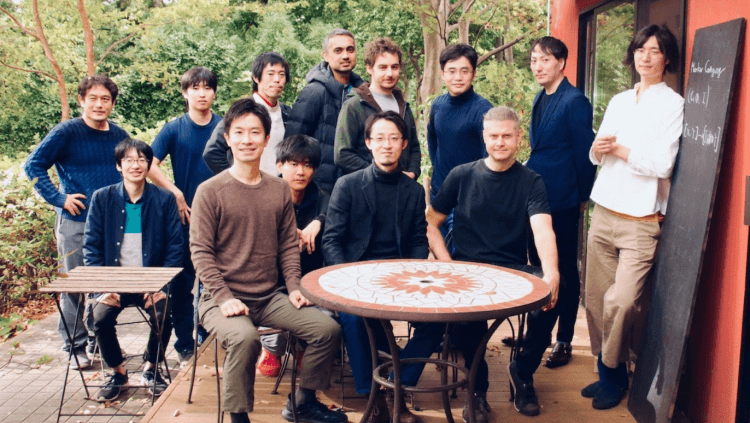
Photo credit: SyntheticGestalt
What is your core business or tech use case for which you use an AI or ML-based solution?
We use machine learning models that predict 28 parameters of compounds, including inhibitory activity, physicochemical properties, and safety, to discover compounds that are effective for specific diseases from a library of four billion compounds.
The novel preclinical candidate proposal can be completed in a matter of weeks, significantly speeding up the compound search process which traditionally takes years.
We also undertake wet lab experiments to validate the outputs of the model, to build up a pipeline for internal use, as well as to offer such compounds externally for pharmaceutical companies to develop.
What inspired you to start an AI or ML startup?
We believe that the most creative and valuable part of human activities is to make scientific discoveries. Our ultimate goal is to enable such scientific discoveries to be delivered to society automatically and at mass scale by an artificially intelligent system. Such a system will provide scientific development to society stably at exponentially increasing speeds and help bring forth a new form of civilizational progress.
How has being on the cloud and AWS helped your startup scale fast?
It has accelerated the speed of our business with minimum IT investment. As a startup, agility is one of the most important success factors. Similarly, the AI space is rapidly evolving, and speed is particularly crucial to stay ahead in this area.
Amazon SageMaker, AWS’ cloud machine-learning platform, saves us a huge amount of time when developing AI models. According to one of our AI engineers, it would have taken us a lot more time to train the models and handle large amounts of data throughout the course of model development if it weren’t for Amazon SageMaker.
We also enjoy various general advantages of cloud platforms with AWS. For example, we were able to kick-start our AI model development soon after we started the business without the need for expensive physical hardware. We were also able to adjust the computing size according to our needs as our business grew.
3. LeapMind
Founded in 2012, LeapMind conducts research and development of deep-learning solutions for embedded devices and helps businesses implement machine learning into their processes. The company recently launched Efficiera, a lightweight deep-learning model that can be easily implemented into edge devices such as security cameras.

LeapMind CEO Soichi Matsuda / Photo credit: LeapMind
What is your core business or tech use case for which you use an AI or ML-based solution?
Since inception, LeapMind has proposed and implemented machine learning solutions for more than 150 companies. Based on the knowledge we have learned from such experiences, we are using our own technology to incorporate machine learning into devices.
How has being on the cloud and AWS helped your startup scale fast?
By using managed services for machine learning operationalization and IoT such as Amazon SageMaker and AWS IoT Greengrass, we can build a training environment, a data aggregation system, and device management infrastructure with less cost involved in installation and operations.
In this way, we can start projects quickly, and customers can focus on addressing issues such as the performance of trained models, power consumption, and the cost of devices. They can also accelerate the commercial use of edge deep learning with LeapMind technologies.
What are your plans for the future?
First of all, we will continue improving Efficiera for even lower power consumption and better performance. We will use our internal resources to focus on the market in the edge deep learning area.
On the software side, we will support widely used machine learning frameworks. We want to give Efficiera an infrastructure-like capability that allows us to create more flexible deep-learning models using our extremely low bit quantization.
On top of that, we want to mass produce models that fit our customers’ use cases and then expand them to the market. We will make the hardware, the models, and the software that connects them all even better.
The APAC AI Conclave, which was held on November 25 to 26, 2020, is a free virtual conference presented by Tech in Asia in partnership with Amazon Web Services.
Missed the event? You can still hear from these companies and other experts in the AI/ML space about how startups and practitioners from the region can build smart, customer-centric, and scalable solutions in the cloud using the latest, broadest, and deepest set of machine learning and AI services.
Find out more on the website.
This content was produced by Tech in Asia Studios, which connects brands with Asia’s tech community. Learn more about partnering with Tech in Asia Studios.
Stay updated on the go with our mobile app.
Get latest insights with smoother, more personalized experience through TIA mobile app.
Recommended reads
 How OpenAI is betting on one powerful “brain” over many tools
 Why falling AI costs spark investor panic but drive new revenue
 TiDB is engineering the infrastructure for AI’s agentic future
 Why robots still need humans to make warehouse automation work
 Will cars drive the future of AI? This Chinese company thinks so
 Robots still struggle with touch. Sharpa wants to fix that
 ‘Good morning, Dave’: The new world of physical AI in daily life
 Math provides the proof. OpenAI says AI makes original ideas.
 Escaping the LLM bubble: AMI Labs goes the physical AI route
 Southeast Asia pulls ahead of global average on AI adoption





Editing by Nathaniel Fetalvero and Jaclyn Teng
(And yes, we’re serious about ethics and transparency. More information here.)







📅 Upcoming Events
22 October 2026
Payoneer x CSPN Summit 2026