Terence Lee · · 5 min read
Singapore computer games company Time Voyager is betting big on China
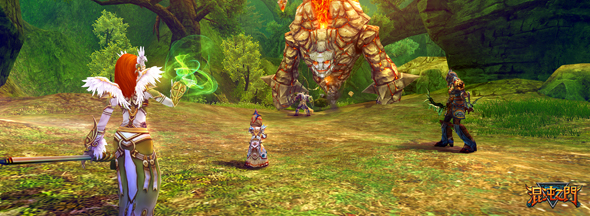
Chaos Gate will be released in China in April this year.
Developing computer games is risky business. More so, if you’re creating a Massively Multiplayer Online Role-playing Game (MMORPG), which requires a massive investment in capital and time.
But that is the risk Singapore-based Time Voyager‘s founder and CEO Chris Loo is willing to take. By developing their first title — Chaos Gate — for the fast-growing China market, they could potentially reap big rewards. Last year, a report revealed that sales from the China games market reached US$7B last year, a 32.4 percent year-on-year increase.
Time Voyager’s risk-taking spirit is something Canon’s Think Big campaign aims to promote. Think Big encourages entrepreneurs to not just earn a profit, but also to expand their business horizons by doing what was thought to be impossible.
For Chris, this meant venturing beyond local shores to develop a full-fledged MMORPG game from scratch, a category that is dominated by established game developers from the US, Japan, South Korea, and China.
He is certainly no wide-eyed neophyte, and has no illusions about the challenges of the gaming industry. Even big name game studios flounder from time to time.
“The survival rate for MMORPG games under development is very low. According to my opinion of the market, three out of four developments will fail before closed beta, and another 50 percent of the remaining commercialized MMORPGs will have mediocre results. It’s a high-risk endeavor,” he said.
But with the right approach, he believes Chaos Gate, which will be free to play, can do well in the China market when it launches there in April.
Already, it’s off to a promising start. Kingsoft, a top ten games publisher in China, has picked up the title. They will handle the game’s marketing push in the country.
What sets Chaos Gate apart from other MMORPGs is that it caters to casual, intermediate, and hardcore players at the same time by adopting the best features from games that target the various market segments.
Casual games that find it hard to play the game with both the keyboard and the mouse — a standard configuration in 3D games — can navigate around using just the mouse. If they want to complete a quest, they can set their avatar to ‘autorun’ to the quest location.
Hardware requirements are also quite lenient — a gamer doesn’t really need the latest rig or state-of-the-art internet connection to run Chaos Gate smoothly. This is a crucial step to ensure widespread adoption of the game in China, since high-end machines and lightning-fast internet connections are out-of-reach to the average consumer.





Stay updated on the go with our mobile app.
Get latest insights with smoother, more personalized experience through TIA mobile app.