
In the defunct US television series Person of Interest, The Machine is an intelligent supercomputer capable of collating information in order to prevent terrorist attacks.
While security and surveillance AI like The Machine is not yet a reality, there have been huge developments in the industry. The hype around artificial intelligence is very real if the number of related patents filed by tech companies like Microsoft is any measure.
AI in security and surveillance
One popular application of AI in security is facial recognition. China, for one, uses it to catch jaywalkers.
Elsewhere, Singapore is testing its use for surveillance in prisons, while Japan used facial recognition for the first time to enhance security around Emperor Akihito’s 30th anniversary ceremony.
Machine learning, a subset of AI, is also proving useful in threat identification. By training AI to pinpoint threats from camera footage, developers hope to deter potential troublemakers.
One such developer is Singapore-based Vi Dimensions. Founded in 2015, the startup developed the Abnormality Recognition Video Analytic System (ARVAS), which uses a self-learning algorithm to identify unusual events in real time.
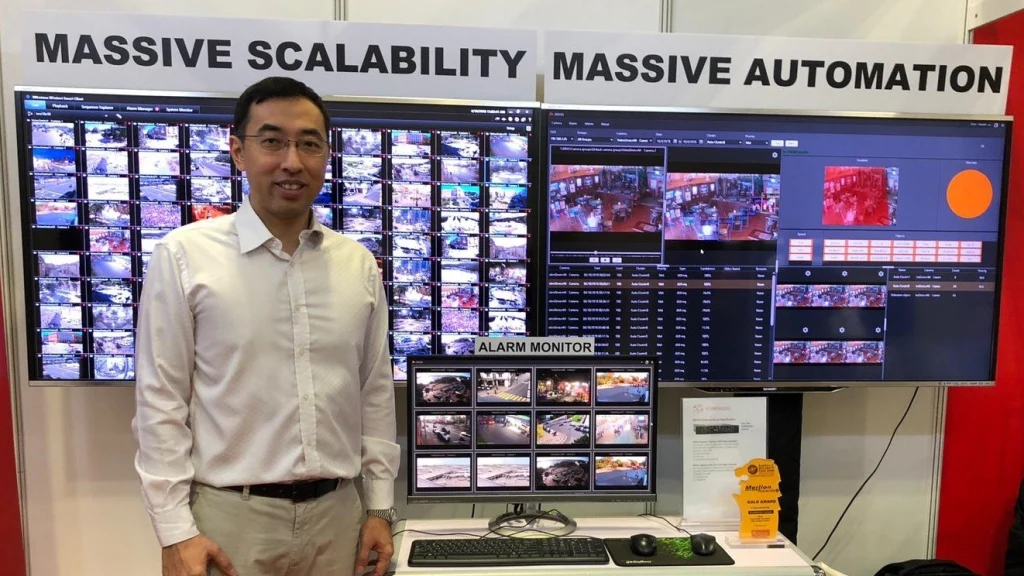
Vi Dimensions CEO Raymond Looi / Photo credit: Vi Dimensions
According to Raymond Looi, co-founder and CEO of Vi Dimensions, the idea for ARVAS came about when he realized that existing systems didn’t adequately meet customers’ needs.
Reliant on rule-based analytics, earlier systems needed operators to predefine what to detect. For example, they had to draw a virtual tripwire that would trigger an alarm whenever it’s crossed. But this wasn’t enough, as there were other elements that customers “wanted to detect that were not addressed by rule-based analytics,” explains Looi.
The shortcomings of existing security technology became more apparent in the wake of the 2016 terrorist attack in Nice, France, where an attacker ran over pedestrians with a truck on Bastille Day, leaving 86 dead and hundreds injured.
It was later discovered that the perpetrator had scouted the area days before the attack, driving the same truck. His behavior was captured on CCTV cameras, but it didn’t come to the attention of security operators who possibly didn’t find the activity suspicious.
This is where ARVAS comes in.
Addressing the gap
Traditionally, CCTV footage is monitored manually by security personnel. Studies have shown that human operators’ attention span wane after 20 minutes, and when divided across hundreds of screens, that number falls.
ARVAS is a first-layer filter for surveillance footage, identifying and flagging abnormal events that operators might miss.
The system intelligently applies unsupervised machine learning technology to mine data from surveillance videos and identify patterns and unusual behaviors, without requiring users to input rules or predefine behaviors.
ARVAS is currently deployed in Singapore’s Sentosa, where it has been installed in over 200 cameras across the island resort, as well as in other countries.
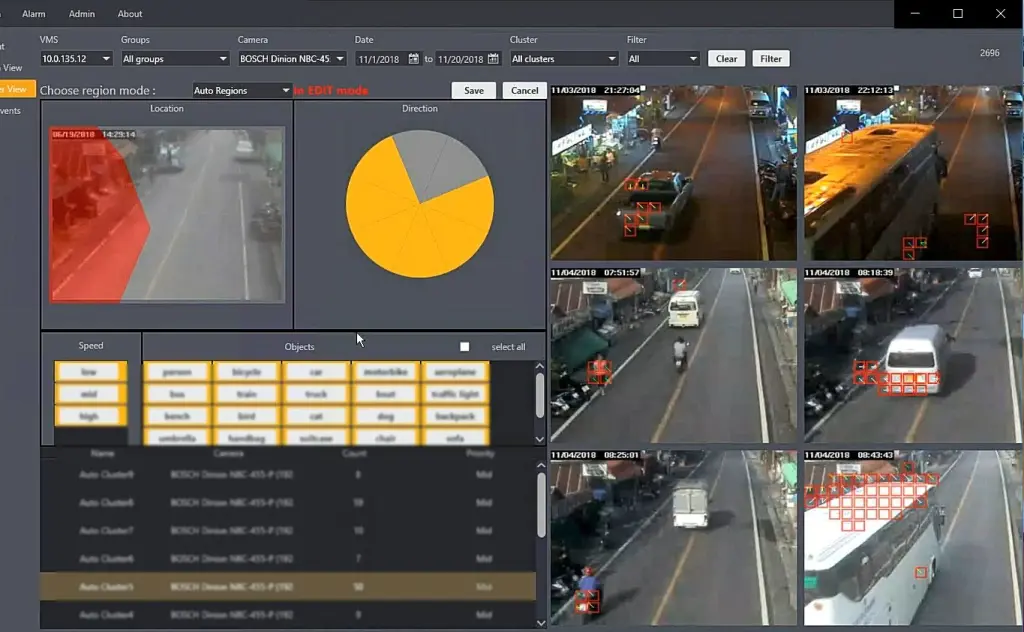
ARVAS identifies and flags abnormal events that operators might miss from surveillance footage / Photo credit: Vi Dimensions
Aside from installing it, Vi Dimensions ensures that ARVAS works with customers’ preexisting security systems, operationalizing it effectively and training security staff on its usage. Looi emphasizes that ARVAS complements existing human operators instead of replacing them.
“We recognize some things are better done by humans, but others are better done by machines, such as the more mundane and repetitive tasks,” he says.
For example, if someone is loitering at a train station, ARVAS might flag it as an unusual activity, according to Looi. This is where a human steps in to examine the situation and judge whether the person is just waiting for a friend or planning an attack.
Furthermore, as ARVAS relies on machine learning, it’s necessary for the system to observe hours of footage in order to recognize abnormal behaviors. Humans are still needed to guide its learning process.
Looi also foresees great potential in combining different applications of AI to further enhance security and surveillance. For example, ARVAS can be used to spot suspicious behavior and facial recognition can be tapped for tracking suspects.
AI moving forward
For all the benefits that AI can provide to security and surveillance, there are still ethical and privacy concerns. For example, China’s use of facial recognition technology has come under fire as an infringement of civil rights and privacy – and it didn’t help when a data leak exposed the information of over 2.5 million people.
Similarly, plans in the US to use facial recognition in place of boarding passes for travel have met with criticism from privacy advocates, who argue that it could be used for expansive law enforcement and misidentify racial minorities and women.
Despite the potential issues, Looi is confident that the industry will be able to overcome them.
He points out that keeping track of artificial intelligence must occur not only on a programmer level but also “on an industry or national level.” The entire industry needs to work together to devise protocols and regulations for managing what AI can or cannot do.
From the Interpol’s use of AI to analyze data and deter terrorist attacks to airports’ reliance on machine learning and facial recognition to sharpen security, these technologies have the potential to make the world a safer place.
And while there may be concerns over AI development and usage, Looi thinks that they won’t hold the industry back. Instead, these issues could prompt developers to be more careful in their work and take a more calculated approach to the technology’s future.
“It will allow us to slow down and think about what has been done, what should the next steps be, so that we can make a better step ahead,” he says.
Founded in 2015, Vi Dimensions was based on the simple idea that video analytics can be done in a much better and efficient way. The company’s ultimate goal is to revolutionize safe city surveillance harnessing thousands of cameras.
To find out more about ARVAS and Vi Dimensions, visit its website.
Stay updated on the go with our mobile app.
Get latest insights with smoother, more personalized experience through TIA mobile app.
Recommended reads
 You can’t spell India without AI
 Southeast Asia’s data center boom has a water problem
 Inside OpenAI’s public-first bet on medical AI
 From science to public safety: turning discoveries into solutions
 This startup helps chipmakers stop repeating the same mistakes
 How AI agents will be the new software buyers
 India tech titans caught snoozing by AI
 How Anthropic and Google split on the next US-China deal
 QuickBytes: How GovTech Singapore is fighting fire with fire in cybersecurity
 2 AI giants, 1 honesty problem





Editing by Winston Zhang, Charmaine de Lazo, and Eileen C. Ang
(And yes, we’re serious about ethics and transparency. More information here.)




📅 Upcoming Events
22 October 2026
Payoneer x CSPN Summit 2026