China is changing the game in international innovation and research and development (R&D). According to Professor Seamus Grimes, a research professor in Social Sciences and Public Policy at the NUI Galway, China has long since decided that “it is no longer willing to be the minor partner in terms of added value and profitability” in any industry. The demands of authorities for ‘indigenous innovation’ represent, he says, a kind of gamble for multinational corporations; for access to the huge Chinese market, foreign firms put their innovations on the line.
But Professor Grimes, from his field visits to Chinese R&D departments as part of his work at NUI Galway, insists that overseas companies like Nokia (HEL:NOK1V; NYSE:NOK) are not in direct danger from their helping out in this indigenous innovation. Yet there are warning lessons for other companies from Motorola and Nokia both struggling in China in the long-term despite their significant investment in local R&D. And let’s not forget China’s new giants, such as ZTE (HKG:0763; SHE:000063) and Huawei.
To discuss whether China might be bending the rules on innovation, and to ponder the rise of China’s own R&D, Seamus (pictured below) agreed to field a few of my questions (note that the footnotes are mine):
1. You’ve written a lot of the “growing internationalisation of R&D activity” – how has that worked out in China in recent years?

Seamus: It’s not very many years since the general pattern was that the greater part of R&D activity took place either in the company’s home country and also at headquarters. The greater part of multinational R&D continues to take place in the world’s more developed regions, but things have begun to change in more recent years as multinationals have become more globalised through outsourcing and offshoring. During this more recent period locations within the so-called BRIC (Brazil, Russia, India, and China) countries have become increasingly attractive locations for decentralising some aspects of multinational R&D activity. But it is important to realise that in the overall context this important development remains a small, but rapidly growing part of the total.
Obviously the huge growth in foreign investment in China in recent years has added greatly to China’s attractiveness as a location for R&D activity. In many cases, foreign-invested companies have played a major role in the initial period of China’s integration into the global economy, and in some ways the more recent focus on R&D reflects a maturing of the profile of investment. In addition to using China as a low cost manufacturing location, many multinational companies have been placing a greater focus on the China market and on their need to learn to compete effectively within that market, not only with other multinational companies, but increasingly with some very effective Chinese companies. While the focus of the R&D activity in China can have various aspects to it related to both the local market and global activities, the need to develop products more suited to this increasingly important market has been a driving force.
The recent policy push of the Chinese government towards ‘indigenous innovation’ has also been very significant. This means that to ensure access to China’s market and, particularly to the significant public procurement part of that market, there was increasing pressure on foreign companies to develop products in China, register intellectual property locally, and use Chinese technology standards.
2. What about fears of theft of intellectual property (IP) – of business and innovation ideas being stolen?
Seamus: There are widespread concerns about IP in China, and at the same time there is general acknowledgement among foreign companies that progress is being made, particularly in relation to the IP regime which has been put in place. The difficulty lies with implementation and judicial independence. There is a strong culture of copying and reengineering products [1] by Chinese companies and changing this culture will take considerable time.
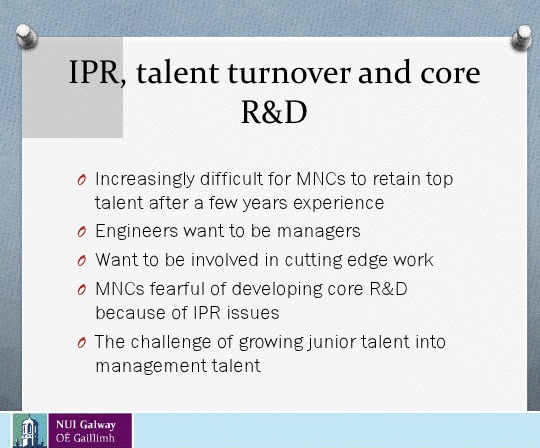
The key challenges for multinationals (MNCs) when doing R&D in China (courtesy of Prof. Grimes)
Major consultants advise foreign companies to adopt specific strategies to avoid IP being stolen, such as not introducing their latest technology to China, or in some ways fragmenting the R&D process so that the end product would be difficult to commercialise. But the attractiveness of a market, still experiencing significant growth, relative to the rest of the world, can be too alluring for some companies and they are prepared to gamble. Specific evidence of IP theft is difficult to unearth apart from particular court cases [2], but there have been many media reports and certainly companies are highly cautious about losing IP in China.
3. Often, ‘technology transfer’ is a legal requirement of doing such business in China. But isn’t that just feeding your smaller rivals until they’ve grown up enough to bite you?





Stay updated on the go with our mobile app.
Get latest insights with smoother, more personalized experience through TIA mobile app.