- Premium Content It takes our newsroom weeks - if not months - to investigate and produce stories for our premium content. You can’t find them anywhere else.
 Melissa Goh · · 7 min read
As SGQR+ reshapes Singapore’s payment scene, who wins?
Payments services firm NETS has had a four-decade head start in Singapore.
But that advantage may be diminishing in line with a push by the Monetary Authority of Singapore to streamline payments, give merchants more choices, and make various payment apps more compatible with each other.
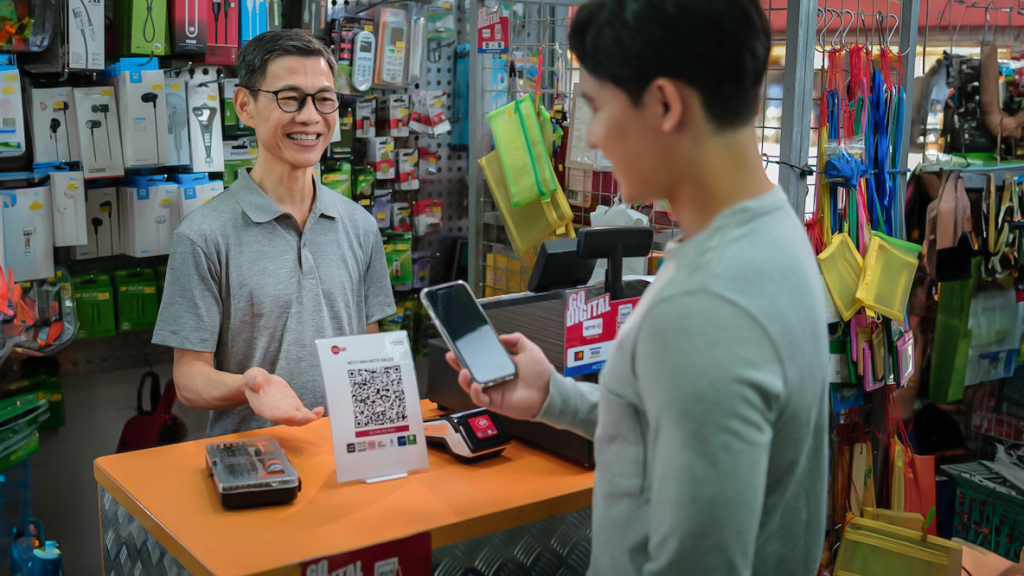
Photo credit: NETS
SGQR+, a new solution unveiled this month that is offered under two different tracks – one by NETS and the other by fintech firm Liquid Group – paves the way for a new contender to match and potentially go beyond NETS’ local merchant network in size.
This could be a game-changer for digital banks, e-wallets, and financial institutions not currently part of the NETS network.
A brief history
NETS’ advantage in payments goes back to its founding. Established by a consortium of local banks in 1985, the firm was set up to drive the adoption of electronic payments in Singapore.
As part of an agreement with its three founding banks – DBS, OCBC, and UOB – NETS was granted the right to be their only acquirer, responsible for signing up merchants to the ecosystem. Meanwhile, the banks took care of signing up customers by issuing them debit cards.
This set the stage for NETS to become Singapore’s largest merchant acquirer. Today, it has a domestic merchant network of over 130,000 acceptance points, of which 96,000 can process QR transactions.
That status gave it the heft to drive broad QR payments adoption at hawker center stalls and other retailers islandwide. It also gave NETS the negotiating power to tie up with its overseas counterparts in Indonesia, Malaysia, and Thailand to enable cross-border QR payments.
For many merchants, NETS QR is synonymous with SGQR, the country’s common QR code standard. SGQR is also often confused with PayNow, a domestic funds transfer scheme. (These all aren’t the same.)
The Monetary Authority of Singapore recognized the need for a solution that could elevate SGQR – which simply consolidates different payment schemes onto one QR label – to one that can “substantially increase the number of merchant acceptance points” where consumers can use their preferred payment apps.
SGQR+ was floated as a potential solution.
What is SGQR+?
While SGQR+ doesn’t immediately make all payment methods acceptable on a single QR code, it’s a step in that direction.
The solution enables merchants to process transactions from a network of payment schemes by working with any one merchant acquirer. This means a customer using the ChangiPay e-wallet can pay at merchants that accept ShopeePay and FavePay, as all three platforms are under one track.
Not created equal
Who wins?
“Never say never”
Stay ahead in Asia’s tech landscape
This is premium content. Subscribe to read the full story.
While NETS has dominated Singapore’s payments sector for 40 years, the new QR code system comes with a formidable competitor.
We know this is not ideal. ⌛ Sign up in 20 seconds. Cancel anytime.
Our subscriber community includes professionals from these companies:





Stay updated on the go with our mobile app.
Get latest insights with smoother, more personalized experience through TIA mobile app.











📅 Upcoming Events
22 October 2026
Payoneer x CSPN Summit 2026