- Premium Content It takes our newsroom weeks - if not months - to investigate and produce stories for our premium content. You can’t find them anywhere else.
 Thu Huong Le · · 8 min read
Why SEA should watch out for Shein’s top rival Temu
Online marketplace Temu made a splash in the US via its Super Bowl ad in February. Called “Shop like a Billionaire,” the ad was not an impromptu marketing effort.
The platform, whose value proposition is offering steep discounts on everyday goods, has been blowing away its rivals in the US.
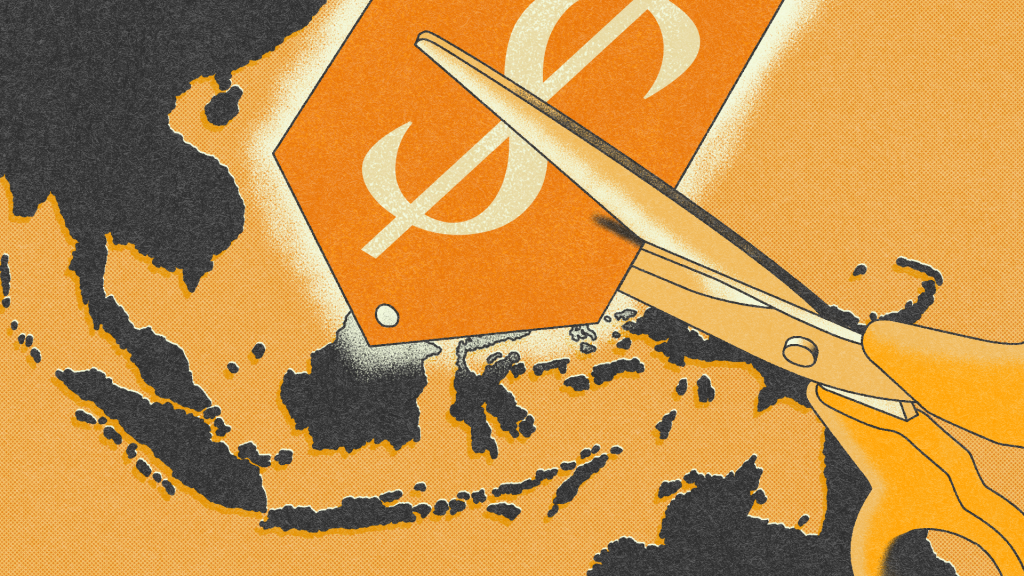
Image credit: Timmy Loen
According to Data.ai, Temu racked up 10.8 million downloads between December 11, 2022 and March 4, 2023, with about 11.2 million active users. It’s currently the most downloaded free app on both the App Store and Google Play in the US.
Temu’s monthly gross merchandise volume (GMV) shot up from US$3 million in September 2022 to US$192 million in January 2023, according to estimates by YipitData, a New York-based market research firm.
Within months, Temu (which means team up, price down) has been tagged as the most notable competitor of Shein, the pioneer of ultra-fast fashion. But Temu is not merely a Shein clone, nor is it an underdog.
Both Temu and Pinduoduo, the Chinese social commerce giant, are units of Nasdaq-listed PDD Holdings. This explains why Temu’s cutthroat efficiency, which it inherited from Pinduoduo, can provide some valuable lessons for its Southeast Asian peers.
The Pinduoduo factor
Globally, ecommerce players have been struggling as consumers curb spending to cope with rising inflation. Even US titan Amazon had to lay off 18,000 employees, close down warehouses, and fold up underperforming units.
But there’s a silver lining even in a market downturn. Temu went live in the US in September 2022, when the US consumer price index soared to 8.2%. Its timely entry and attractive price points are appealing to the mass market.
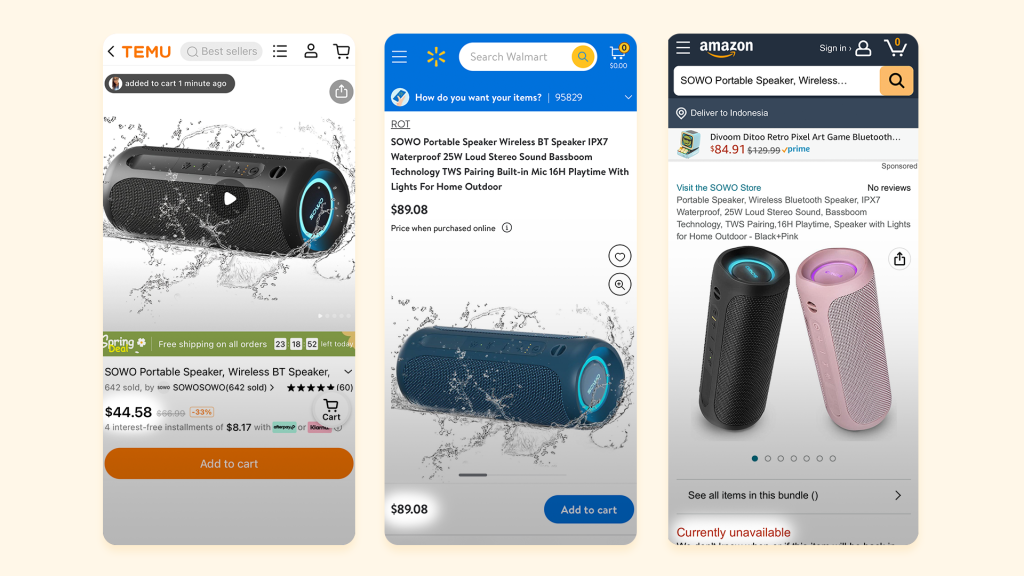
Price comparison of the same speaker on Temu, Walmart, and Amazon / Image credit: Timmy Loen/ Tech in Asia
Leveraging PDD Holdings, Temu can source from a global network of sellers built up by its parent company. “This access has enabled Temu to offer a wide range of quality products at very competitive prices all year round,” a company spokesperson said in an email to Tech in Asia.
Even though it was “only an idea in a Pinduoduo management meeting in January last year,” Temu scaled so fast because “Pinduoduo already knows which factories and merchants in China can deliver goods at the lowest prices,” points out Ed Sander, a digital tech analyst who runs content site ChinaTalk.
Not another Wish
Enter the challenger
An indefinite game?
Stay ahead in Asia’s tech landscape
This is premium content. Subscribe to read the full story.
Tech in Asia deciphers the factors behind the meteoric rise of Temu, Pinduoduo’s sister company.
We know this is not ideal. ⌛ Sign up in 20 seconds. Cancel anytime.
Our subscriber community includes professionals from these companies:





Stay updated on the go with our mobile app.
Get latest insights with smoother, more personalized experience through TIA mobile app.










📅 Upcoming Events
22 October 2026
Payoneer x CSPN Summit 2026