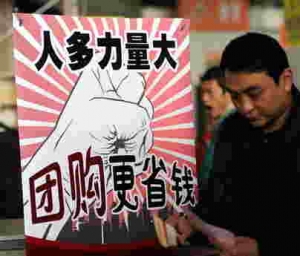
group buy in china: power to the people
The group buy industry in China is having a rough go of it. Aside from the layoffs and closings, there have been rumors of corrupt practices, dishonest advertising, and more.
So, the Industry and Commerce Department held a meeting last weekend in Hangzhou for research and discussion of how the group buy industry should be supervised. But, according to a report in the Beijing Business Times, many of the heads of big group buy operations here couldn’t be bothered to show up.
Unfortunately, the report doesn’t name names, but one gets the impression that almost no one important from the industry did attend. The meeting continued without them, and ultimately resolved that there are six major regulatory problems facing the group buy industry:
- There are no standards for companies entering the industry
- There need to be authentication standards for [group buy] websites
- Product inspection needs to occur at regular intervals
- The system for taxing group buy companies is still imperfect
- The responsibilites a company has for service after a sale are still unclear
- The relevant insurance systems haven’t come out yet
More interesting than the resolutions, though, is the question of why so many group buy leaders chose not to attend. Perhaps they were too busy firing people? I’m not sure, but it seems like a dangerous game to play for the leaders of an industry that already appears to be on the brink of collapse.
The internet sector is, or at least can be, tightly controlled by the government, and internet companies ignore the government at their peril. Moreover, the importance of “face” in Chinese culture makes the indifference toward this meeting look more like a slight — officials at the Industry and Commerce Department are going to feel they’ve been made to lose face, especially given that the story is now public and on the front pages of many national news portals.
Causing the government to lose face can be risky, but Penn-Olson reached out to a number of Chinese group buy sites for comment, and learned that for some, the meeting seemed to be missing the point. Ahn Seunghae, the founder and CEO of Letyo.com, a group buy aggregator site, told us:
LetYo.com supports the attempt by the government to rally group buying websites, in a bid to achieve a consensus with regards to recent happenings in the group buying scene. However, there is a problem in this. The group buying market in China is now very much different from what it was 1 year ago. The group buying industry has evolved. More and more group buying sites have diversified into other modes of businesses, often integrating other forms of e-commerce.
Also, bigger players in the e-commerce market, for example, 360buy.com (electronics), vipshop.com (luxury goods), ctrip.com (travel), and many other banks have also integrated group buying into their services. It is now very difficult for the government to categorize which companies are group buying firms, due to the integration of group buying services as mentioned previously.
As such, with the rapid expansion of group buying services into the e-commerce market, if the government wanted to resolve issues in this market, shouldn’t they then approach the entire e-commerce market, since all of them are now stakeholders in the group buying market? Thus, the targeted focus group should not only be group buying sites alone; to resolve these issues, the rest of the players in the e-commerce sector should be involved as well.
Indeed, with most major internet companies involved in some sort of group buy scheme, an initative that targets only group buy sites does seem to be sort of missing the point. Still, I can’t imagine it helped these sites’ case with the government to skip this meeting.
We’re following the group buy scene here pretty closely, so we’ll be sure to let you know how this regulatory discussion evolves, and if any of the other group buy sites we reached out to are willing to speak on the record, we’ll share their comments as well.





Stay updated on the go with our mobile app.
Get latest insights with smoother, more personalized experience through TIA mobile app.













📅 Upcoming Events
22 October 2026
Payoneer x CSPN Summit 2026