- Premium Content It takes our newsroom weeks - if not months - to investigate and produce stories for our premium content. You can’t find them anywhere else.
 Simon Huang · · 8 min read
Why SEA’s unicorn founders give up more equity than their peers
Southeast Asia’s business community is buzzing as many of the region’s tech unicorns prepare to go public. Bukalapak got the ball rolling, and others such as Grab and GoTo are set to follow suit.
Photo credit: 123rf.com
Their listings are a validation of the blood, sweat, and tears of their founders, who will be worth millions through the value of their stakes in these companies. Some may even become billionaires.
Some SEA founders own under 5% of their companies
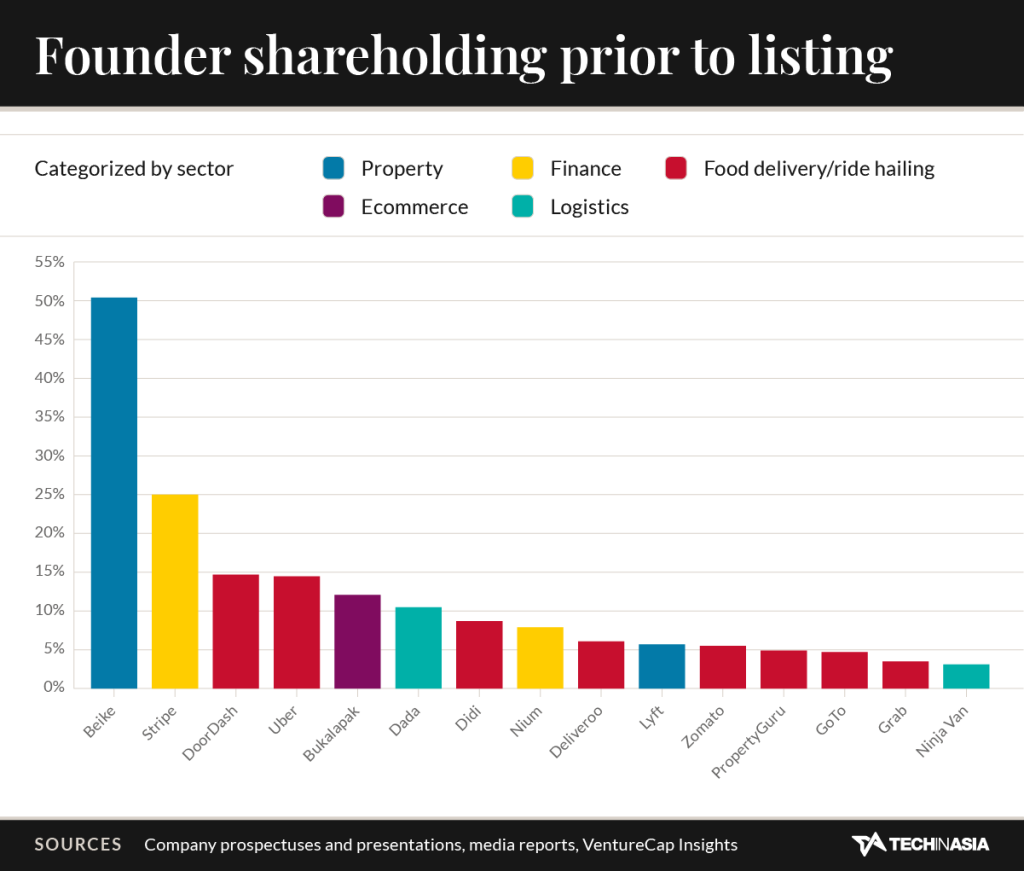
However, our analysis of data on large tech companies that have gone public over the past three years, as well as those that are planning to have an initial public offering soon, indicates that many Southeast Asian founders have faced greater levels of dilution compared to their peers from other regions. While this isn’t a complete list, the companies here represent some of the most prominent (mostly consumer) tech IPOs of the past few years.
This is not to put a damper on the excitement surrounding these listings, but the issue is an important one to consider, especially if there are ways to ensure that, going forward, founders can enjoy a higher stake in their companies.
Out of the 15 startups on the list, nine have gone public. In these firms, founder shareholdings before listing ranged from 5.5% to 50.4%, with a median of 10.6%. This group includes Bukalapak, whose three founders collectively held 12.1% of the company before its IPO.
Five of the remaining six companies are Southeast Asia-based. They are expected to go public between now and 2023, and their founders hold stakes between 3.4% and 7.9%, with a median of 4.8%.
Is ride-hailing or food delivery inherently more dilutive?
What’s behind the lower shareholdings of the region’s founders?
Perhaps, building a business in a sector like ride-hailing or food delivery may require more cash upfront than other industries.
Even large markets can only support a handful of players, and the network effects are limited to a particular geographic location. With an undifferentiated product, companies who want to build market share have to spend on incentives for drivers and consumers.
Indeed, of the 15 companies above, the five that raised the largest amounts prior to listing – Uber, Didi, Grab, GoTo, and Lyft – are all in the ride-hailing and/or food delivery sectors.
However, the evidence is inconclusive. There were some companies from those two sectors in our list where the founders held a larger share compared to their counterparts from other industries. The stakes in these food delivery and ride-hailing businesses were also distributed pretty evenly.
The benefits of focusing on a single market
It’s still early innings for venture debt in Southeast Asia
Debt: crown of thorns or halo?
Could corporate investors play a bigger role?
Stay ahead in Asia’s tech landscape
This is premium content. Subscribe to read the full story.
The star founders of the region are set to become millionaires as their companies go public, but they have taken a large equity hit.
We know this is not ideal. ⌛ Sign up in 20 seconds. Cancel anytime.
Our subscriber community includes professionals from these companies:





Stay updated on the go with our mobile app.
Get latest insights with smoother, more personalized experience through TIA mobile app.