 Samantha Cheh · · 5 min read
Navigating the changing digital advertising landscape

With the pandemic pushing consumption online, digital marketing has reached its peak. More money is being spent on digital marketing and advertising than ever before, and it has overtaken all other formats for the first time in 2021.
Before digital, advertising was more art than science: Marketers were heavily reliant on “impressions” as a measurement of an ad’s effectiveness based on how many times it’s seen.
“Everything was based on an impression, like how many people drove past a billboard,” observes Michael Hahn, CEO and founder of digital advertising platform ReverseAds.

ReverseAds founder and CEO Michael Hahn / Photo credit: ReverseAds
While impressions are important because they signal the beginning of an interaction with a customer, marketers soon dropped cost-per-click (CPC) models and moved towards those optimized for actual sales or conversions.
These new “attribution-based” models were made possible by the emergence of cookie and tracking technologies like Facebook Pixel and Google’s AdWords, which allow marketers to glean specific consumer data.
A complicated space
However, the evolution of adtech has led to its fair share of problems.
Greater awareness around data privacy has led the industry to shift away from third-party cookies, presenting an entirely different challenge for advertisers left in the dark.
Another problem is attribution, a key metric that helps advertisers figure out how to charge their clients by tracking where certain actions occur during a user journey. The issue is further compounded by the sheer number of digital ad players out there, as well as factors like multi-click attribution, click fraud, and accidental clicks.
However, some of the biggest challenges facing marketers can be summed up in two names: Facebook and Google.
Over the last 20 years, these companies have become the “default option.” In 2021 alone, these tech titans accounted for over half of global digital ad revenues outside of China, alongside retail giant Amazon.
Hahn likens Facebook and Google to “public utilities” because of their ubiquity. With their huge digital footprints, Facebook and Google are continuously engaging users across other platforms such as Instagram and YouTube.
A digital ad duopoly
As a result of this reality, both companies have the power to set prices, resulting in reduced returns for advertisers. This duopoly also has little incentive to make changes to their platforms that benefit anyone but themselves.
Google and Facebook’s “walled gardens” – environments where the platforms control users’ access to content and services – are yielding fewer advantages for advertisers than before. Social platforms like Facebook don’t drive actual product sales, especially for considered purchases like business-to-business services, cars, or luxury goods, which require more thought and involve a high degree of financial or emotional risk and reward.
“Consumers browsing social media aren’t in the mindset to make serious purchases,” points out Hahn.

Photo credit: 123RF
In fact, even a search maverick like Google isn’t meeting the needs of brands because a lot of search activity is moving elsewhere, such as ecommerce platforms.
Another issue marketers face is the pricing models imposed by Google and Facebook. Facebook frequently changes its algorithm, making it difficult for brands to reach their target audiences. In turn, this uncertainty essentially forces advertisers to buy the algorithm’s favor.
Meanwhile, Google’s bidding-based model drives advertisers to pay a fee for every gleaned impression – without the promise of conversions. ReverseAds says that some of its clients like German automaker BMW have had to spend up to half of their budgets just to ensure that they stay ahead of the competition in terms of search rankings.
“You shouldn’t have to do so in a just internet,” says Hahn. “It’s almost like paying the internet gods to allow your brand’s name to come up.”
The first true alternative to Google
From the beginning, ReverseAds was designed to be a true alternative to Google in the face of privacy concerns.
“We didn’t want to build a product that was dependent on tracking users’ every movement online,” he recalls.
ReverseAds’ “cookie-less” technology leverages artificial intelligence and machine learning to predict consumers’ behavior before presenting ads at the right time and the right place.
Hahn explains that ReverseAds opens up opportunities “after search,” which refers to the time after a user’s first keyword search, when they leave the search engine and enter the open web. Advertising on the open web is based on predictions of the user’s path to purchase made via ReverseAds’s patented Keywords Assignment Algorithm.
“The step after search – after you leave Google’s properties – is just as important or even more so in the purchase process for long-consideration products,” Hahn says.
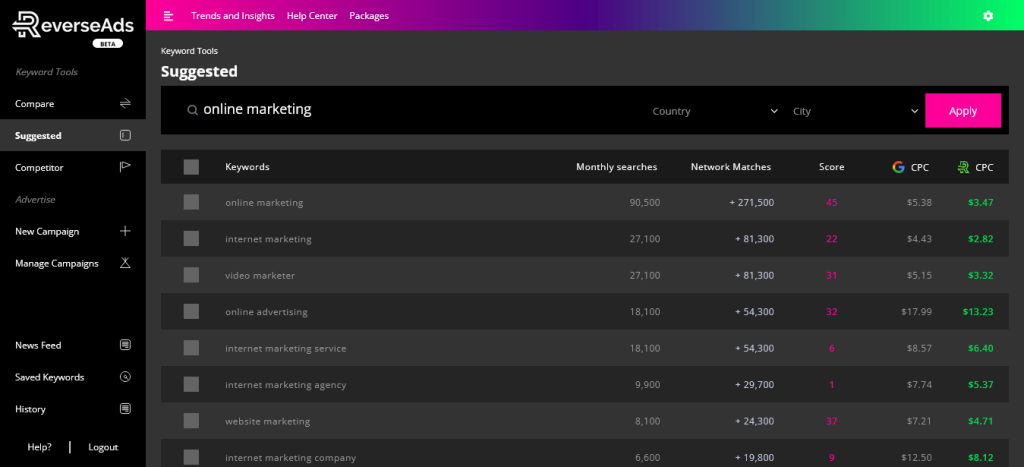
Photo credit: ReverseAds
In a head-to-head comparison, the cost of purchasing the same keywords in after search is roughly half of what Google charges, leading to lower prices for advertisers for an equal amount of value. Furthermore, instead of relying on traditional metrics like CPC, ReverseAds has pioneered the “cost-per-intent” (CPIn) model, where advertisers are only charged for quality clicks.
Hahn explains that by using CPIn, ReverseAds can measure the quality of a click by applying the Internet Advertising Bureau’s (IAB’s) rigorous 22-second standard, where a click is only measured if a user spends at least that much time on a website, visits three pages on the site, or reaches 100% scroll depth on the landing page, enabling meaningless or accidental engagement to be automatically weeded out.
He says that the CPIn model allows brands “to grow a big database of users who actually demonstrate real intent without paying extremely high rates just to buy on a conversion basis.” The firm also focuses on ensuring ads are shown to users at a time when they are receptive to them.
Changing the ad experience
As the industry gradually matures, Hahn emphasizes the increased desire for privacy and personalization in the internet experience of users, which in turn will lead to an “ad-less” future.
“I know that sounds strange, but we think advertising has to stop being advertising,” he says. “Users are going to continue demanding their privacy online, and advertising is going to have to be a benefit, not a nuisance.”
Hahn also predicts that customers’ disdain for ads will naturally push more advertisers to innovate new kinds of predictive engagement models that reimagine the core of advertising itself.
“We’re really working to change the experience of what an ad is,” he concludes.
ReverseAds is building the world’s first true alternative to Google search ads by leveraging artificial intelligence and predictive keyword assignment technology to help businesses reclaim their online advertising ROI and connect with valuable, high-intent users.
Learn more about how ReverseAds’s revolutionary cost-per-intent model can help you reap the best returns on your online ads.
This content was produced by Tech in Asia Studios, which connects brands with Asia’s tech community. Learn more about partnering with Tech in Asia Studios.
Stay updated on the go with our mobile app.
Get latest insights with smoother, more personalized experience through TIA mobile app.
Recommended reads
 How ecommerce firms can get the most bang for their buck with digital advertising
 France hits TikTok with $5.4m fine over data tracking
 Engaging Gen Z through interactive gaming
 CapCut could be ByteDance’s next cash cow
 How you like that: Behind Tokopedia’s K-wave marketing campaigns
 The necessary nature of branded content
 Line to launch NFT marketplace in Japan next month
 Don’t play nice: guerrilla marketing for SaaS startups
 What’s next for Ajaib and peers as SEA’s trading frenzy fizzles out?
 Boom times for affiliate programs in Indonesia as Tokopedia, Shopee onboard influencers





Editing by Stefanie Yeo, Nathaniel Fetalvero, and Eileen C. Ang
(And yes, we’re serious about ethics and transparency. More information here.)






📅 Upcoming Events
22 October 2026
Payoneer x CSPN Summit 2026