 Nathaniel Fetalvero · · 4 min read
This is the biggest challenge that small firms face in meeting customer demands

The Fourth Industrial Revolution has led to the increasing adoption of technologies like AI, the internet of things, big data, and more, which are changing the ways companies – especially smaller ones – do business.
Another factor that has created this shift is the growing demands of consumers. According to Salesforce’s Small and Medium Business Trends Report, which surveyed over 2,000 small and medium-sized business (SMB) owners and leaders worldwide, 34% of companies said that keeping up with the changes in customer expectations is the biggest challenge they face in meeting their demands.
“[Consumers] want specific information,” says Chris Yio, Salesforce’s regional vice president of SMB in Asia. “If we cannot find that information, we will go to the next website. This is how customer behavior has changed.”
Competing with big corporations
SMBs face tough competition from larger corporations, which typically have the resources to hire entire teams of sales, marketing, and customer service experts to address their users’ concerns. In fact, Salesforce’s report found that 53% of SMB leaders felt that they were at a competitive disadvantage versus enterprises in meeting their customers’ expectations.
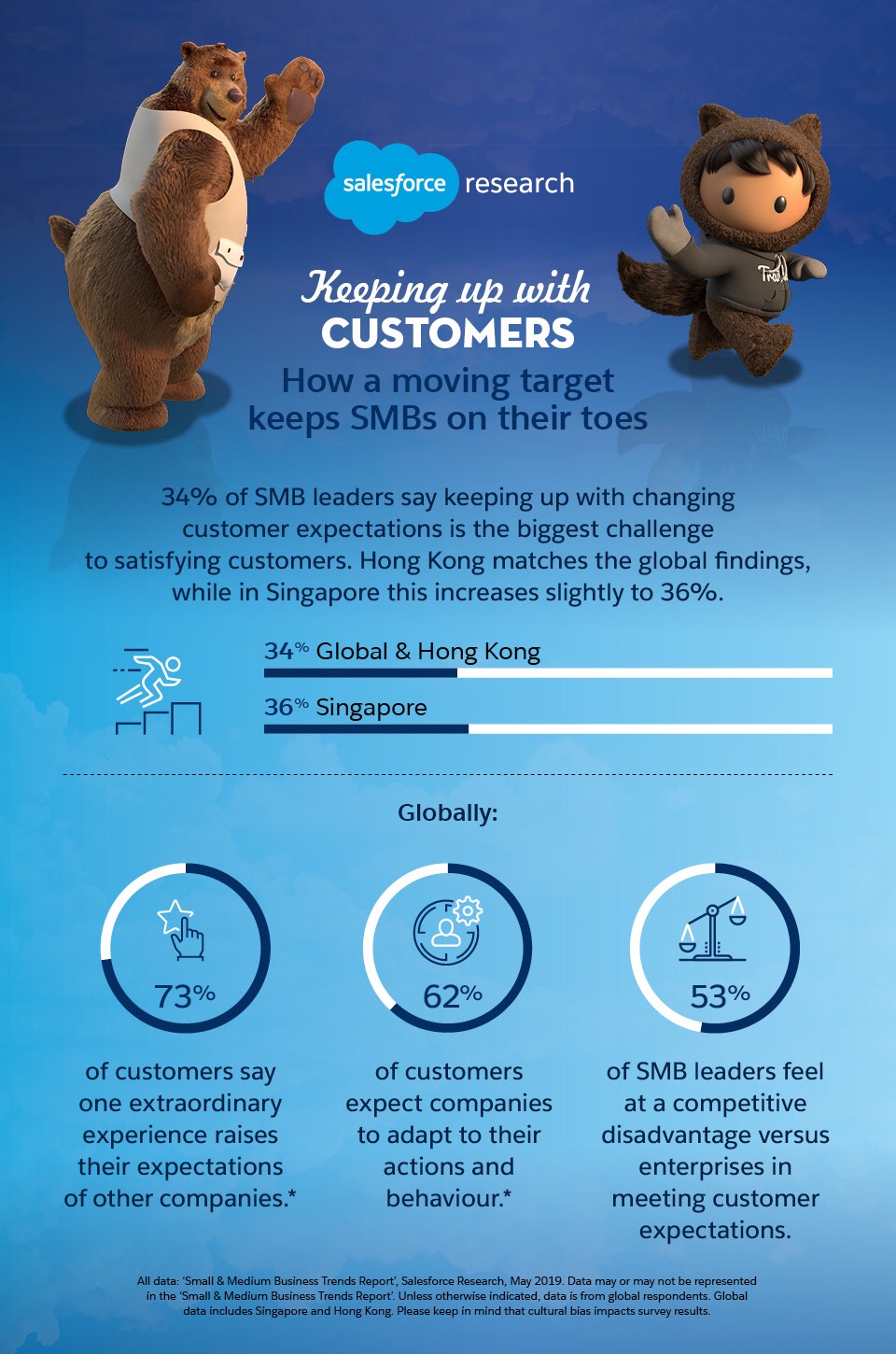
Image credit: Salesforce
To match that level of user satisfaction, SMBs would need to “create structures and processes to train and elevate employees to the level where they need to be,” advises Yio. “The question is: How do businesses – big or small – transform to connect with their customers in a whole new way?” he adds.
This is where technology comes in. For tech-savvy SMB owners, adopting new systems can help them compete with bigger players.
“In this digital era, it’s about how you adopt technology to be able to find more customers effectively through your website, win more deals by more efficiently engaging customers, and keep customers happy by serving them better through channels such as phone, email, and social media,” shares the executive.
One example of how technology can enable better user experience is when companies onboard new customer service employees. Typically, new hires lack the experience or knowledge required to handle a customer’s query. But with tools like Salesforce, service agents gain greater visibility on the past interactions that a business has had with different consumers, says Yio.
“Equipped with that knowledge, the customer agent can now get up to speed and serve the customer better by quickly finding answers to solve the problem,” he explains.
Building trust through personalized service
When a business engages with people in a way that shows its understanding of their needs, it establishes a relationship of trust between them – a difficult task because of ever-changing consumer demands.
“We are in a new age of service,” says Yio. “Service impacts every moment of the customer journey, all the way from pre- to post-purchase, and each of those is an opportunity to deliver value and create deeper relationships that will turn customers into brand ambassadors and make your business thrive.”
He adds that growing a business the traditional way requires “a lot of salespeople, marketers, and service agents.” With technology, SMBs are able to broaden their reach without having to go on a hiring spree. It also enables them to scale smoothly when faced with the hurdles of expansion.
See: The lessons Eatigo learned in its early days
When Eatigo began entering new markets, for instance, it needed to do two things: speed up its restaurant onboarding process and engage with end users at the right times. Using Salesforce’s service and marketing cloud tools, the restaurant booking and discount platform was able to successfully accomplish those tasks without having to incur the additional costs of hiring a significant amount of staff.
“There was really no other way [for Eatigo] except to use technology to run their business because they came to a point where they weren’t able to invest in more human resources to cover their customers,” Yio recalls.
It doesn’t matter what your name is
Today, people often care little about who they’re dealing with – be it an enterprise, a startup, or SMB.
“The customer will not be concerned if the company is big or small, but whether you would know them intimately [enough] to be able to provide the products and services they want,” claims Yio. With widespread access to technology, he adds that SMBs “are no longer disadvantaged by being small.”
However, Asian businesses face a unique challenge.
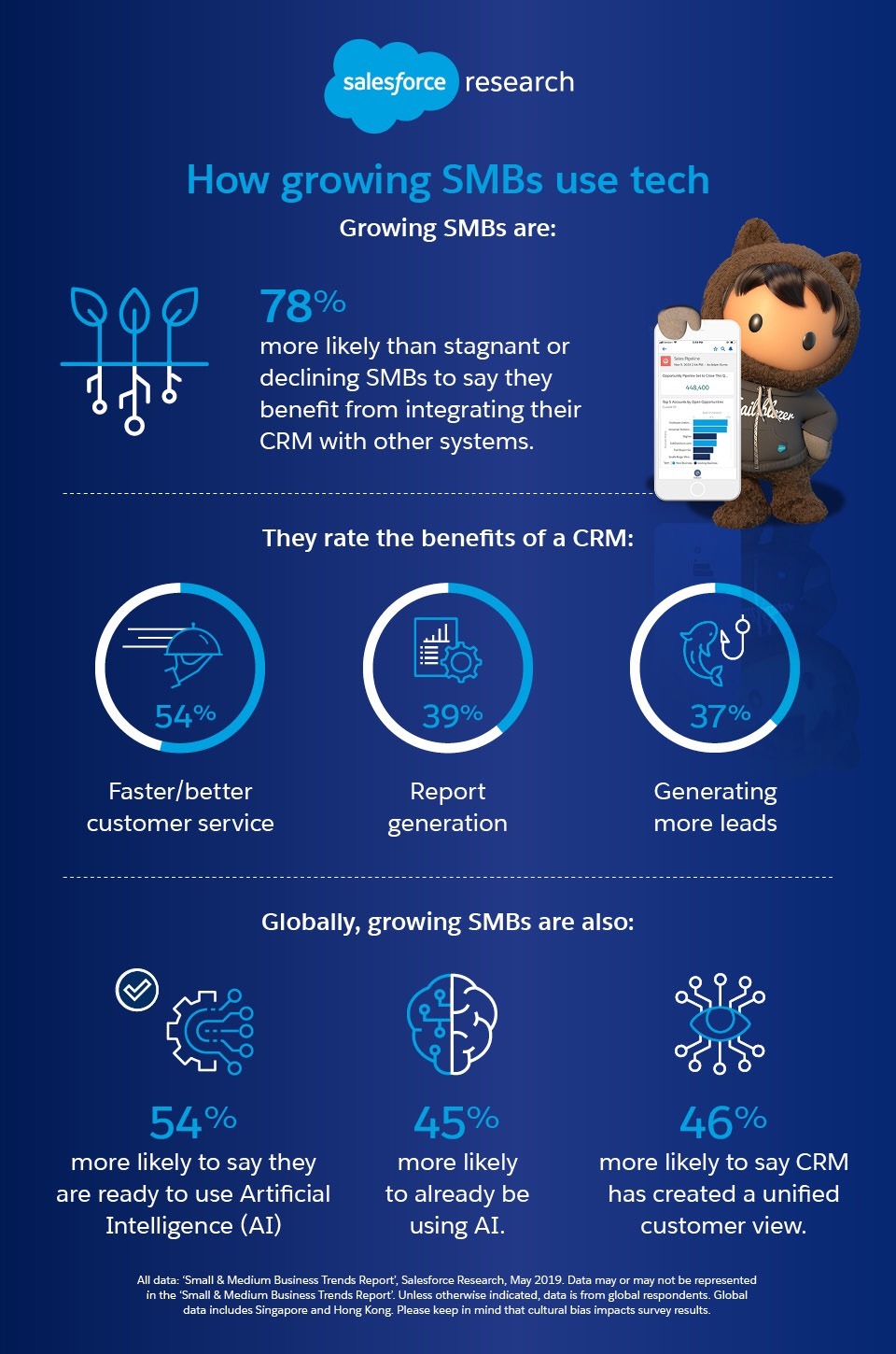
Image credit: Salesforce
While most SMB owners in the region understand that technology can make their lives easier, they often default to managing their data manually in spreadsheets and through email, notes Yio. In order for companies to meet rising customer expectations, they need a single view of their consumers and their own technology to provide the relevant and personalized experience that their users expect. But before this can happen, Yio posits that SMBs will need to be properly educated about the tools at their disposal.
“In Asia, we are seeing that some SMBs know that they need to adopt technology, but they don’t know where to start,” he says. “They need to understand what technology is currently available that can help them achieve their growth objectives.”
Salesforce brings companies and customers together. It’s the global leader in integrated customer relationship management, which gives all departments – from marketing and sales to commerce and service – a single, shared view of every user to deliver the personalized experiences that they expect.
Read Salesforce’s Small and Medium Business Trends report to get insights and trends from over 2,000 SMB leaders worldwide.
Stay updated on the go with our mobile app.
Get latest insights with smoother, more personalized experience through TIA mobile app.
Recommended reads
 How Europe wins the AI race in SAP CEO’s view
 This startup makes durian season last all year with freeze tech
 Why AI is hiring problem, not just a technology one
 Zhipu AI’s formula for surviving China’s tech market
 Why ‘too expensive’ is just a decoy for leaving customers
 AI is shrinking SaaS moats, redefining sales
 Shopee’s using AI – and more – to make marketing easy for MSMEs
 Microsoft’s bet: What’s left when AI models are commodities?
 How a 20-minute email edit explains the AI scaling problem
 Why Google is forcing travel sites to pivot or die




Editing by Jaclyn Teng and Eileen C. Ang
(And yes, we’re serious about ethics and transparency. More information here.)






📅 Upcoming Events
22 October 2026
Payoneer x CSPN Summit 2026