Paul Bischoff · · 3 min read
This is where the Saito brothers invest their money in Japan (#StartupAsia)
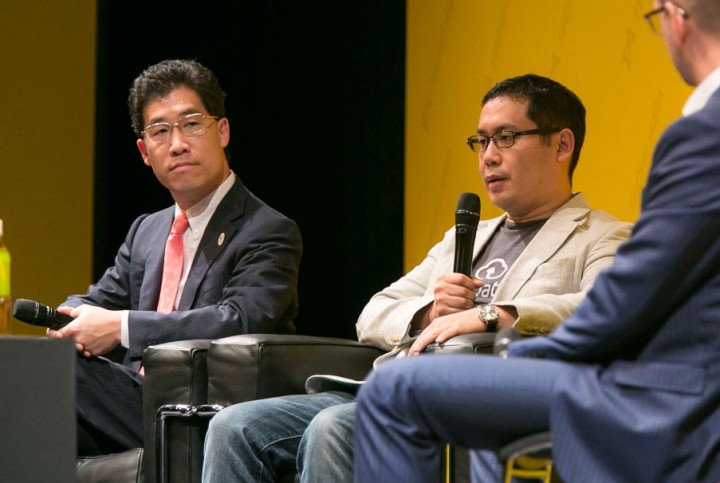
Daniel and William Saito are two of the most prominent startup investors in Japan, and their name has become ubiquitous among entrepreneurs here. Besides working as investors, Daniel is the managing director of FlyData and the CEO of RedRobot, while William serves in the prime minister’s cabinet as a special advisor focused on innovation and is involved in one of Tokyo’s premiere co-working spaces.
So where are the two brothers putting their money? While they agreed with much of each others’ advice during a fireside chat on stage at Startup Asia Tokyo 2014, their preferred sectors rarely intersect.
Daniel likes agriculture and startups that can innovate on big data. “In theory, if your data is growing, then you business is going well,” he says.
Most of William’s 19 investments have been in biotech, batteries, security, and other hardware. “The shrinking and aging demographics here is a huge one, and I see it as a huge opportunity in the next 10 to 20 years,” he says. Currently, there are 4.3 young people taking care of every one elderly person in Japan. “When I’m at retirement age there will only be 1.1 person to take care of me.”
And Japan is not alone, although its situation is probably the most severe in the world. William says other developed countries will be in the exact same position in 10 to 15 years, and Japan can lead the way. He doesn’t have faith in big corporations to make breakthroughs in this area, so venture companies will fill the gap.
See: Whill, an anti-wheelchair that’d make Professor X jealous, debuts on Kickstarter
As for Japan’s famous hardware sector outside of healthcare application, William says Japan will excel at robots that make other robots. He also has faith in Japan’s 3D printing industry. Daniel foresees a surge in drone technology.
But William warns against investing in technologies that compete with Moore’s Law – the observation that computing power doubles every 18 months. He names these as transistors, communication tech, sensors, and storage. These technologies become cheaper to the point that they’re nearly free within just a few short years, and that devaluation makes them dangerous investments.
“When you compete against Moore’s Law, there are countries that are going to do this faster and cheaper,” Williams says. Instead, he advises investors to look for startups that use these technologies rather than make them, as their incurred costs can only drop. “Japan needs to take advantage of these technologies.”
Both Saitos agree diversity is also a vital aspect to a successful venture. Daniel’s co-working space, Mov, is one of the most diverse in Tokyo. About one-third of its members are foreigners. Of William’s 19 venture investments, 15 are led by women, because women in turn tend to hire more diverse teams.
Finally, with the Olympics fast approaching Tokyo in 2020, opportunities for innovation will arise. Startups and their investors can capitalize on technologies to “find the next Shinkansen,” Japan’s famous high-speed railway. Both brothers foresee the 2020 Olympics as a catalyst for innovation, specifically mentioning cyber security and space and crowd management.
See: Japanese-American entrepreneur William Saito: I only bet on those who have failed
Japan’s grant system has to change
Japan’s venture capital ecosystem has many problems, but William pointed to one in particular. An obstacle to effective venture capital in Japan, William says, are the subsidies and grants that the national government makes “too easy” for Japanese startups to receive.
These grants are worth up to half a million dollars, but it doesn’t force startups to build something viable in the open market, and often turns into research money instead of practical application. But rather than eliminate the subsidies completely, William suggests a venture capital matching system, wherein a startup would receive as much government money as it first raises from private investors up to a certain threshold.





Stay updated on the go with our mobile app.
Get latest insights with smoother, more personalized experience through TIA mobile app.