Terence Lee · · 6 min read
Perx dumped daily deals business to focus on loyalty card app, has no regrets
Before Perx co-founders Andrew Roth and Jon Sugihara started work on their loyalty card mobile app, which is now the market leader in Singapore, they ran successful daily deals site PLAYhawaii.com. It was on track to generate US$2M in revenue a year.
Based in Hawaii, they expanded their business to Asia, founding Maiplay last year with Facebook co-founder Eduardo Saverin as an investor and advisor. They launched in Jakarta and Singapore, entering a heated field dominated by Groupon.
However, they dumped their daily deals business within months. They sold PLAYhawaii.com and launched their loyalty card mobile app in October 2011. They’re now based in Singapore.
What sparked the change was their belief that daily deals is a lousy way to acquire loyal customers for merchants. The hunch paid off: At the time of the interview, Perx had close to 40,000 registered users, and about 400 merchants in Singapore, with 10 to 20 new locations each week.
Their partner merchants are not lightweights either. Big brands like Popeyes, Famous Amos, and Dunkin Donuts have come on board. With pole position in the country secured (around!, Pointpal, and Squiryl are competitors), they are now working with a partner to scale their business to other parts of Asia.
“When we call merchants, we really had to tell them not to hang up as we’re not a daily deals company.”
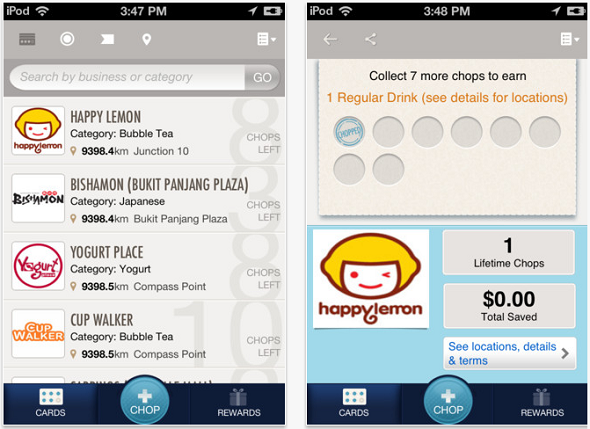
Perx works very simply for consumers. Once they open up the app, they will find merchants that are near their location. They can get a “chop” from the merchant every time they spend, simply by scanning a QR code. Rewards can be redeemed once they hit a certain amount of chops on a loyalty card. To date, Perx has registered 160,000 chops.
Elaborating on the problems with the daily deals model, Jon points out a fundamental conflict between daily deals sites and merchants: While sites like Groupon and LivingSocial are concerned with procuring as many deals in as short a time as possible, their clients are actually after loyal customers.
“When we call merchants, we really had to tell them not to hang up as we’re not a daily deals company. Merchants were fatigued with group buying sites,” says Jon.
Deals, which can give a discount between 60 to 80 percent, tend to attract bargain hunters, and merchants hate that. Perx weeds bargain hunters out, simply by rewarding users after one chop instead of offering a steep discount right away.
Perx differentiates itself from other loyalty card apps by offering not just analytical tools as a value proposition, but the ability to increase revenue and decrease costs for merchants through “Chopmobs”.
“Offering just a replacement for a paper loyalty card doesn’t excite CEOs,” says Andrew.
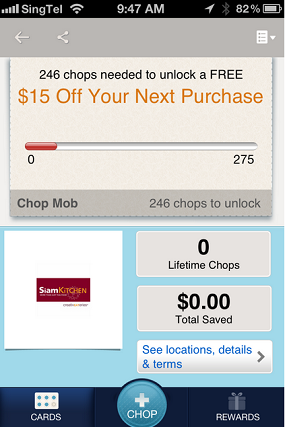 Perx’s Chopmobs have been rather successful in generating top-line revenue for merchants, through increasing sales by 30 to 50 percent in any given week. The company takes a commission from the sales, or 25 percent of the value of reward items.
“We don’t want to send invoices to small merchants all the time. We don’t want them to feel like they’re getting cut everytime they get a chop.”





Stay updated on the go with our mobile app.
Get latest insights with smoother, more personalized experience through TIA mobile app.