Disconnect is a weekly column in which Tech in Asia’s Charlie Custer pokes at holes, plays devil’s advocate, or otherwise attempts to rain on the tech industry’s parade.

Original image via Asia Society
Like most news that PR people fear could be taken poorly, the news that Alibaba is buying the South China Morning Post came late on a Friday. It’s not clear how much the company spent acquiring the paper and its assets (though I’ve seen estimates of around US$100 million), but the end result is that Jack Ma and company now own SCMP.
Why is Alibaba buying a newspaper? Here’s the company’s explanation, straight from the press release:
“The South China Morning Post is unique because it focuses on coverage of China in the English language. This is a proposition that is in high demand by readers around the world who care to understand the world’s second largest economy,” said Joe Tsai, executive vice chairman of Alibaba Group. “Our vision is to expand the SCMP’s readership globally through digital distribution and easier access to content.”
But it’s not just about covering China. It’s about making China look good. In an interview with the New York Times, Mr. Tsai said that “when people don’t really understand China and have the wrong perception of China, they also have a lot of misconceptions about Alibaba […] What’s good for China is also good for Alibaba.” In fact, Alibaba even hired Eric X. Li – a Shanghai venture capitalist who is notorious for his spirited defense of China’s government and political system in English-language media – to consult on the SCMP purchase.
In other words, this is a political move. Alibaba is buying the South China Morning Post to spread a positive narrative about China. That’s a terrible idea.
To begin with, Jack Ma seems to be breaking his own advice here. He has repeatedly said that one should “love the government, but never marry it,” meaning that one should cooperate with the government but (again, these are his own words): “never do projects for [it].” But operating the South China Morning Post as a pro-China paper is essentially doing work for the government. It’s for-profit political propaganda.
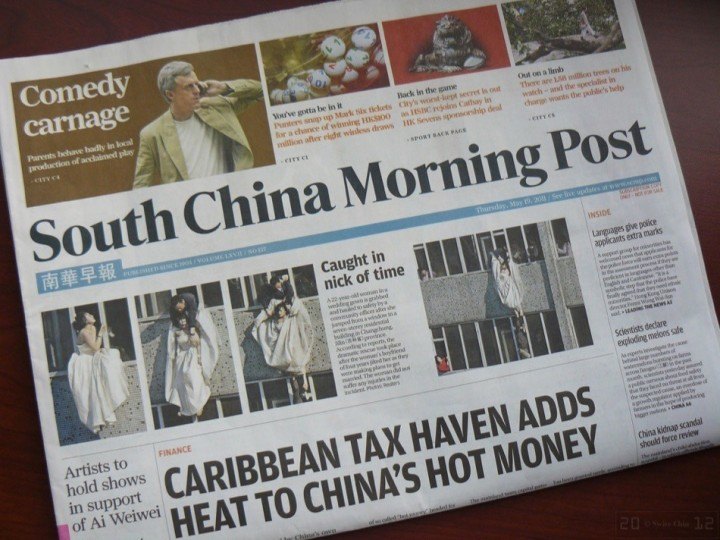
It’s getting harder to imagine Ai Weiwei on the front pages of this paper. Photo credit: Canadian Pacific.
Why this matters
Now, how much this will actually change things at the South China Morning Post remains to be seen. The paper was once lauded as one of the few major China-based media outlets that had the guts to report on topics mainland China’s government didn’t want covered, but since the paper was purchased by the Beijing-friendly Kuok family in the 1990s, it has seen a series of high-profile firings and departures and has increasingly been accused of pro-China bias. For example, when prominent Chinese labor rights activist Li Wangyang died under suspicious circumstances, many papers ran it as a frontpage story with full coverage, but SCMP – at the orders of the paper’s chief editor – ran it as a short news brief that it “buried in the back pages.”
Given that (and a litany of other similar stories), some would say that Jack Ma’s influence on the paper is likely to be minimal because the SCMP has already become a pro-China newspaper. Plus, it has a circulation of less than 100,000. As my former colleague Josh Horwitz put it: “Who cares?”
In terms of the effects on the South China Morning Post’s editorial independence, I’m inclined to agree. That ship, as they say, has already sailed. Or perhaps sunk. Alibaba isn’t likely to push the paper much closer to Beijing’s Party line because (at least according to many of its critics) it’s already pretty damn close.
PR nightmare
Journalism does not work that way





Stay updated on the go with our mobile app.
Get latest insights with smoother, more personalized experience through TIA mobile app.










📅 Upcoming Events
22 October 2026
Payoneer x CSPN Summit 2026