This article was written after substantial discussions with Bernard Leong.
 Rocket Internet appears to be in transition. According to Business Insider, the clone factory has not been churning out copies of US startups for months, opting instead to consolidate its existing ventures and build on them.
With the Samwer brothers’ new USD 193M fund, we might even see Rocket Internet source for its own dealflow rather than copy successful US consumer internet companies.
As for its existing businesses, building them towards a public offering suddenly becomes a viable option — if done right, the Samwer brothers could end up becoming far wealthier than they already are now.
Rocket Internet is unlikely to go public with its entire suite of ventures. That would severely handcuff the company, curbing its ability to start new businesses without incurring shareholder’s wrath.
Instead, Rocket Internet may choose to take one of its holding companies public (Bigfoot II, consisting of Zalora, Zando, and The Iconic, could be a candidate). Or, it could pick a particularly lucrative venture like Zalando.
However, there are several possible reasons why a Rocket Internet IPO can be delayed or derailed. We will examine them in turn to see how they may impact its decision to go public.
Failure to meet entry requirements
Listing a company on the stock market is not difficult. Looking at the Singapore Stock Exchange for example, candidates can pick between the Mainboard for large cap companies and Catalist for smaller firms.
While listing on the Catalist is the easy route, it is one that Rocket Internet does not need to take, since its companies have the clout and resources to get onto the Mainboard. It’s preferable too, as stocks on the Catalist are perceived to have higher risk, scaring away some retail investors and restricting a company’s access to capital.
To see if Rocket Internet is ready for an IPO, we can look at the valuation estimates of Zalando, Lazada, and Zalora for a start:
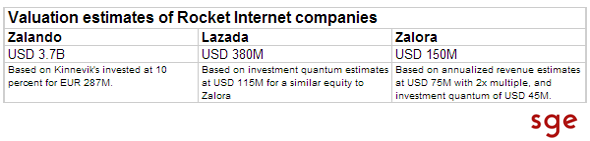
There are several things we need to note about these estimates. Firstly, valuation at the growth stage of a company is highly subjective, since it is impossible to value a company using EBITA due to the losses accumulated from capital spent on expansion.





Stay updated on the go with our mobile app.
Get latest insights with smoother, more personalized experience through TIA mobile app.










