- Premium Content It takes our newsroom weeks - if not months - to investigate and produce stories for our premium content. You can’t find them anywhere else.
 Scott Shuey · · 5 min read
Robots still struggle with touch. Sharpa wants to fix that
For decades, advancements in robotics have come in bursts. Mobility came first, followed by the ability to see and navigate the environment.
The next phase will involve teaching robots a skill that will allow them to become useful outside of controlled surroundings: touch. To interact with the world, they must first learn how to handle it – literally.
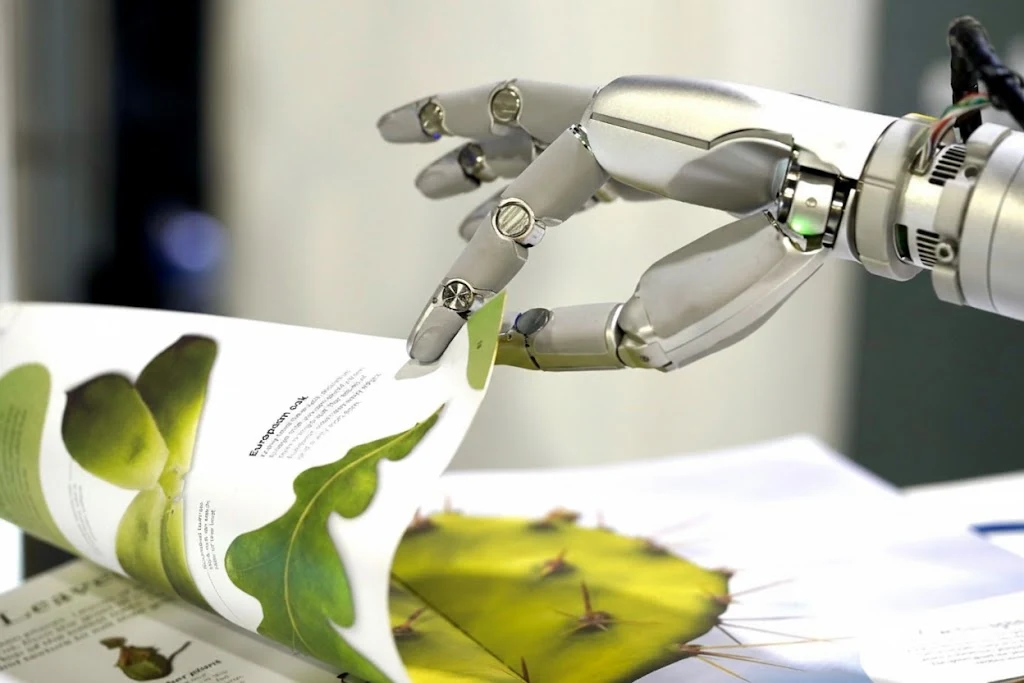
A Sharpa robotic hand demonstration at a robotics conference in 2025./ Photo credit: Sharpa
But so far, the inability of robots to use their hands with anything close to human precision has been a stumbling block, albeit one that is being aggressively addressed across the industry.
This challenge was on display at this year’s Consumer Electronics Show, where Singapore-based Sharpa won a CES 2026 Innovation Award.
Instead of leaning on the typical theatrical demonstrations used at big shows, the company focused on tasks that required dexterity, such as handling flexible materials like paper, as well as other actions requiring coordination between vision and touch.
See also: Rlwrld takes aim at US robotics giants with new foundation model
The demonstrations show the shift underway in robotics: Dexterity, not mobility, is what may finally move robots from factory jobs and into homes.
“Robots can backflip, dance, box, whatever. But they cannot cook you a burger,” Alicia Veneziani, Sharpa’s global vice president of go-to-market and president for Europe, tells Tech in Asia.
The startup was established in late 2024 by Shaoqing Xiang, David Li, and Kai Sun. Veneziani says that since its founding, Sharpa has treated robotics as a tactile-first problem.
The three founders also set up Hesai Technologies, a lidar company, in 2014.
Sharpa is raising a series A round but declined to provide financial details. While the startup is headquartered in Singapore, it also has a research and development unit in China and business offices in the US.
It begins with manipulation
Sharpa has organized its strategy around the belief that “manipulation is productivity” – the premise being that touch must be at the center of robotics development.
While robots have improved steadily in navigation and perception, touching and holding objects introduce a different level of complexity. Machines must regulate their grip strength, react to slippage, and adjust to variations in weight, texture, and resistance – often within fractions of a second.
Consumer robotics
Making your own data
Stay ahead in Asia’s tech landscape
This is premium content. Subscribe to read the full story.
As AI moves into the physical world, touch is emerging as a major constraint. Sharpa shows why data – not hardware – may define robotics’ next phase.
We know this is not ideal. ⌛ Sign up in 20 seconds. Cancel anytime.
Our subscriber community includes professionals from these companies:





Stay updated on the go with our mobile app.
Get latest insights with smoother, more personalized experience through TIA mobile app.













📅 Upcoming Events
22 October 2026
Payoneer x CSPN Summit 2026