 Samantha Cheh · · 6 min read
The 3 biggest mistakes founders make with their business finance tool

Summary:
- Entrepreneurs can spend over a third of their workweek on paperwork. This is where business finance tools can help by streamlining a tedious process.
- When selecting the right tool, founders often make these three mistakes: focusing on software, not services; opting for more features instead of the essentials; and ignoring the power of financial insights.
- Ultimately, founders need to ensure they are working with a provider that is speedy, responsive, and gives them peace of mind.
- Learn more about Osome and how it built an AI-enabled business management platform that founders and companies trust.
Even in this digital age, business owners can’t escape the eternal drag of paperwork, whether it’s licensing applications or bookkeeping. By some estimates, daily admin can add four additional hours to a founder’s day, even as they’re already spending more than a third of the workweek on tasks like emails, invoicing, and data entry.
That burden only gets heavier with time, which is why founders in the early stages of the journey typically turn to business finance platforms to handle their paperwork.

Photo credit: David Gyung / Shutterstock
Not all platforms are made equal, and taking a one-size-fits-all approach to these tools can be limiting.
“When it comes to accounting services, freelancers and solopreneurs will have different needs from someone who is just setting up shop,” says Tamas Gogge, chief product officer at Osome, a provider of incorporation, bookkeeping, and accounting services.
But given how fragmented the accounting services market is, picking the right solution with the appropriate combination of tools is easier said than done.
Gogge highlights three big mistakes founders typically make when it comes to choosing a provider.
1. Focusing on software, not services
Startups can err on the side of familiarity by defaulting to big-name accounting solutions like QuickBooks and Xero, ignoring the underlying services in favor of software.
“These are really amazing software but they’re still just software,” Gogge says. “So unless you run a super simple business or it’s the 25th company you’re building in the exact same way, you’ll still need an accountant and probably a tax advisor to manage your books.”

Tamas Gogge, chief product officer at Osome / Photo credit: Osome
Even large companies that have accounting software still consult financial advisors before making big decisions.
Osome understood early on the need to provide this blend of human expertise and digital capability, which is why the company built its platform with people in mind. Users can directly engage with a dedicated accounting team through live chats to ask questions and get advice on the best way to manage their cashflow.
Incorporating your company? Fill out this form to download a handy guide from Osome
“Not only do you get advice from the platform but also from the people behind the software,” Gogge says. This human touch will only become more important as AI adoption grows. “At the end of the day, clients still want to be able to talk to humans, to validate or discuss complex questions.”
2. Too many features isn’t always a good thing
Gogge points out that while some platforms provide all the features that users could want, the reality is that most people only need a few key ones.
Platforms can easily become bloated with all the bells and whistles as companies race to innovate and differentiate themselves from the competition, resulting in “feature creep”. These attempts to become an “everything app” mean that platforms can end up losing focus on what users actually need and want.
According to Gogge, Osome’s customers, especially first-time founders or founders running complex companies, “mostly worry about compliance” and want advice for their business setup.

Photo credit: Summit Art Creations / Shutterstock
“It sounds very obvious, but there are risks if you give people a million different services that they can’t stay on top of,” he explains. “Entrepreneurs just want a hassle-free and seamless experience that gives them the peace of mind of staying compliant.”
To that end, Osome developed its platform to enable business owners to “self-service” their bookkeeping services. The process is straightforward, and winning over companies that were working with other partners.
Learn more about Osome and how it offers a seamless experience
Gogge observes that users who switch to Osome are not usually driven by cost concerns. Instead, it’s because they aren’t getting value from their current providers.
“People want that value and we do that by providing contextual information and being responsive,” he adds.
3. Neglecting the power of insights
Financial information is one of the most useful pieces of data for any business, enabling companies to get a good look at their inner workings as they make major decisions and plan for the future.
However, far too many founders can end up missing out on just how valuable insights from financial data can be, with some only thinking about their bookkeeping and accounting needs just before the filing deadlines.
Detailed insights into cashflow and spending can help businesses identify where leaks are happening and make accurate projections as to where investments would be most effective.
“We want to ensure that users are focusing on the innovative insights we can give them,” says Gogge. “With Osome, they’ll be able to understand every data point and have every question resolved at the click of a button.”
One of Osome’s main goals is to put the power of financial data back into the hands of users.
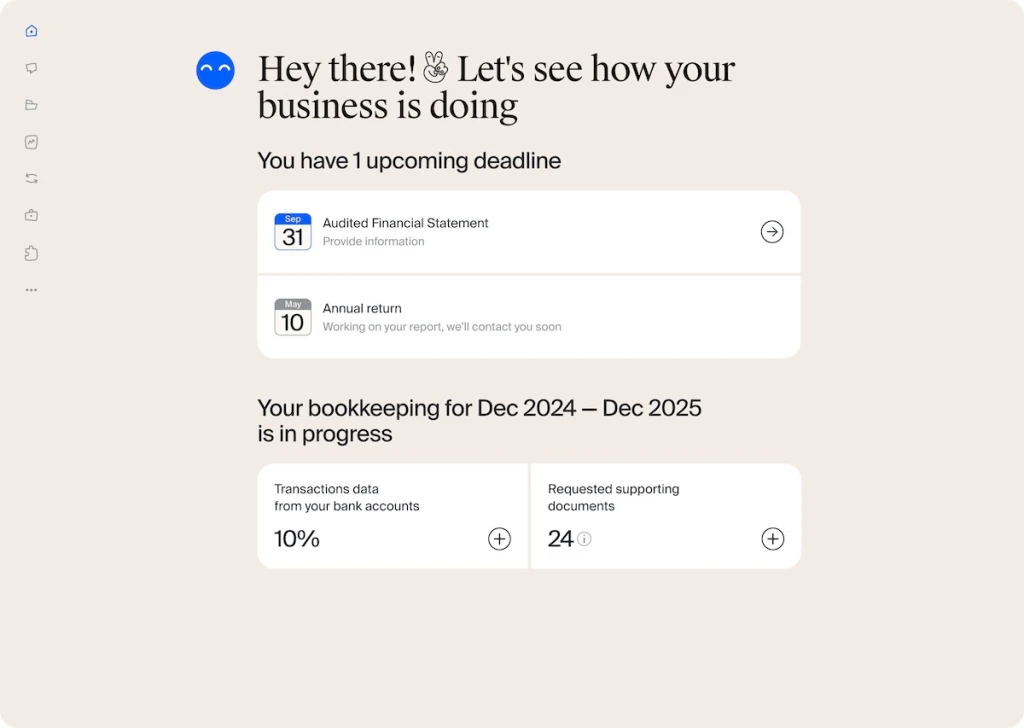
Osome’s platform / Photo credit: Osome
“We know from our advisory questions that people are wondering about their analytics,” says Gogge. “If we give it to them, we make our platform more engaging. That makes reporting much easier later on.”
Through a single personalized interface, Osome users can easily upload financial documents that are logged, with each transaction sorted into specific categories. The platform leverages AI to help categorize and analyze these transactions, providing a big-picture understanding of a company’s finances in near-real time.
This feature has the added benefit of encouraging customers to consistently update the Osome platform with their paperwork and documentation throughout the year, sparing them from a mad rush when filing deadlines roll around.
“It’s all automated, so you can easily see how your cashflow is doing,” Gogge explains. “We also have dashboards and reports, and we’re working on connecting with banks so we can provide all the relevant information in real time.”
Trust the process
Osome plans to evolve its offerings in line with the needs of its customers. It is exploring new features such as shareholder management, but “doubling down on core quality” remains a focus for the firm, Gogge says.
He also stresses that founders need to think beyond tools. “It’s very important to think about what your exact requirements are and how a digital backend fits into that. But at some point, you have to just get on with running your business,” Gogge adds.
Ultimately, it boils down to trust. Building a business is challenging, and founders need to trust that their chosen providers will be speedy, responsive, and give them peace of mind.
“People want to be sure that they’re dealing with someone who knows what they’re doing, especially when they’re setting up a company because there’s so much noise out there,” Gogge says. “If you know what your high-level needs are, then what the tool does is take the weight off your shoulders.”
Built for founders and backed by experts, Osome takes the stress out of daily financial admin with the help of AI-powered digital services and a one-stop interface with out-of-the-box usability. To learn more about how making the move to Osome can help you focus on what matters, click on this link.
Keen on starting a business in Singapore? Osome has a handy guide on everything you need to know to get things going. Fill in the form below to get your copy of A Step-by-Step Guide to Setting Up a Company in Singapore today.
This content was produced by Tech in Asia Studios, which connects brands with Asia’s tech community. Learn more about partnering with Tech in Asia Studios.
Stay updated on the go with our mobile app.
Get latest insights with smoother, more personalized experience through TIA mobile app.
Recommended reads
 If AI eats the world, what’s for dessert?
 AI bubble grows as bets rise
 Microsoft’s bet: What’s left when AI models are commodities?
 A $650M AI founder: Your ‘demo-level’ AI is a ‘real danger’
 NUS talent joins OpenAI co-founder to rethink how AI models work
 Will cars drive the future of AI? This Chinese company thinks so
 Coach Gemini is in session
 The 2026 Prediction Bingo update: half right, fully accountable
 Asia’s AI divide: Creators vs. experimenters
 India tech titans caught snoozing by AI





Editing by Stefanie Yeo, Winston Zhang, and Eileen C. Ang
(And yes, we’re serious about ethics and transparency. More information here.)







📅 Upcoming Events
22 October 2026
Payoneer x CSPN Summit 2026