 Winston Zhang · · 5 min read
Behind the scenes of Bundesliga’s 11-petabyte football archive

Being a fan of European football is a temporal experience. The latest results and player transfers drive the news cycle and feed into supporters’ insatiable appetite for the now and the future.
That said, nostalgia runs deep in the sport. You don’t have to spend much time on any football website before you come across a feature or a series spotlighting a player, team, or match from past decades.
It’s like being a futurist and a historian at the same time. Even the hype around Cristiano Ronaldo’s return to Manchester United is predicated on a confluence of past and future events.
One element that drives this past-future dichotomy is video highlights.
Video to the rescue
While it might not provide the same thrill of seeing a football match in person, watching video footage is the simplest, quickest way to see and understand how things unfolded. These recordings allow people to learn about and analyze matches – something that’s also become easier to do thanks to the internet. Amateur sports blogs can perform in-depth analyses on par with media giants such as ESPN, for instance.
Also – highfalutin ideals aside – video highlights are simply good entertainment.
In fact, archived footage proved particularly important when football league competitions big and small were suspended – some even outright canceled – due to the pandemic. The lack of new material during this period drove up demand for existing videos.
In 2020, the German Football Archive saw its highest footage retrieval numbers since 2007 as licensees scrambled to find new ways to keep fans engaged.
“We all were happy to have the possibility to make use of the footage especially in a time when streaming platforms and social media channels are growing and need more content,” says Andreas Heyden, executive vice president of digital innovations at the Deutsche Fussball Liga Group (DFL).

Andreas Heyden, executive vice president of digital innovations at the DFL / Photo credit: DFL
The company runs Bundesliga, the top league competition in Germany, and manages the archives. Heyden is also the CEO of DFL subsidiary Digital Sports.
A treasure trove of football footage
With its dedication to providing the best content to its licensees, DFL’s football archive is well-maintained. It contains 11 petabytes – around 175,000 hours – of football footage and stores full-length matches and live broadcast recordings of the competitions under DFL’s purview. These include – in addition to Bundesliga – DFB-Pokal (Germany’s national knockout cup competition) and Women’s Bundesliga.
That’s a daunting amount of footage. To make it easier for licensees to find the videos they want, DFL has simplified the retrieval process.
“A continuous exchange with our media partners enables us to know their needs pretty well,” says Heyden. “With the latest enhancements, we’ve developed it into a smart content hub to make our media partners’ search for the right footage easier and more efficient.”
These enhancements consist of applying different kinds of metadata to the stored clips, which means details like the official match data, live-logged data, and data generated by artificial intelligence are all attached to each video. This has turned the German Football Archive into what is now known as the DFL Media Hub.
Official match data, which is made up of basic information such as team lineups and match statistics, serves as the underlying framework for each game. Once a match kicks off, a specialist follows the action and ascribes tags – for example, “Save,” “Free Kick,” “Fan Images,” and so on – to everything that happens. This makes it easier for media partners to search for specific scenes and images.
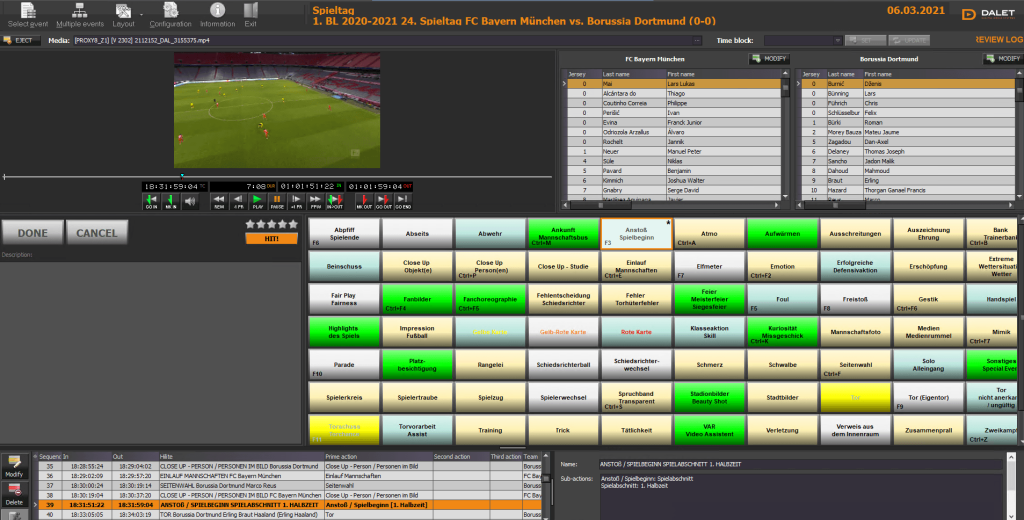
Photo credit: DFL
The latest enhancements are made possible through AI, Heyden says. DFL collaborates with Amazon Web Services and applied AI and data science software and services company Quantiphi to apply face and emotion recognition and logo detection features.
Heyden explains that the AI-based software can recognize, categorize, and store specific players and emotions in a matter of seconds based on their facial features. The system also continues to learn as more players are added.
The logo detection feature, meanwhile, also operates on a similar logic, making it possible for users to refine their search and find the exact combination of player, team, and emotion they’re looking for.
Streamlining the user experience even further, DFL works with video and audio content recognition solutions provider Ivitec to develop “fingerprinting” technology which automatically provides legal information on video footage. This makes it easier for users to attribute videos or learn about copyrighted material, for instance, and improves search efficiency.
Encouraging diversity in storytelling
Broadly speaking, the DFL Media Hub initiative is aimed at helping its media partners create more in-depth content about Bundesliga, giving them a bigger bang for their buck for their investment in Bundesliga media rights.
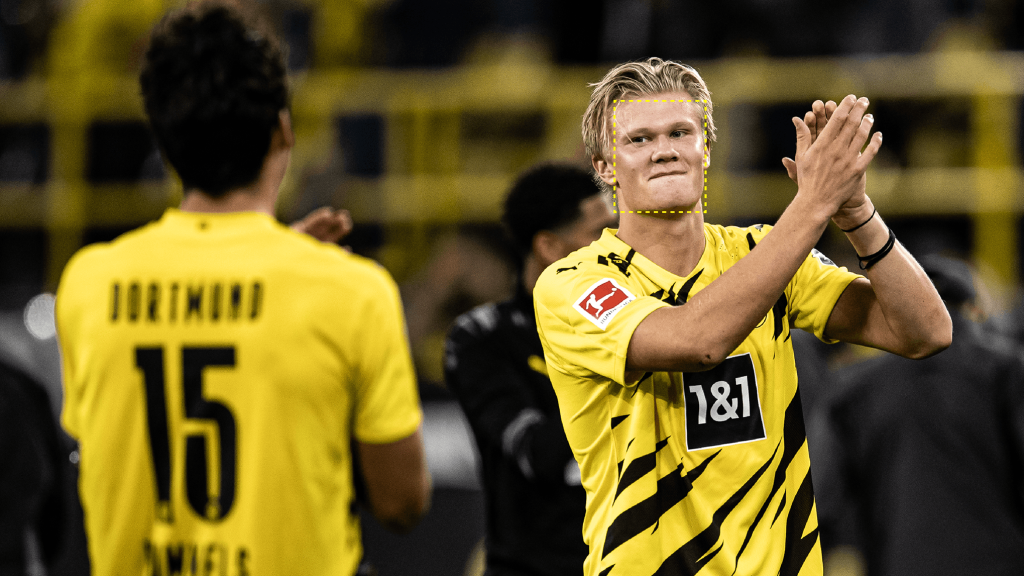
Photo credit: DFL
While the usual types of content that come to mind might revolve around German or European angles, Heyden suggests that providing this resource and the tools to navigate it could also encourage better localization, personalization, and diversity in the stories told of and about Bundesliga.
“Imagine a broadcaster from Asia, for example, that wants to produce highlight clips of Asian players in Bundesliga history,” he offers. “They can easily find good material of Yasohiko Okudera and Bum-Kun Cha, who played for German clubs in the 70s and 80s; Chen Yang, who represented Eintracht Frankfurt and St Pauli at the turn of the century; Shinji Kagawa, who won consecutive league titles with Borussia Dortmund; or Makoto Hasebe, who currently plays for Eintracht Frankfurt and has captained them before.”
Looking ahead, DFL is working on more innovations that could give viewers an active role, letting them decide what they want to see and when. It is also experimenting with using augmented reality for better immersion.
As always in football, it’s about finding a way to connect the past with the future.
“The future will always contain a look back into historical events. What is historical depends from the individual perspective,” Heyden says. The DFL Media Hub is certainly a way to explore the past using technology from the future.
DFL is an innovation leader in professional sport and especially football. The courage to embrace technological development is one of the hallmarks of German professional football. In recent years, this has resulted in groundbreaking changes. These include the development and/or implementation of state-of-the-art camera systems, continuous advancements in the handling of match data, a formative role in eFootball, and the establishment of SportsInnovation as a platform for demonstrating innovative technologies and a venue for specialists to discuss the latest developments in the sector.
Stay up to date with DFL’s latest developments by subscribing to its Focus: Tomorrow newsletter.
This content was produced by Tech in Asia Studios, which connects brands with Asia’s tech community. Learn more about partnering with Tech in Asia Studios.
Stay updated on the go with our mobile app.
Get latest insights with smoother, more personalized experience through TIA mobile app.
Recommended reads
 What does the ‘AI-first’ bank actually look like in Southeast Asia?
 Why the AI bubble isn’t a bubble (yet)
 AI-powered Heidi lands in SG, aims to cut doctors’ paperwork load
 Coach Gemini is in session
 Feeding your AI less information might be the smarter move
 Sam Altman: AI needs attention span, not higher IQ
 Vietnamese startup gives AI coding agents a memory boost
 Zuckerberg’s strategy to cure all disease by 2100
 Temasek-backed PsiQuantum to build first commercial quantum computer
 OpenAI says Singapore in its top 5 markets for Codex adoption





Editing by Nathaniel Fetalvero and Jaclyn Tiu
(And yes, we’re serious about ethics and transparency. More information here.)







📅 Upcoming Events
22 October 2026
Payoneer x CSPN Summit 2026