Jonathan Chew · · 6 min read
From twin confusion to regtech revolution: the rise of Sumsub

Summary:
- Sumsub was founded in 2015 after its co-founders experienced challenges with digital verification.
- Leveraging their backgrounds in tech, they built faster, more scalable KYC solutions and expanded rapidly by targeting underserved, complex markets.
- Today, Sumsub has grown into a full-cycle verification company with around 1,000 employees, serving over 4,000 clients worldwide.
- Get the lowdown on the latest fraud trends in its Identity Fraud Report 2025-2026.
Some startup co-founders take a while to get the synergy going. Others are just born with it – literally.
That’s the case with Sumsub, a global verification and anti-fraud solutions provider. It was founded in 2015 by brothers Andrew, Jacob, and Peter Sever – with the latter two being twins – alongside a fourth co-founder, Vyacheslav Zholudev.
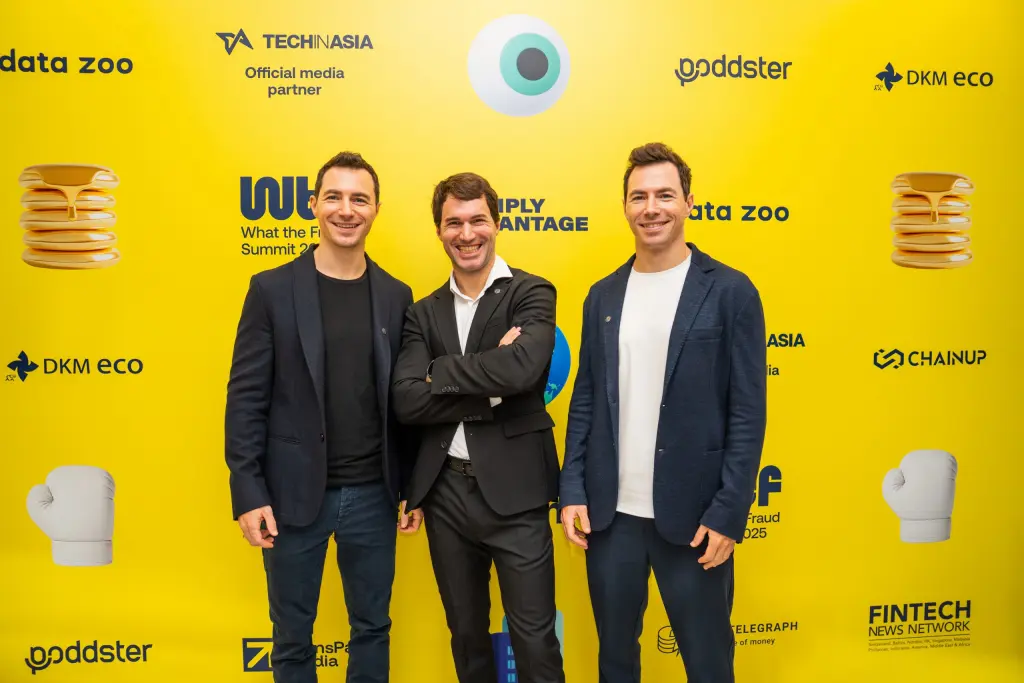
Spot the twins. / Photo credit: Sumsub
Andrew shares that just because they’re siblings doesn’t mean they always agree on everything. But he also says that being open to contrasting perspectives has only made the company stronger.
“We’ve had our fair share of difficult discussions, but it’s also helped us undergo a positive metamorphosis,” Andrew, the firm’s CEO, explains. “It’s always good to have people with different angles and mindsets coming together.”
Java and Slava to the rescue
One of the key moments that inspired Sumsub’s creation was when Jacob, the firm’s current chief innovation officer, tried to sign up for a particular online service. However, Peter, Sumsub’s chief strategy officer, had already registered with the same service.
“The system thought that they were the same people just because they’re twins,” Andrew recalls. “We realized early on that know-your-customer (KYC) systems need to account for this to avoid digital exclusion, and so we wanted to build a solution to help firms onboard as many users as possible while avoiding fraud and staying compliant.”
Externally, the brothers also had several friends in fintech who constantly complained to them about how slow and inefficient onboarding and compliance procedures were.
The co-founders had limited knowledge about compliance, though.
“We didn’t even know what KYC stood for,” Jacob admits.
Yet, they leveraged their expertise in computer graphics and digital image processing to develop digital solutions that automated many aspects of the KYC process, offering efficient alternatives.
With that, Sumsub was born.
“By the time we launched our first product in 2017, the digital market was taking off, and everyone was going online,” says Jacob. “It was perfect timing with a bit of luck – a lot of new financial services were looking for super scalable, efficient, and reliable KYC tools.”

Photo credit: Sumsub
This huge influx of customers was a good thing, but then a new challenge arose: actually being able to address the demand.
“So many customers wanted to implement our product instantly,” Andrew shares.
Jacob adds that in many cases, developer teams would even leave the implementation of KYC tools to the last minute.
To meet those quick turnaround times, the firm’s CTO, Zholudev, stepped up. Peter shares how Slava, as he’s affectionately called by the brothers, took a look at Sumsub’s tech stack at the time and immediately said it wasn’t tenable.
“He rebuilt everything in just one month using Java,” Peter recalls. “Typically, coding with Java requires a lot of human resources, and everyone told us it was impossible. Slava just said, ‘You’ll see,’ and did it.”
The move proved extremely fortuitous for other reasons. According to Peter, using Java allowed the firm to both meet demand back then and subsequently scale up in a cost-efficient manner.
Going where others dare not
Besides its strong technical foundation, the firm’s rapid expansion was also underpinned by a somewhat bold strategy: targeting complex, emerging markets.
Andrew shares that many of Sumsub’s competitors typically focused on the Europe and US markets because they were more familiar with the documents, languages, and processes there. Sumsub, on the other hand, wasn’t afraid to handle the unfamiliar, character-based languages seen in Asia Pacific.
“The important thing is to be trend-setters and not wait for new developments to tell us what to do next,” says Peter.
Stay in the know. Read about the latest fraud trends in Sumsub’s Identity Fraud Report 2025-2026
He then brings up the firm’s non-documentation verification solution, which connects with and gets information directly from government databases. It delivers 100% regulatory-compliant, document-free identity verification in 30+ jurisdictions worldwide, enabling frictionless access to digital services for over 3 billion people.
Sumsub keeps building this solution as well, even launching the integration services with Singpass most recently.
“Singaporean businesses can now onboard users in a very efficient and secure way,” shares Jacob.
This focus on efficiency led the team to build out more features, eventually creating a one-platform solution that supports the verification process along the whole user journey – from identity and business verification to ongoing transaction and event monitoring, which adapts to evolving risks, market demands, and regulatory requirements.
This includes its Reusable Digital Identity product suite – Reusable KYC and Sumsub ID – which allows users to securely store and re-use their verified documents for multiple verifications across 4,000+ Sumsub client platforms, with companies in the Sumsub ecosystem also able to share applicants’ data upon receiving their consent. This, in turn, provides businesses with higher pass rates, fewer drop-offs, and stronger compliance. There are now millions of Sumsub ID clients in its ecosystem, according to the co-founders.
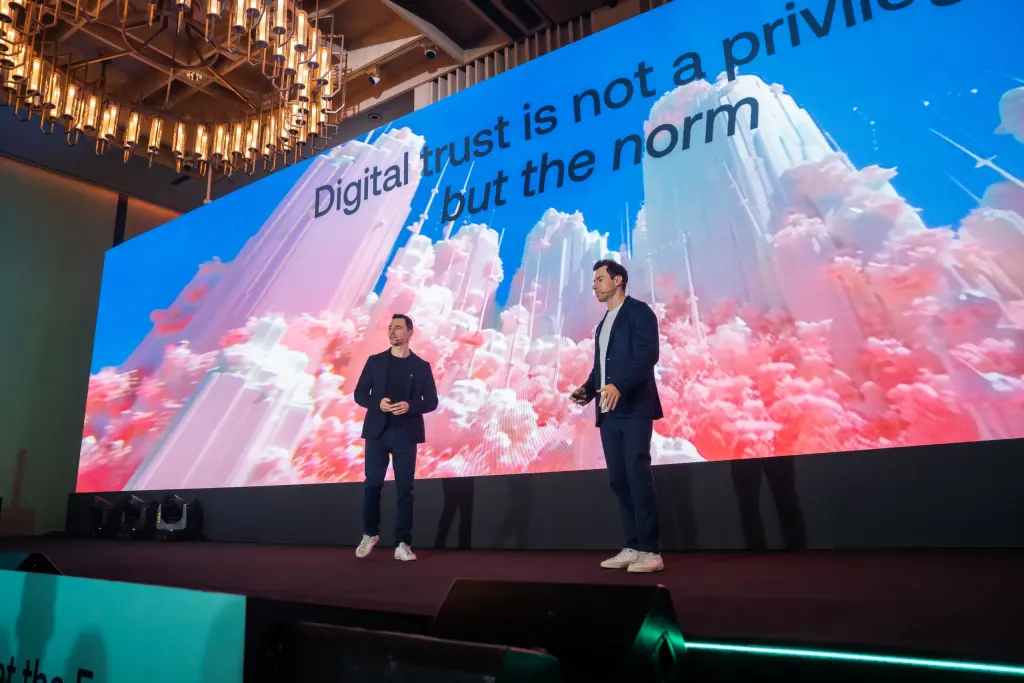
Photo credit: Sumsub
Interestingly, the company has also taken the rise of AI – generative or otherwise – into account in its strategy. It is always exploring how the latest tech can improve its solutions.
“AI has been part of Sumsub since day one,” Jacob says, pointing out that machine learning powered much of the firm’s initial tech.
Sumsub has had a team dedicated to AI fraud prevention since 2022. This foundation is important, as there has been 158% year-on-year growth in deepfake fraud in 2025 in Singapore, and Asia Pacific has experienced three-digit deepfake growth for the third year in a row.
Multi-layered protection is more critical than ever, and Sumsub’s one-platform solution approach offers just that, combining document verification, biometrics, device fingerprinting, and behavioral signals at different touchpoints.
Finally, the co-founders hired a strong legal team and data protection officers early on because Sumsub’s solutions would usually have to be vetted by compliance teams. This allows the firm to present itself not only as a tech startup but as one specializing in regtech solutions, reassuring potential customers.
“We helped customers connect the dots between technical capabilities and legal compliance, giving them the best of both worlds,” Andrew says.
Building the future of fraud prevention
Sumsub has come a long way since those early, scrappy days from a decade ago. Today, it employs around 1,000 people spread across eight offices in 70 countries, including Singapore, its headquarters in Asia Pacific. It has also achieved an annual run rate of 162 million euros (US$186 million) recently, according to Andrew.
With the Singpass development, its research collaboration agreement with Nanyang Technological University to combat deepfake fraud, as well as its recent What the Fraud Summit held in Singapore, Sumsub sees Asia Pacific as a key market. It is also committed to building an expert community to fight fraud in the region.
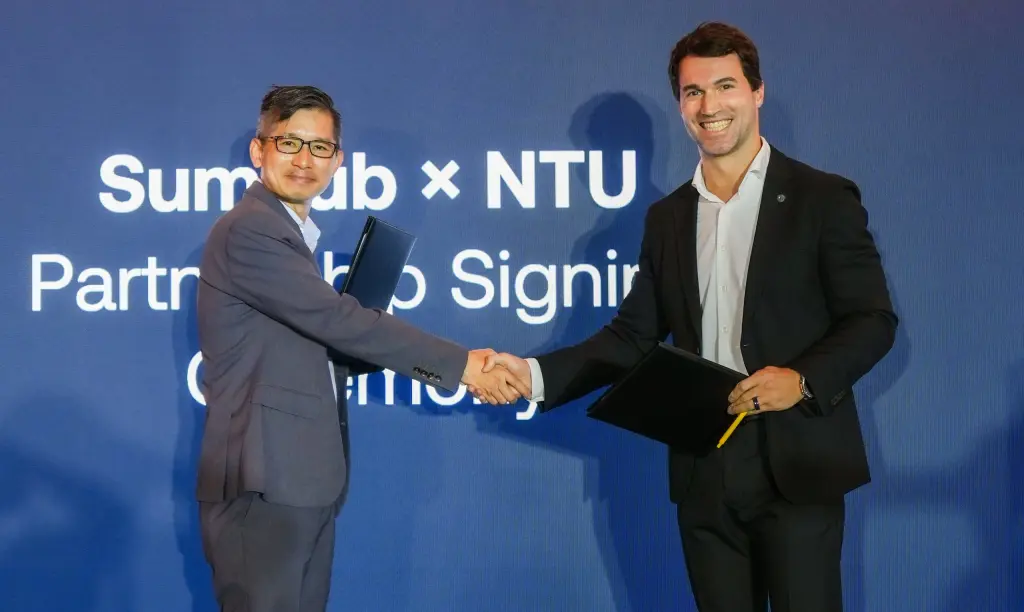
Photo credit: Sumsub
Leading such a huge company isn’t easy, but Andrew says it’s important that they allow themselves to make mistakes.
“If you’re too much of a perfectionist, you’ll never take the next step,” he explains. “As co-founders, we need to take responsibility and not just blame each other.”
And while they’re focused on many big-picture questions – like managing the future of the company and bringing in new ideas – retaining this startup founder mentality is still good for a significant reason.
“We didn’t start Sumsub to be recognized – we did it because we’re obsessed with solving this problem of fraud and digital exclusion,” says Andrew. “Ultimately, we want to create a better, safer world for everyone.”
Sumsub is a leader in global verification that enables fraud-free, scalable compliance with its adaptive, no-code solution. Stay ahead of the latest fraud developments by downloading its Identity Fraud Report 2025-2026.
This content was produced by Tech in Asia Studios, which connects brands with Asia’s tech community. Learn more about partnering with Tech in Asia Studios.
Stay updated on the go with our mobile app.
Get latest insights with smoother, more personalized experience through TIA mobile app.
Recommended reads
 Life’s a game, and AI agents are Animoca’s new play
 Indonesian AI startup goes global
 Forrest Li on scaling Sea, building smarter bots, and founder grit
 An AI assistant that joins sales calls and scores team skills
 Beyond the check: Why VCs need more than capital
 SGX’s CEO says it doesn’t need a unicorn to win
 SMEs want AI too, but not the kind Big Tech is selling
 Oatside’s alt-milk rise hits a profitable gear
 Alibaba’s financial health in 12 charts
 Asia’s telcos bundle AI into mobile plans. Will it pay off?





Editing by Winston Zhang and Mina Deocareza
(And yes, we’re serious about ethics and transparency. More information here.)